


When Shanghai-based designer Guo Qingshan posted a vacation photo on Valentine’s Day and captioned it “Puppy Mountain,” it became a sensation in China and even created a tourist destination.
Guo had gone on a hike while visiting his hometown of Yichang in central China’s Hubei Province late last month. When reviewing the photographs, he saw something he had not noticed before: A mountain shaped like a dog’s head rested on the ground next to the Yangtze River, its snout perched at the water’s edge.
“It was so magical and cute. I was so excited and happy when I discovered it,” Guo said. “The puppy’s posture is like it’s drinking water, or it’s looking at some fish. It also looks like it’s quietly protecting the Yangtze River.”

Photo: AP
Guo’s post on Chinese social media app Xiaohongshu, or RedNote, received 120,000 likes within 10 days. On the Sina Weibo media platform, the hashtag #xiaogoushan (小狗山) — Chinese for “Puppy Mountain” — drew millions of views.
Dog owners started to post pictures of their dogs to see which one had the closest resemblance. Many people traveled directly to the location in Yichang to see the mountain for themselves and some even brought their dogs to take photos.
“Puppy Mountain here I am!” one social media user wrote on RedNote along with photos of the mountain. “Just stroke the puppy’s head and then everything will be OK.”
Another social media user commented: “We all need the eyes to see the beauty in this world.”
Yang Yang, who lives about an hour and a half from the location, drove there with her friends and her two-year-old gray poodle named Yang Keyi.
“I was really happy to see the mountain,” she said. “I always travel with my dog if possible, so Puppy Mountain and my own little dog really match.”
The mountain is in Yichang’s Zigui County, where it can be seen from an observation deck.
After Guo’s photo went viral, many people shared photos of the view they previously had taken from the same deck, many saying they had not realized it looked like a dog. Some discussed how the dog’s appearance has changed over the years.
Yichang resident Shi Tong said he knew he had seen the mountain before, and posted a photo he took of the location in 2021.
“After I saw the Puppy Mountain photo online, I tried to look up where it is, and then I realized that I have been to this place before. I thought it looked like a dog at that time, too,” Shi said.

An American scientist convicted of lying to US authorities about payments from China while he was at Harvard University has rebuilt his research lab in Shenzhen, China, to pursue technology the Chinese government has identified as a national priority: embedding electronics into the human brain. Charles Lieber, 67, is among the world’s leading researchers in brain-computer interfaces. The technology has shown promise in treating conditions such as amyotrophic lateral sclerosis and restoring movement in paralyzed people. It also has potential military applications: Scientists at the Chinese People’s Liberation Army have investigated brain interfaces as a way to engineer super soldiers by boosting

Indonesian police have arrested 13 people after shocking images of alleged abuse against small children at a daycare center went viral, sparking outrage across the nation, officials said on Monday. Police on Friday last week raided Little Aresha, a daycare center in Yogyakarta on Java island, following a report from a former employee. CCTV footage circulating on social media showed children, most younger than two, lying on the floor wearing only diapers, their hands and feet bound with rags. The police have confirmed that the footage is authentic. Police said they also found 20 children crammed into a room just 3m by 3m. “So

A grieving mother has ended her life at a clinic in Switzerland four years after the death of her only child. Wendy Duffy, 56, a physically healthy woman, died at the Pegasos clinic in Basel after struggling to cope with the death of her 23-year-old son, Marcus. The former care worker, from the West Midlands, England, had previously attempted to take her own life. The case comes as assisted dying would not become law in England and Wales after proposed legislation, branded “hopelessly flawed” by opponents, ran out of time. Ruedi Habegger, the founder of Pegasos, described Duffy’s death as
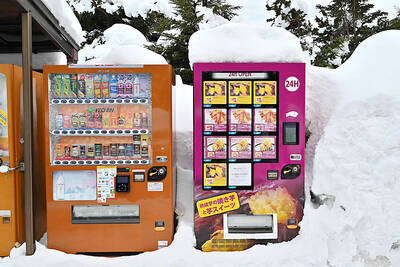
From post offices and parks to stations and even the summit of Mount Fuji, Japan’s vending machines are ubiquitous, but with the rapid pace of inflation cooling demand for their drinks, operators are being forced to rethink the business. Last month beverage giant DyDo Group Holdings announced it would remove about 20,000 vending machines — about 7 percent of their stock nationwide — by January next year, to “reconstruct a profitable network.” Pokka Sapporo Food & Beverage, based in Nagoya, also said last month it would sell its 40,000-machine operation to Osaka-based Lifedrink Co. “The strength of the vending machine


 RSS
RSS