


Researchers in Cyprus have discovered a hidden portrait that lay undetected for centuries beneath a 1570 oil painting by Renaissance master Titian, a rendering of which is now on display in the city of Limassol.
The newly discovered work shows an unidentified man with a thin mustache, quill in hand, standing next to a stack of papers or books — a prosaic image compared to the scene of Jesus Christ, bound and wearing a crown of thorns, that Titian later painted over it.
The painting “holds a secret, and the secret is that there is, unknown until now, a painting underneath,” said Nikolas Bakirtzis, who leads a team at the Cyprus Institute (CyI), a non-profit educational body.
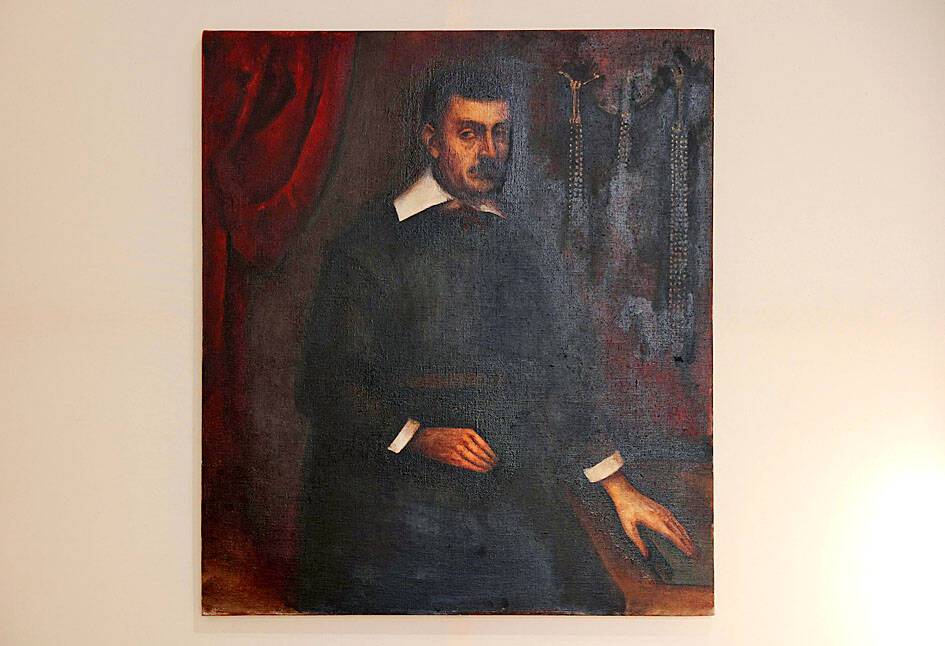
Photo: Reuters
The finished artwork, called Ecce Homo — meaning “Behold, The Man” in English — shows Jesus standing next to Pontius Pilate, who presided over the last stages of Jesus’ trial before he was crucified.
The painting was being prepared for conservation when researchers put it under a microscope and noticed different pigments through the craquelure, or pattern of fine cracks that form on the surface of old paintings.
“It was like uncovering a puzzle,” Bakirtzis said.
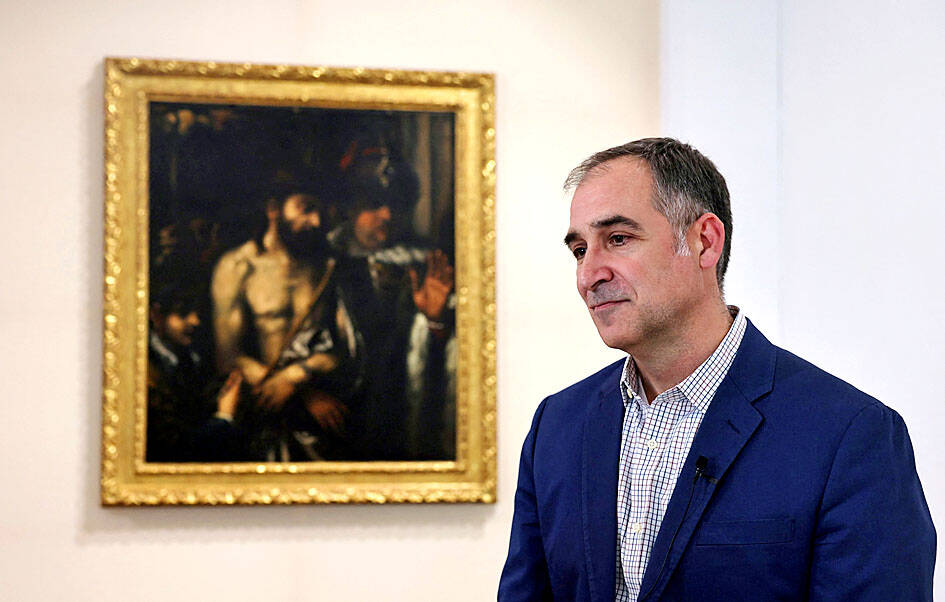
Photo: Reuters
Using a combination of imaging and non-invasive analytical techniques, researchers at the Andreas Pittas Art Characterization Laboratories (APAC) at CyI pieced together the full, buried portrait.
Based on the X-ray visuals, experts then created an oil painting of the man.
“It is clearly the portrait of a banker, a lawyer, some professional man in his workspace,” said Bakirtzis, an art and architectural historian who is the director at APAC.
An exhibit of Titian’s painting, as well as a rendering of the hidden portrait, opened in Limassol late last month and runs until March 10.
Born Tiziano Vecellio in 1488, Titian, together with his studio in Venice, produced hundreds of paintings until his death in 1576.
Researchers know that he reused canvases on partially finished work. In this instance, it was a full portrait, which he turned upside down and painted over with Ecce Homo.
“I am not aware of any case where we can safely map the direct painting of a composition over an earlier one,” Bakirtzis said.
Bakirtzis believes Titian used elements of the earlier painting for the new one, including using the man’s jawline to outline the ropes tying Christ’s wrists.
“This shows the hand of a confident artist. The leader, the head of the studio, Titian himself ... and this is why this Ecce Homo version is the one which preserves Titian’s artistry,” he said.
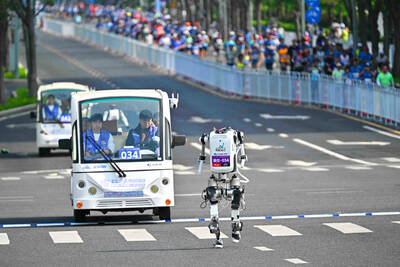
A humanoid robot that won a half-marathon race for robots in Beijing on Sunday ran faster than the human world record in a show of China’s technological leaps. The winner from Honor, a Chinese smartphone maker, completed the 21km race in 50 minutes and 26 seconds, said a WeChat post by the Beijing Economic-Technological Development Area, also known as Beijing E-Town, where the race began. That was faster than the human world record holder, Ugandan Jacob Kiplimo, who finished the same distance in about 57 minutes in March at the Lisbon road race. The performance by the robot marked a significant step forward
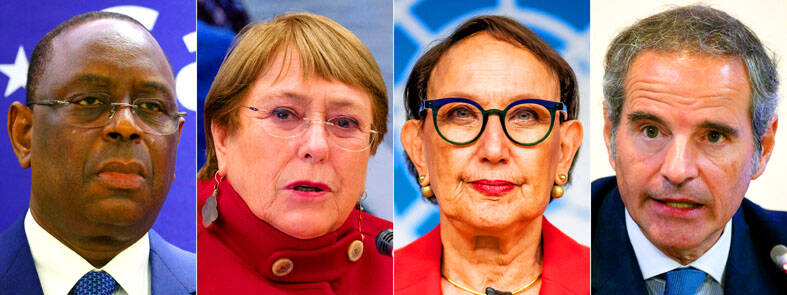
Four contenders are squaring up to succeed Antonio Guterres as secretary-general of the UN, which faces unprecedented global instability, wars and its own crushing budget crisis. Chile’s Michelle Bachelet, Argentina’s Rafael Grossi, Costa Rica’s Rebeca Grynspan and Senegal’s Macky Sall are each to face grillings by 193 member states and non-governmental organizations for three hours today and tomorrow. It is only the second time the UN has held a public question-and-answer, a format created in 2016 to boost transparency. Ultimately the five permanent members of the UN’s top body, the Security Council, hold the power, wielding vetoes over who leads the
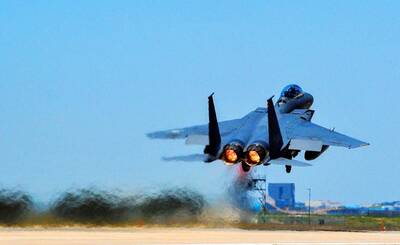
South Korea’s air force yesterday apologized for a 2021 midair collision involving two fighter jets, a day after auditors said the pilots were taking selfies and filming during the flight and held them responsible for the accident. “We sincerely apologize to the public for the concern caused by the accident that occurred in 2021,” an air force spokesman told a news conference, adding that one of the pilots involved had been suspended from flying duties, received severe disciplinary action and has since left the military. The apology followed a report released on Wednesday by the South Korean Board of Audit and Inspection,
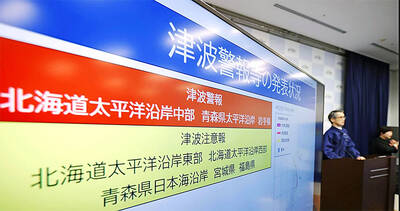
An earthquake registering a preliminary magnitude of 7.7 off northern Japan on Monday prompted a short-lived tsunami alert and the advisory of a higher risk of a possible mega-quake for coastal areas there. The Cabinet Office and the Japan Meteorological Agency said there was a 1% chance for a mega-quake, compared to a 0.1% chance during normal times, in the next week or so following the powerful quake near the Chishima and Japan trenches. Officials said the advisory was not a quake prediction but urged residents in 182 towns along the northeastern coasts to raise their preparedness while continuing their daily lives. Prime


 RSS
RSS