


Seven people sustained mostly minor injuries in an airplane fire in South Korea, authorities said yesterday, with local media suggesting the blaze might have been caused by a portable battery stored in the overhead bin.
The Air Busan plane, an Airbus A321, was set to fly to Hong Kong from Gimhae International Airport in southeastern Busan, but caught fire in the rear section on Tuesday night, the South Korean Ministry of Land, Infrastructure and Transport said.
A total of 169 passengers and seven flight attendants and staff were evacuated down inflatable slides, it said.
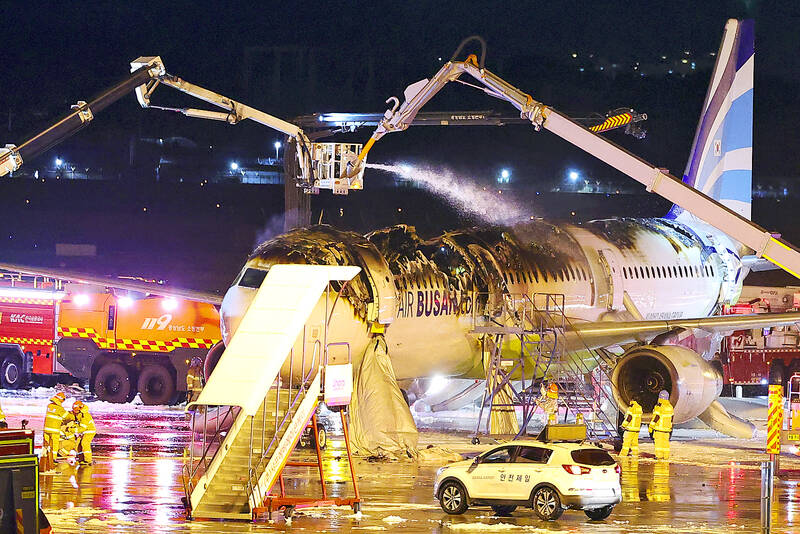
Photo: EPA-EFE
Authorities initially reported three injuries, but revised the number to seven yesterday.
One of them is currently hospitalized, the ministry added.
The accident left nearly half of the fuselage burnt, but its wings and engines on both sides remain undamaged, it said, adding that the cause of the fire is under investigation.
“It is unclear when we will be able to disclose the investigation findings on the cause of last night’s fire,” a ministry spokesperson said.
Dramatic images and footage from local media on Tuesday night showed the aircraft engulfed in flames, with thick smoke appearing to billow from the interior of the plane.
Images from yesterday morning revealed that the upper half of the fuselage was burned away, leaving a huge hole. While the ministry did not comment on the possible cause of the fire, Yonhap News Agency reported that the blaze began to spread after black smoke emerged from the overhead compartment in the back row.
“It seems that a fire broke out when a passenger’s portable battery, stored in the overhead bin as carry-on luggage, became compressed,” local daily JoongAng Ilbo reported, citing an unnamed person affiliated with Air Busan.
“As the smoke filled the cabin, a passenger seated near the emergency exit opened the door, and the flight attendant opened the opposite one, allowing others to start evacuating,” a passenger recounted, as quoted by Yonhap. “It was ... chaotic and terrifying.”
South Korea suffered the worst aviation disaster on its soil last month when a Jeju Air Boeing 737-800, flying from Thailand to Muan on Dec. 29, crash-landed and exploded into a fireball after slamming into a concrete barrier.
That crash killed 179 of the 181 passengers and crew members on board.
“In the wake of the Jeju Air passenger aircraft tragedy, an additional aviation accident has taken place, and we feel deeply sorry for the passengers on board and the public,” Minister of Transportation minister Park Sang-woo said in a statement yesterday.

Through the noise of rushing papers and whirring belts at a print factory in Kyoto, two creators watch their photo essay come to life in broadsheet form — part of an effort to win new audiences in the age of artificial intelligence (AI). Despite the decline of the publishing industry, self-publication and handmade “zine” magazines are growing in popularity in Japan, reflecting the nation’s enduring love of paper in the digital era. While speaking to Agence France-Presse at the plant, his hands black with ink, one of the creators, Kazuma Obara, said: “I think [paper] is a medium that engages all five
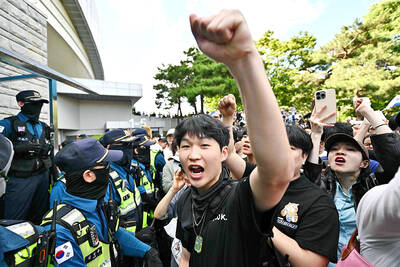
‘ABSURD MISTAKE’: The election commission said that there had been a failure to anticipate turnout after 14 polling stations ran short of ballot papers South Korean riot police yesterday cleared protesters from a Seoul polling station after a 35-hour blockade sparked by a shortage of ballot papers during local elections earlier this week. Wednesday’s election was the first nationwide vote since South Korean President Lee Jae-myung took office following the ouster of Yoon Suk-yeol over his short-lived martial law declaration. Lee’s ruling Democratic Party swept most races, but failed to flip the crucial Seoul mayoral seat. The South Korean National Election Commission apologized, blaming a failure to anticipate turnout after 14 polling stations in Seoul ran short of ballot papers. Some polling stations stayed open until 10pm to

Australian researchers have trained lab-grown brain cells on a silicon computer chip to play the 1990s shooter game Doom and said they are just scratching the surface of what the neurons could be capable of doing. It is the science-fiction work of biotech boffins at Cortical Labs, who researched and developed the technology that harnesses the workings of the brain’s networking system. Each so-called “biological computer” contains about 200,000 living human brain cells, grown from stem cells that were harvested from blood donations. Having mastered the simple computer game Pong, where a paddle is moved up and down to send a ball

France experienced its hottest spring on record, the French weather service said on Tuesday, after an exceptional early heat wave that also broke highs for the season in England and Wales. Meteo-France said the average nationwide temperature over March to May was 13.8°C — about 1.7°C above the norm, and surpassing records set in 2011 and 2020. “The warmest spring since records began in 1900,” it said in a bulletin. All three months were warmer than average, but the onset of an “unprecedented heatwave” late last month pushed the mercury to highs typically seen at the height of the summer. “Our country had never


 RSS
RSS