


A California woman was on Monday sentenced to more than three years in prison in a long-running case over a business that helped pregnant Chinese women travel to the US to deliver babies who automatically became US citizens.
US District Judge R. Gary Klausner gave Phoebe Dong (董晶) a 41-month sentence and ordered her immediately taken into custody from his federal court in Los Angeles.
Dong and her husband, Michael Liu (劉維岳), were convicted in September last year of conspiracy and money laundering through their company, USA Happy Baby.

Photo: AP
The sentencing came as birthright citizenship has been thrust into the spotlight in the US with the return of US President Donald Trump to the White House. Since taking office, he issued an executive order to narrow the definition of birthright citizenship, a move quickly blocked by a federal judge who called it “blatantly unconstitutional.”
Dong and Liu were among more than a dozen people charged in a crackdown during the administration of then-US president Barack Obama on so-called “birth tourism” schemes that helped Chinese women hide their pregnancies while traveling to the US to give birth. Such businesses have long operated in various states catering to people from China, Russia, Nigeria and elsewhere.
Under the 14th Amendment, any child born in the US is a US citizen. Many have seen these trips as a way to help their children secure a US college education and a better future — especially as the tourists themselves can apply for permanent residency once the children turn 21.
During her sentencing hearing, Dong wiped away tears as she recalled growing up without siblings due to China’s strict “one-child” policy and told the court that the Chinese government forced her mother to have an abortion.
Moving to the US was challenging, but she grew hopeful after having children of her own and saw she could help Chinese women who want to have additional children in California, she said.
“I don’t want to lose my kids,” she told the court. “I hope you can give me fair judgement. I will take all my responsibility.”
Federal prosecutors sought a more than five year sentence for Dong and said that she and Liu helped more than 100 pregnant Chinese women travel to the US.
They said the pair worked with others to coach women on how to trick customs officials by flying into airports believed to be more lax while wearing loose-fitting clothing to hide their pregnancies.
“For tens of thousands of dollars each, defendant helped her numerous customers deceive US authorities and buy US citizenship for their children,” prosecutors said in court filings.
In December last year, Liu was sentenced to 41 months in prison.
Dong’s lawyer, John McNicholas, asked that she be allowed to serve her term after Liu completes his sentence because of their three children. The youngest is 13.
Federal prosecutor Kevin Fu agreed to the delay, but Klausner refused and had her taken into custody immediately.
Dong removed a necklace and gave it to a family member before she was led away.
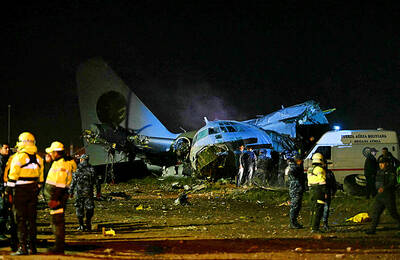
MONEY GRAB: People were rushing to collect bills scattered on the ground after the plane transporting money crashed, which an official said hindered rescue efforts A cargo plane carrying money on Friday crashed near Bolivia’s capital, damaging about a dozen vehicles on highway, scattering bills on the ground and leaving at least 15 people dead and others injured, an official said. Bolivian Minister of Defense Marcelo Salinas said the Hercules C-130 plane was transporting newly printed Bolivian currency when it “landed and veered off the runway” at an airport in El Alto, a city adjacent to La Paz, before ending up in a nearby field. Firefighters managed to put out the flames that engulfed the aircraft. Fire chief Pavel Tovar said at least 15 people died, but

LIKE FATHER, LIKE DAUGHTER: By showing Ju-ae’s ability to handle a weapon, the photos ‘suggest she is indeed receiving training as a successor,’ an academic said North Korea on Saturday released a rare image of leader Kim Jong-un’s teenage daughter firing a rifle at a shooting range, adding to speculation that she is being groomed as his successor. Kim’s daughter, Ju-ae, has long been seen as the next in line to rule the secretive, nuclear-armed state, and took part in a string of recent high-profile outings, including last week’s military parade marking the closing stages of North Korea’s key party congress. Pyongyang’s official Korean Central News Agency (KCNA) released a photo of Ju-ae shooting a rifle at an outdoor shooting range, peering through a rifle scope
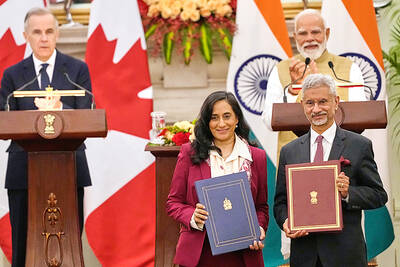
India and Canada yesterday reached a string of agreements, including on critical mineral cooperation and a “landmark” uranium supply deal for nuclear power, the countries’ leaders said in New Delhi. The pacts, which also covered technology and promoting the use of renewable energy, were announced after Indian Prime Minister Narendra Modi and Canadian Prime Minister Mark Carney hailed a fresh start in the relationship between their nations. “Our ties have seen a new energy, mutual trust and positivity,” Modi said. Carney’s visit is a key step forward in ties that effectively collapsed in 2023 after Ottawa accused New Delhi
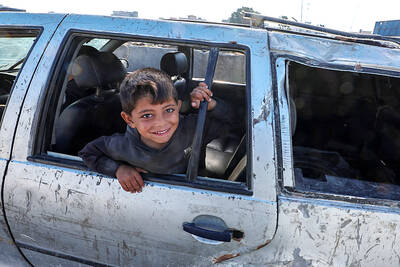
Gaza is rapidly running out of its limited fuel supply and stocks of food staples might become tight, officials said, after Israel blocked the entry of fuel and goods into the war-shattered territory, citing fighting with Iran. The Israeli military closed all Gaza border crossings on Saturday after announcing airstrikes on Iran carried out jointly with the US. Israeli authorities late on Monday night said that they would reopen the Kerem Shalom crossing from Israel to Gaza yesterday, for “gradual entry of humanitarian aid” into the strip, without saying how much. Israeli authorities previously said the crossings could not be operated safely during


 RSS
RSS