


The makers of a new documentary saying the iconic “Napalm Girl” photo was deliberately credited to the wrong photographer — claims denied by The Associated Press — on Sunday said that it is “critical” to “share this story with the world.”
The Stringer, which premiered at the Sundance film festival, chronicles an investigation into rumors that the devastating image which helped change global perceptions of the Vietnam War was actually taken by a little-known local freelancer.
Nick Ut, the AP staff photographer credited with the photo of a nine-year-old girl fleeing naked from a napalm strike, won a Pulitzer Prize. He has always said that he took the photo.
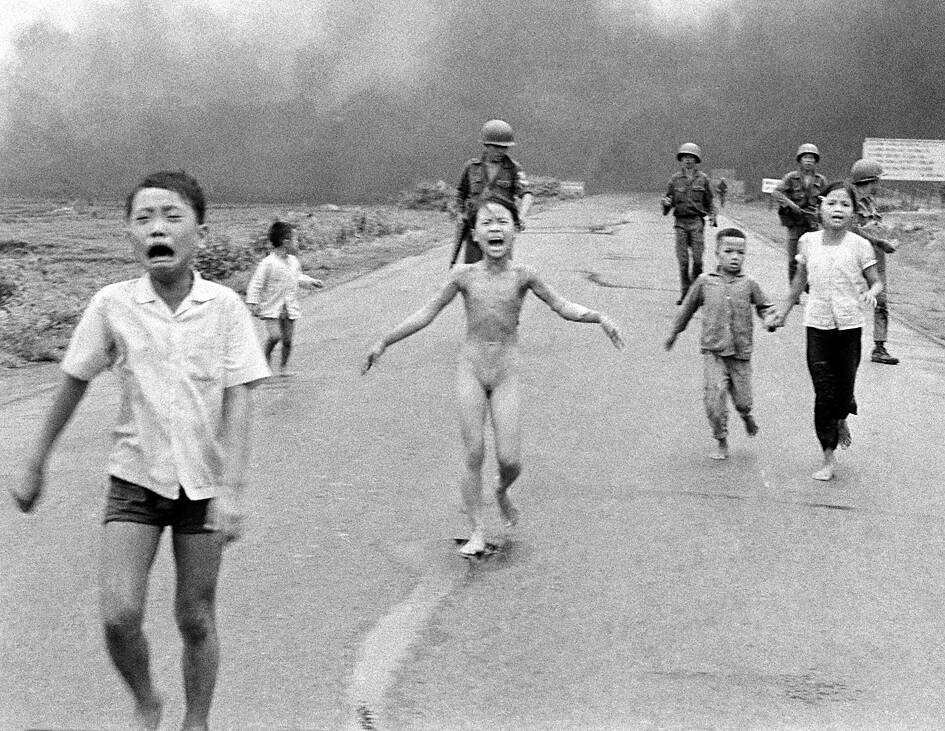
Photo: AP
Ut’s lawyer had attempted to block the film’s release.
AP published a report last week detailing its own investigation into the controversy, which found “nothing that proves Nick Ut did not take the photo,” but said it had not yet been granted access to the film’s research.
“AP stands ready to review any and all evidence and new information about this photo,” the organization said.
The new film was triggered when Carl Robinson, the photo editor on duty in AP’s Saigon bureau on the day the image was captured, began speaking out about the provenance of the photo.
In the film, Robinson said he was ordered to write a photo caption attributing the photo to Ut by Horst Faas, AP’s two-time Pulitzer Prize-winning chief of photos in Saigon.
“I started writing the caption... Horst Faas, who had been standing right next to me, said: ‘Nick Ut. Make it Nick Ut,’” Robinson said.
After interviewing Robinson, the filmmakers identified the long-lost name of a Vietnamese freelance photographer who is visible in other photos of the infamous scene at Trang Bang on June 8, 1972.
They eventually tracked down Nguyen Thanh Nghe, who states in the film that he is certain he took the photo.
“Nick Ut came with me on the assignment. But he didn’t take that photo... That photo was mine,” he said.
Executive director Gary Knight, a photojournalist who led the film’s investigation, said that it was “critical” that members of the news media “hold ourselves to account.”
“The photograph in question is one of the most important photographs of anything ever made, certainly of war,” he said.
“Just getting that recognition [for Nghe]... it was always important for us as a film team to share this story with the world,” director Bao Nguyen added.
One question repeatedly raised in response to the new allegations is why it took so long for anybody to speak up.
Robinson said that at the time of the photo being captioned, he feared for his job.
He added he consequently felt it was “too late” to speak out, until he learned the name of the freelancer decades later.
Ut’s lawyer Jim Hornstein said that Robinson had a “50-year vendetta against Nick Ut, AP and Horst Faas,” and that “a defamation action will soon be filed against the filmmakers.”
In the documentary, Nghe’s family said he consistently spoke at home of his regret about losing credit for the photo.
Nghe says: “I felt upset. I worked hard for it, but that guy got to have it all. He got recognition, he got awards.”
Bao Nguyen said the idea that the family are “only now are speaking up ... is sort of a fallacy.”
“Within their own circles, they’ve been saying this for so long,” he said.
Knight said there has always been “a huge power imbalance in journalism.”
“It has been dominated by white, Western heterosexual males for as long as I’ve been in it, and before,” he said.
The filmmakers also hired INDEX, a France-based non-profit that specializes in forensic investigations, which concluded it is “highly unlikely” Ut was in the right position to take the photo.
AP’s latest statement repeats its request for the filmmakers to share evidence, including eyewitness accounts and the INDEX report.
“When we became aware of this film and its allegations broadly, we took them very seriously and began investigating,” it said. “We cannot state more clearly that The Associated Press is only interested in the facts and a truthful history of this iconic photo.”

A humanoid robot that won a half-marathon race for robots in Beijing on Sunday ran faster than the human world record in a show of China’s technological leaps. The winner from Honor, a Chinese smartphone maker, completed the 21km race in 50 minutes and 26 seconds, said a WeChat post by the Beijing Economic-Technological Development Area, also known as Beijing E-Town, where the race began. That was faster than the human world record holder, Ugandan Jacob Kiplimo, who finished the same distance in about 57 minutes in March at the Lisbon road race. The performance by the robot marked a significant step forward
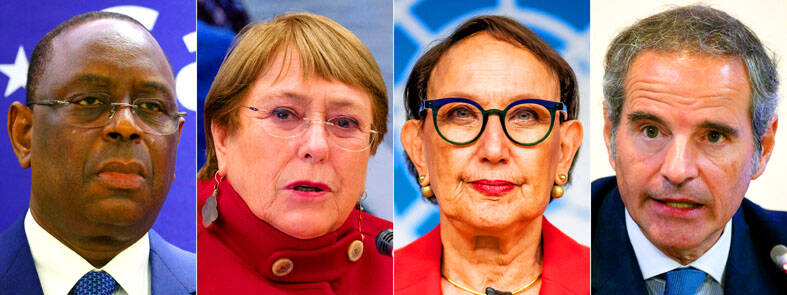
Four contenders are squaring up to succeed Antonio Guterres as secretary-general of the UN, which faces unprecedented global instability, wars and its own crushing budget crisis. Chile’s Michelle Bachelet, Argentina’s Rafael Grossi, Costa Rica’s Rebeca Grynspan and Senegal’s Macky Sall are each to face grillings by 193 member states and non-governmental organizations for three hours today and tomorrow. It is only the second time the UN has held a public question-and-answer, a format created in 2016 to boost transparency. Ultimately the five permanent members of the UN’s top body, the Security Council, hold the power, wielding vetoes over who leads the
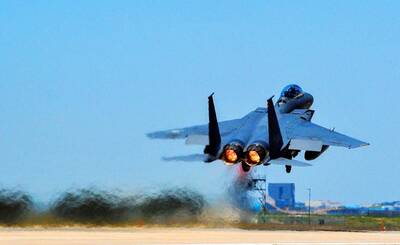
South Korea’s air force yesterday apologized for a 2021 midair collision involving two fighter jets, a day after auditors said the pilots were taking selfies and filming during the flight and held them responsible for the accident. “We sincerely apologize to the public for the concern caused by the accident that occurred in 2021,” an air force spokesman told a news conference, adding that one of the pilots involved had been suspended from flying duties, received severe disciplinary action and has since left the military. The apology followed a report released on Wednesday by the South Korean Board of Audit and Inspection,

An earthquake registering a preliminary magnitude of 7.7 off northern Japan on Monday prompted a short-lived tsunami alert and the advisory of a higher risk of a possible mega-quake for coastal areas there. The Cabinet Office and the Japan Meteorological Agency said there was a 1% chance for a mega-quake, compared to a 0.1% chance during normal times, in the next week or so following the powerful quake near the Chishima and Japan trenches. Officials said the advisory was not a quake prediction but urged residents in 182 towns along the northeastern coasts to raise their preparedness while continuing their daily lives. Prime


 RSS
RSS