


Exhausted after 12 hours of cooking, Nguyen Thi Thuy Hong gently unpeels the last of five leaves encasing a squishy, sticky rice cake known as banh chung — a Lunar New Year delicacy in Vietnam.
The wrapped cakes of glutinous rice, green beans and pork belly have for centuries been one of several dishes prepared in a frenzy at home especially for Tet, the Vietnamese New Year, which begins on Wednesday. Hong, 55, has labored over the dish — which must be boiled for 12 hours over a wood fire — almost every year for the last four decades.
“We can buy ready-made banh chung, but it doesn’t create that Tet atmosphere,” she said, explaining she enjoyed the process of cleaning leaves, soaking rice and pre-cooking beans in the very early morning.
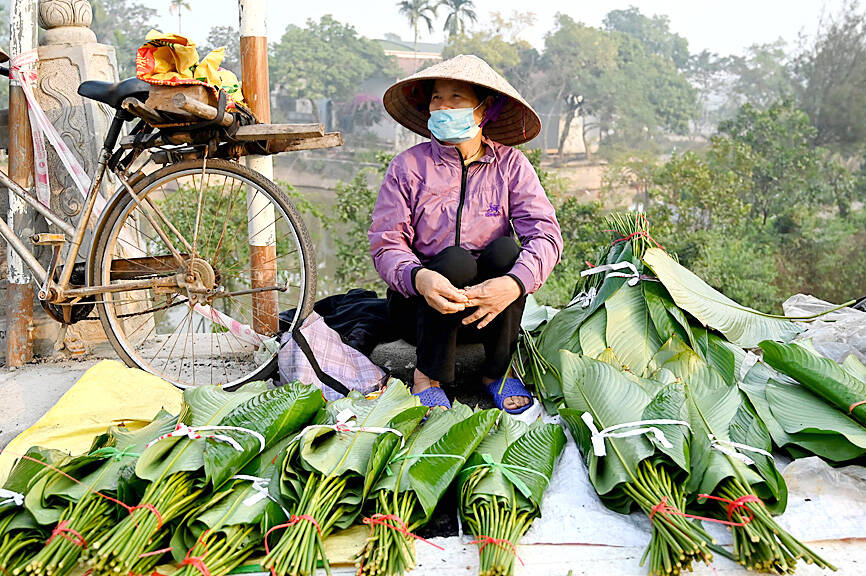
Photo: AFP
“It keeps me busy, and it’s tiring, but I still love making the cake myself,” she said.
According to an oft-told legend, the banh chung recipe was first prepared thousands of years ago by a Vietnamese prince who wanted to impress his father in a bid for the throne. Pleased with the cake’s flavor and impressed with his son’s demonstration of respect, the king duly handed down his crown.
The banh chung are often laid at family altars as an offering to ancestors, who are widely venerated in Vietnam — a communist country that is officially atheist, but still steeped in Confucian social mores.
Many families no longer make them from scratch, but for those that keep the tradition, the work usually falls to the elders of the family.
Hong’s 23-year-old son Nguyen Dao Anh Khoi is already fretting over taking the helm. “Our generation has so many other things to worry about, so I am not sure I can keep this up,” he said as he rinsed a mound of rice under an outside tap at their Hanoi home.
For now, he is happy to enjoy the rich and comforting cooking of his mother. A self-described healthy eater who often prefers Western dishes, Khoi makes an exception for banh chung. “It’s a bit fatty and too starchy,” but “it’s also delicious,” he said.
“I can’t imagine a Tet without banh chung,” he added.


When a hiker fell from a 55m waterfall in wild New Zealand bush, rescuers were forced to evacuate the badly hurt woman without her dog, which could not be found. After strangers raised thousands of dollars for a search, border collie Molly was flown to safety by a helicopter pilot who was determined to reunite the pet and the owner. A week earlier, an emergency rescue helicopter found the woman with bruises and lacerations after a fall at a rocky spot at the waterfall on the South Island’s West Coast. She was airlifted on March 24, but they were forced to

HIGH HOPES: The power source is expected to have a future, as it is not dependent on the weather or light, and could be useful for places with large desalination facilities A Japanese water plant is harnessing the natural process of osmosis to generate renewable energy that could one day become a common power source. The possibility of generating power from osmosis — when water molecules pass from a less salty solution to a more salty one — has long been known. However, actually generating energy from that has proved more complicated, in part due the difficulty of designing the membrane through which the molecules pass. Engineers in Fukuoka, Japan, and their private partners think they might have cracked it, and have opened what is only the world’s second osmotic power plant. It generates
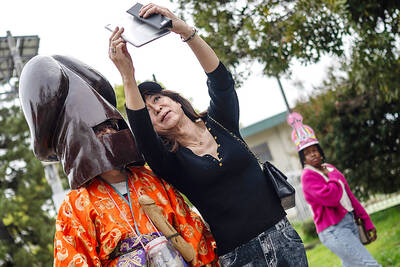
Showcasing phallus-shaped portable shrines and pink penis candies, Japan’s annual fertility festival yesterday teemed with tourists, couples and families elated by its open display of sex. The spring Kanamara Matsuri near Tokyo features colorfully dressed worshipers carrying a trio of giant phallic-shaped objects as they parade through the street with glee. The festival, as legend has it, honors a local blacksmith in the Edo Period (1603-1868) who forged an iron dildo to break the teeth of a sharp-toothed demon inhabiting a woman’s vagina that had been castrating young men on their wedding nights. A 1m black steel phallus sits in the courtyard of

Hundreds of Filipinos and tourists flocked to a sun-bleached field north of Manila yesterday, on Good Friday, to witness one of the country’s most blood-soaked displays of religious fervor, undeterred by rising fuel prices. Scores of bare-chested flagellants with covered faces walked barefoot through the dusty streets of Pampanga Province’s San Fernando as they flogged their backs with bamboo whips in the scorching heat. Agence France-Presse (AFP) journalists said they saw devotees deliberately puncturing their skin with glass shards attached to a small wooden paddle to ensure their bleeding during the ritual, a way to atone for sins and seek miracles from


 RSS
RSS