


The fifth anniversary of the first known death from COVID-19 passed seemingly unnoticed in China on Saturday, with no official remembrances in a country where the pandemic is a taboo subject.
On Jan. 11, 2020, health officials in the central Chinese city of Wuhan announced that a 61-year-old man had died from complications of pneumonia caused by a previously unknown virus.
The disclosure came after authorities had reported dozens of infections over several weeks by the pathogen later named SARS-CoV-2 and understood as the cause of COVID-19.
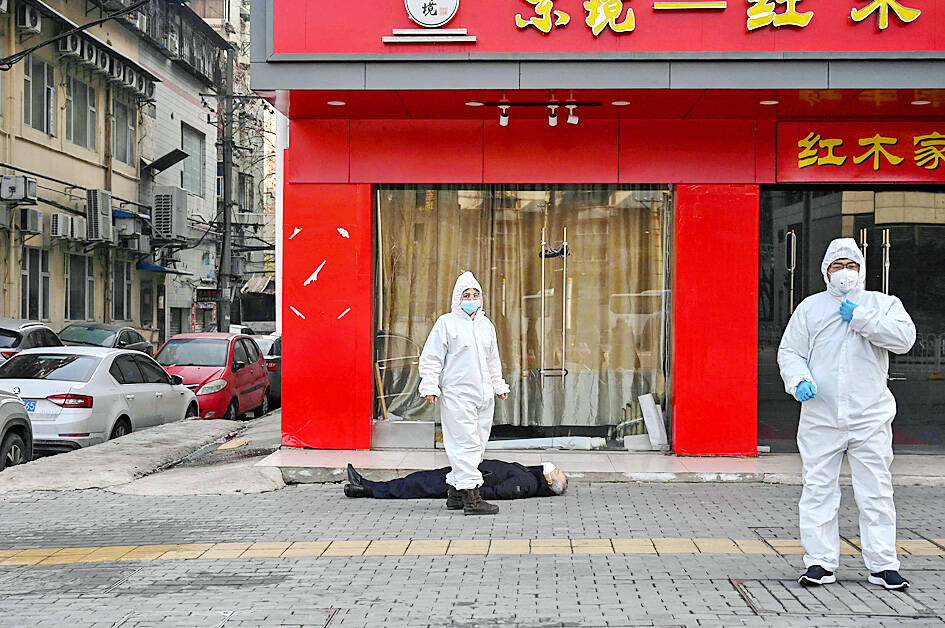
Photo: AFP
It went on to spark a global pandemic that has so far killed more than 7 million people and profoundly altered ways of life around the world, including in China.
However, on Saturday, there appeared to be no official memorials in Beijing’s tightly controlled official media.
The Chinese Communist Party kept a tight leash on public discussion throughout its “zero COVID” policy, and has eschewed reflections on the hardline curbs since dramatically ditching them at the end of 2022.
On social media, many users seemed unaware of the anniversary.
A few videos circulating on Douyin — the Chinese version of TikTok — noted the date, but repeated the official version of events.
On the popular Sina Weibo platform, users who gravitated to the former account of Li Wenliang (李文亮) — the whistle-blower doctor who was investigated by police for spreading early information about the virus — did not directly reference the anniversary.
“Dr Li, another year has gone by,” read one comment posted on Saturday. “How quickly time passes.”
There was also little online commemoration in Hong Kong, where Beijing has largely snuffed out opposition voices when it imposed the sweeping National Security Law on the semi-autonomous territory in 2020.
Unlike other countries, China has not built major memorials to those who lost their lives during the pandemic.
Little is known about the identity of the first COVID-19 casualty except that he was a frequent visitor to a Wuhan seafood market where the virus is thought to have circulated during the initial outbreak.

‘CROSSING THE LINE’: China’s embassy in Seoul criticized US Forces Korea Commander General Xavier Brunson, asking if his ‘hostile’ remarks were authorized by Washington South Korea and the US are in talks over recent public remarks by the commander of US Forces Korea, Seoul’s presidential office said yesterday, after the comments drew sharp criticism from China. In a recent podcast interview, US Forces Korea Commander General Xavier Brunson described South Korea as “the dagger in the heart of Asia” from China’s east coast, prompting the Chinese embassy in Seoul to say that he had “truly crossed the line.” The interview came amid growing speculation that Washington might seek to expand the role of US Forces Korea in countering the growing regional influence of China, a key

Through the noise of rushing papers and whirring belts at a print factory in Kyoto, two creators watch their photo essay come to life in broadsheet form — part of an effort to win new audiences in the age of artificial intelligence (AI). Despite the decline of the publishing industry, self-publication and handmade “zine” magazines are growing in popularity in Japan, reflecting the nation’s enduring love of paper in the digital era. While speaking to Agence France-Presse at the plant, his hands black with ink, one of the creators, Kazuma Obara, said: “I think [paper] is a medium that engages all five

Australian researchers have trained lab-grown brain cells on a silicon computer chip to play the 1990s shooter game Doom and said they are just scratching the surface of what the neurons could be capable of doing. It is the science-fiction work of biotech boffins at Cortical Labs, who researched and developed the technology that harnesses the workings of the brain’s networking system. Each so-called “biological computer” contains about 200,000 living human brain cells, grown from stem cells that were harvested from blood donations. Having mastered the simple computer game Pong, where a paddle is moved up and down to send a ball

France experienced its hottest spring on record, the French weather service said on Tuesday, after an exceptional early heat wave that also broke highs for the season in England and Wales. Meteo-France said the average nationwide temperature over March to May was 13.8°C — about 1.7°C above the norm, and surpassing records set in 2011 and 2020. “The warmest spring since records began in 1900,” it said in a bulletin. All three months were warmer than average, but the onset of an “unprecedented heatwave” late last month pushed the mercury to highs typically seen at the height of the summer. “Our country had never


 RSS
RSS