


More than 400 people trapped by a strong earthquake in the foothills of the Himalayas have been rescued, Chinese officials said, while more than 30,000 residents have been relocated, as the search for survivors entered a second day yesterday.
The epicenter of Tuesday’s magnitude 6.8 quake, one of the region’s most powerful tremors over the past few years, was in Tingri County in China’s Tibet region, about 80km north of Mount Everest, the world’s highest mountain. It also shook buildings in neighboring Nepal, Bhutan and India.
Twenty-four hours after the temblor struck, survivors trapped under rubble would have endured a night in sub-zero temperatures, and be at risk of succumbing to hypothermia and dehydration.
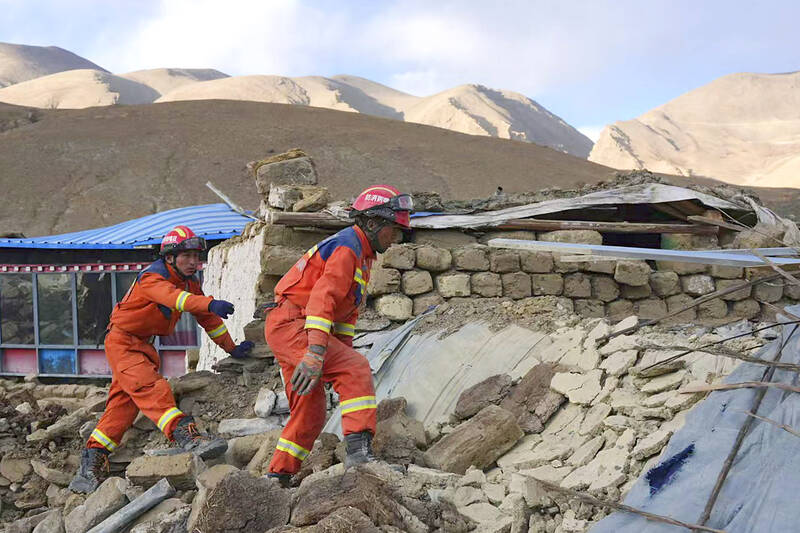
Photo: Xinhua via AP
An initial survey showed 3,609 homes had been destroyed in the Shigatse region of Tibet, which is home to 800,000 people, Chinese state media reported late on Tuesday, citing local officials.
More than 500 people and 106 ambulances had been dispatched to help the injured.
At least 126 people were known to have been killed and 188 injured on the Tibetan side, China’s state broadcaster China Central Television (CCTV) reported.
No deaths have been reported in Nepal or elsewhere.
Temperatures in the high-altitude region dropped to as low as minus-18°C overnight, adding to the misery of those left homeless.
Tents, food rations, electrical generators and other supplies had reached the site by late on Tuesday, and all sections of road damaged by the temblor had been reopened, CCTV added.
Southwestern parts of China, Nepal and northern India are often hit by earthquakes caused by the collision of the Indian and Eurasian tectonic plates.
More than 500 aftershocks with magnitudes of up to 4.4 had followed the quake as of 8am local time yesterday, the China Earthquake Networks Center said.
Over the past five years, there have been 29 earthquakes with magnitudes of 3 or above within 200km of the epicenter of Tuesday’s temblor, according to Sichuan Province’s earthquake bureau.
In 2008, a magnitude 8.0 earthquake hit Sichuan’s Chengdu, claiming the lives of at least 70,000 people, the deadliest quake to hit China since the 1976 Tangshan quake that killed at least 242,000 people.

Australians were downloading virtual private networks (VPNs) in droves, while one of the world’s largest porn distributors said it was blocking users from its platforms as the country yesterday rolled out sweeping online age restriction. Australia in December became the first country to impose a nationwide ban on teenagers using social media. A separate law now requires artificial intelligence (AI)-powered chatbot services to keep certain content — including pornography, extreme violence and self-harm and eating disorder material — from minors or face fines of up to A$49.5 million (US$34.6 million). The country also joined Britain, France and dozens of US states requiring

Hungarian authorities temporarily detained seven Ukrainian citizens and seized two armored cars carrying tens of millions of euros in cash across Hungary on suspicion of money laundering, officials said on Friday. The Ukrainians were released on Friday, following their detention on Thursday, but Hungarian officials held onto the cash, prompting Ukraine to accuse Hungary’s Russia-friendly government of illegally seizing the money. “We will not tolerate this state banditism,” Ukrainian Minister of Foreign Affairs Andrii Sybiha said. The seven detained Ukrainians were employees of the Ukrainian state-owned Oschadbank, who were traveling in the two armored cars that were carrying the money between Austria and

Kosovar President Vjosa Osmani on Friday after dissolving the Kosovar parliament said a snap election should be held as soon as possible to avoid another prolonged political crisis in the Balkan country at a time of global turmoil. Osmani said it is important for Kosovo to wrap up the upcoming election process and form functional institutions for political stability as the war rages in the Middle East. “Precisely because the geopolitical situation is that complex, it is important to finish this electoral process which is coming up,” she said. “It is very hard now to imagine what will happen next.” Kosovo, which declared

MORE BANS: Australia last year required sites to remove accounts held by under-16s, with a few countries pushing for similar action at an EU level and India considering its own ban Indonesia on Friday said it would ban social media access for children under 16, citing threats from online pornography, cyberbullying, online fraud and Internet addiction. “Accounts belonging to children under 16 on high-risk platforms will start to be deactivated, beginning with YouTube, TikTok, Facebook, Instagram, Threads, X, Bigo Live and Roblox,” Indonesian Minister of Communications and Digital Meutya Hafid said. “The government is stepping in so that parents no longer have to fight alone against the giants of the algorithm. Implementation will begin on March 28, 2026,” she said. The social media ban would be introduced in stages “until all platforms fulfill their


 RSS
RSS