


In the winding alleys of southern Iran, artist Adel Yazdi has taken it upon himself to turn his rustic old neighborhood into a cultural and tourist hub through vibrant paintings and carved relief faces.
Narenjestan, a neighborhood characterized by crumbling, uninhabited houses, is nestled in Shiraz, a southern city celebrated for its historic architecture, lush gardens and revered poets.
“Most of the dilapidated walls in old Shiraz have no historical value,” said Yazdi, a bushy-bearded, bespectacled 40-year-old artist who has dedicated himself to revitalizing Narenjestan.
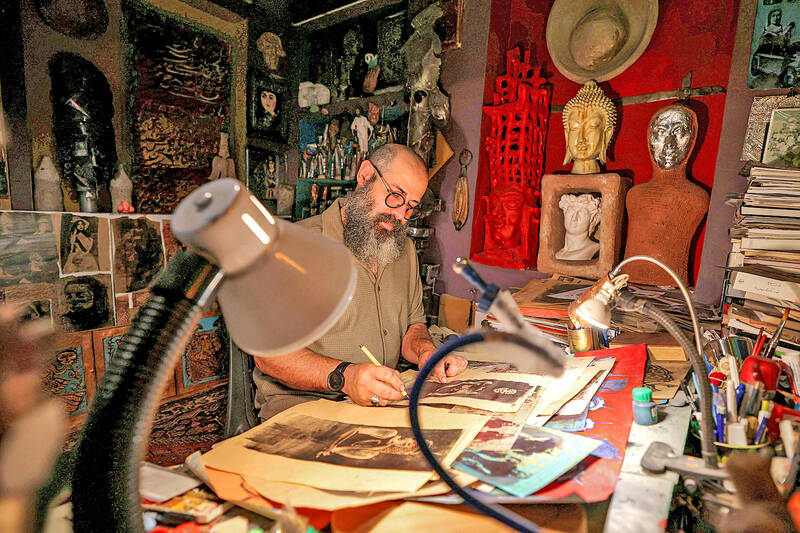
Photo: AFP
Yazdi has over the years turned the long-neglected neighborhood walls into a vivid visual tapestry “telling the stories of the people living here.”
Arabesque patterns and relief faces carved with intricate details and painted in an array of vivid hues of greens, pinks, blues and purples now adorn the walls. With its striking designs and bright colors, Yazdi’s art can be reminiscent of Surrealism.
It often comes across as surprising, showcasing a different side of Iran’s artistic heritage that goes beyond the conventional focus on Persian or Islamic architecture.
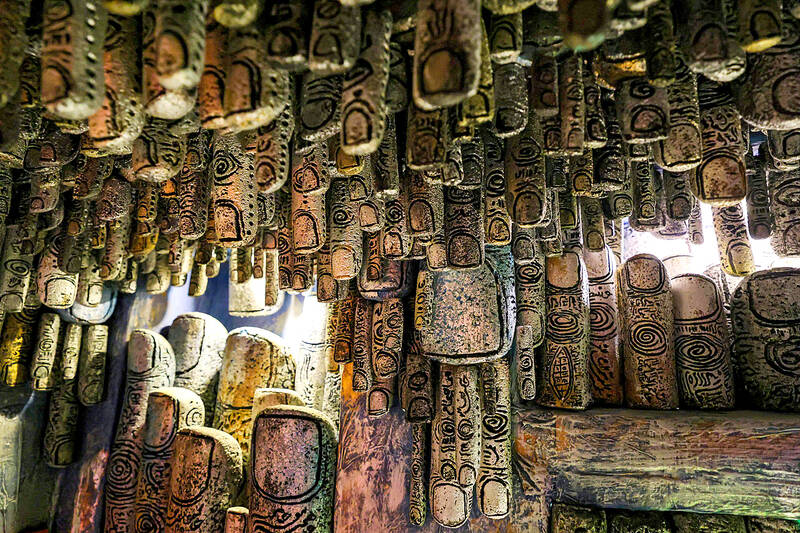
Photo: AFP
SOCIAL MEDIA
The artwork includes the face of Scheherazade, Yazdi said, referencing the legendary storyteller from the One Thousand and One Nights collection of folktales.
Yazdi’s work stands out in Shiraz where graffiti and murals are rare, becoming a social media sensation and a tourist attraction.
One visitor, Mahdieh, said she discovered Yazdi’s murals through Instagram.
“I arrived in Shiraz yesterday... and it was the first site I wanted to visit,” the 40-year-old said, who declined to give her last name.
At the end of one alleyway, Yazdi has established his workshop in a century-old building with small rooms encircling a serene garden.
He also lives in the building, with a traditional Persian architectural style. It is filled with artifacts and sculptures, resembling a museum warehouse. Replicas of Shiite Muslim mosque doors feature prominently.
To Maedah, a 30-year-old engineer, Yazdi’s house brings to mind “other historical places in the city, such as the Eram Garden and the Mausoleum of the Poet Hafez.”
Yazdi said he drew inspiration from the Centre Pompidou in Paris, a cultural hub that transformed the heart of the French capital in the 1970s.
He hopes his efforts can turn Shiraz’s alleyways into even more of a vibrant cultural center as well.
At his residence, visitors are particularly drawn to what Yazdi calls “the Finger Room.”
Inside, he installed about 14,000 finger sculptures on the ceiling, all pointing downward.
“The room is inspired by the legend of an angel that counts raindrops with thousands of fingers,” he said, referring to an Islamic fable. “These fingers are there to constantly remind us that the present moment is precious and that we must seize it.”

‘CROSSING THE LINE’: China’s embassy in Seoul criticized US Forces Korea Commander General Xavier Brunson, asking if his ‘hostile’ remarks were authorized by Washington South Korea and the US are in talks over recent public remarks by the commander of US Forces Korea, Seoul’s presidential office said yesterday, after the comments drew sharp criticism from China. In a recent podcast interview, US Forces Korea Commander General Xavier Brunson described South Korea as “the dagger in the heart of Asia” from China’s east coast, prompting the Chinese embassy in Seoul to say that he had “truly crossed the line.” The interview came amid growing speculation that Washington might seek to expand the role of US Forces Korea in countering the growing regional influence of China, a key

Through the noise of rushing papers and whirring belts at a print factory in Kyoto, two creators watch their photo essay come to life in broadsheet form — part of an effort to win new audiences in the age of artificial intelligence (AI). Despite the decline of the publishing industry, self-publication and handmade “zine” magazines are growing in popularity in Japan, reflecting the nation’s enduring love of paper in the digital era. While speaking to Agence France-Presse at the plant, his hands black with ink, one of the creators, Kazuma Obara, said: “I think [paper] is a medium that engages all five

Australian researchers have trained lab-grown brain cells on a silicon computer chip to play the 1990s shooter game Doom and said they are just scratching the surface of what the neurons could be capable of doing. It is the science-fiction work of biotech boffins at Cortical Labs, who researched and developed the technology that harnesses the workings of the brain’s networking system. Each so-called “biological computer” contains about 200,000 living human brain cells, grown from stem cells that were harvested from blood donations. Having mastered the simple computer game Pong, where a paddle is moved up and down to send a ball

A surprising gut feeling may help pigeons find their way home. Animals use various techniques to navigate, including following the stars and remembering key landmarks. Birds, fish and turtles orient themselves using Earth’s magnetic field as a compass, but it is not yet clear how exactly they do this. Pigeons are a well-known group of frequent flyers that can traverse hundreds of kilometers in a single day. For thousands of years, humans have used them to carry news, notes and military messages. Scientists have long tried to untangle how pigeons travel without getting lost. Some think the birds detect magnetic cues using light-sensitive


 RSS
RSS