


South Korea's presidential guards and military troops prevented authorities from arresting impeached President Yoon Suk Yeol today in a tense six-hour stand-off inside Yoon's compound in the heart of Seoul.
Yoon is under criminal investigation for insurrection over his Dec. 3 martial law bid that stunned South Korea and led to the first arrest warrant to be issued for a sitting president.
"It was judged that it was virtually impossible to execute the arrest warrant due to the ongoing standoff," the Corruption Investigation Office for High-ranking Officials (CIO) said in a statement.
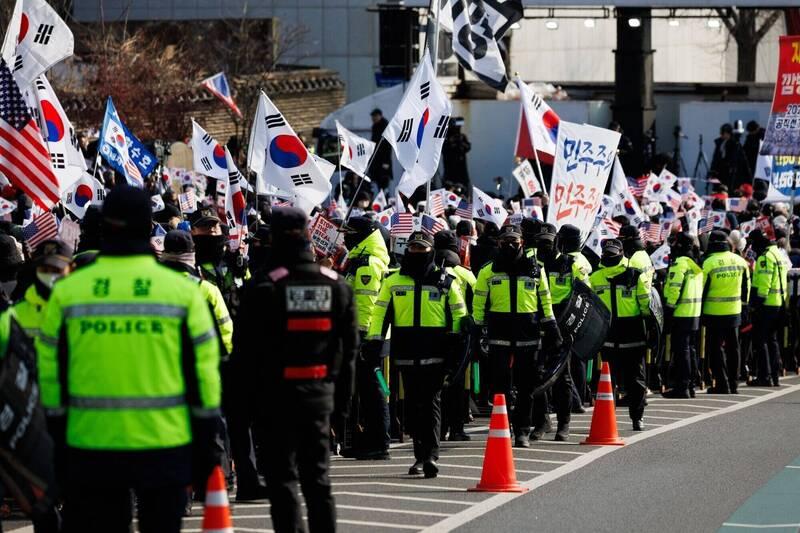
Photo: Bloomberg
CIO officials and police evaded hundreds of Yoon supporters who gathered in the pre-dawn hours near his residence today, vowing to block the arrest "with our lives."
Some chanted "President Yoon Suk Yeol will be protected by the people," and called for the head of the CIO to be arrested.
Officials from the CIO, which is leading a joint team of investigators into possible insurrection charges related to Yoon's brief declaration of martial law, arrived at the gates of the presidential compound shortly after 7am and entered on foot.
Once inside the compound, the CIO and police were outnumbered by cordons of Presidential Security Service (PSS) personnel, as well as military troops seconded to presidential security, a CIO official told reporters.
As many as 200 formed a human chain to block the CIO and police, the official added.
South Korea's Ministry of National Defense said the troops were under the control of the PSS.
The CIO called off the effort to arrest Yoon around 1:30pm due to concerns over the safety of its personnel due to obstruction, and said it "deeply regretted" Yoon's attitude of non-compliance.
His arrest warrant, approved by a court on Tuesday after Yoon ignored multiple summons to appear for questioning, is viable until Jan. 6.
Yoon has been isolated since he was impeached and suspended from power on Dec. 14.
In a statement after the arrest effort was suspended, Yoon's legal team said the CIO had no authority to investigate insurrection and it was regrettable that it had tried to "forcibly execute an illegal and invalid arrest and search warrant" in a sensitive security area.
The statement warned police against supporting the arrest effort.
The interim head of Yoon's People Power Party welcomed the suspension and said the investigation must be carried out without detaining Yoon.
The current warrant gives investigators only 48 hours to hold Yoon after he is arrested. Investigators must then decide whether to request a detention warrant or release him.
Yoon sent shockwaves through Asia's fourth-largest economy and one of the region's most vibrant democracies with his late-night announcement on Dec. 3 that he was imposing martial law to overcome political deadlock and root out "anti-state forces".
Within hours, however, 190 lawmakers had defied the cordons of troops and police to vote against Yoon's order. About six hours after his initial decree, Yoon rescinded it.
He later issued a defiant defense of his decision, saying domestic political opponents are sympathetic to North Korea and citing uncorroborated claims of election tampering.
Two South Korean military officials, including army chief Park An-su who was named martial law commander during the short-lived declaration, have been indicted after being detained by prosecutors investigating insurrection charges, Yonhap reported today.
Kim Yong-hyun, who resigned as Yoon's defense minister after playing a major role in the martial law decree, has been detained and was indicted last week on charges of insurrection and abuse of power.
Separate from the criminal investigation, his impeachment case is currently before the Constitutional Court to decide whether to reinstate or permanently remove him. A second hearing in that case is scheduled for later today.
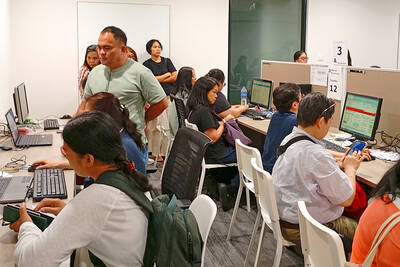
A new online voting system aimed at boosting turnout among the Philippines’ millions of overseas workers ahead of Monday’s mid-term elections has been marked by confusion and fears of disenfranchisement. Thousands of overseas Filipino workers have already cast their ballots in the race dominated by a bitter feud between President Ferdinand Marcos Jr and his impeached vice president, Sara Duterte. While official turnout figures are not yet publicly available, data from the Philippine Commission on Elections (COMELEC) showed that at least 134,000 of the 1.22 million registered overseas voters have signed up for the new online system, which opened on April 13. However,

EUROPEAN FUTURE? Albanian Prime Minister Edi Rama says only he could secure EU membership, but challenges remain in dealing with corruption and a brain drain Albanian Prime Minister Edi Rama seeks to win an unprecedented fourth term, pledging to finally take the country into the EU and turn it into a hot tourist destination with some help from the Trump family. The artist-turned-politician has been pitching Albania as a trendy coastal destination, which has helped to drive up tourism arrivals to a record 11 million last year. US President Donald Trump’s son-in-law, Jared Kushner, also joined in the rush, pledging to invest US$1.4 billion to turn a largely deserted island into a luxurious getaway. Rama is expected to win another term after yesterday’s vote. The vote would
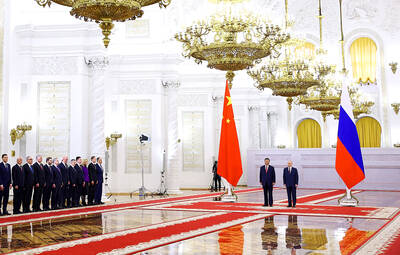
ALLIES: Calling Putin his ‘old friend,’ Xi said Beijing stood alongside Russia ‘in the face of the international counter-current of unilateralism and hegemonic bullying’ Chinese President Xi Jinping (習近平) yesterday was in Moscow for a state visit ahead of the Kremlin’s grand Victory Day celebrations, as Ukraine accused Russia’s army of launching air strikes just hours into a supposed truce. More than 20 foreign leaders were in Russia to attend a vast military parade today marking 80 years since the defeat of Nazi Germany in World War II, taking place three years into Russia’s offensive in Ukraine. Putin ordered troops into Ukraine in February 2022 and has marshaled the memory of Soviet victory against Nazi Germany to justify his campaign and rally society behind the offensive,
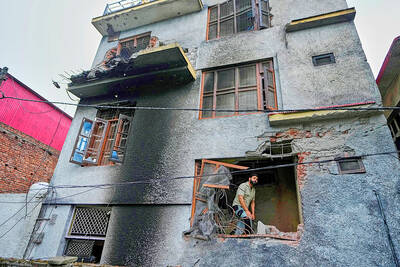
CONFLICTING REPORTS: Beijing said it was ‘not familiar with the matter’ when asked if Chinese jets were used in the conflict, after Pakistan’s foreign minister said they were The Pakistan Army yesterday said it shot down 25 Indian drones, a day after the worst violence between the nuclear-armed rivals in two decades. Pakistani Prime Minister Shehbaz Sharif vowed to retaliate after India launched deadly missile strikes on Wednesday morning, escalating days of gunfire along their border. At least 45 deaths were reported from both sides following Wednesday’s violence, including children. Pakistan’s military said in a statement yesterday that it had “so far shot down 25 Israeli-made Harop drones” at multiple location across the country. “Last night, India showed another act of aggression by sending drones to multiple locations,” Pakistan military spokesman Ahmed


 RSS
RSS