


Thousands of students marched in Belgrade and two other Serbian cities during a New Year’s Eve protest that went into yesterday, demanding accountability over the fatal collapse of a train station roof in November.
The incident in the city of Novi Sad occurred on Nov. 1 at a newly renovated train facility, killing 14 people — aged six to 74 — at the scene, while a 15th person died in hospital weeks later.
Public outrage over the tragedy has sparked nationwide protests, with many blaming the deaths on corruption and inadequate oversight of construction projects.

Photo: EPA-EFE
In Belgrade, university students marched through the capital city’s center late on Tuesday, where local authorities had organized New Year’s Eve celebrations with music and performance programs.
“There is nothing to celebrate,” the students said in a message sent before the protest started.
Alongside the Belgrade march, students in Nis, a university center in the south of the Balkan country, also held a march to disrupt concerts, while Novi Sad — which did not have New Year’s Eve celebrations — had a student demonstration.
In Belgrade and Nis, students stood in silence for 15 minutes at midnight to honor the 15 people who died, bowing their heads as fireworks could be seen going off to ring in the new year.
In Novi Sad, students placed black ribbons on its city hall.
Residents gathered at the central city square at the invitation of students, with some carrying banners that read “For the New Year, I wish for justice.”
Before midnight, which they welcomed in silence and holding aloft lights of mobile phones, the students recited poems and sang songs.
The protests come on the heels of 13 people being charged in connection with the tragedy, including former Serbian minister of transport Goran Vesic, who resigned days after the incident.
The Serbian government has seen eight weeks of nationwide demonstrations following the deaths, with many protesters accusing the authorities of corruption and inadequate oversight.
Faced with public pressure, the government made all documentation related to the reconstruction of the train station public, followed by the prosecutors’ office doing the same.
Serbian President Aleksandar Vucic earlier on Tuesday said that “all student demands had been met” and added that this is now “a matter of politics.”
In a bid to abate public anger, the authorities over the past few weeks have promised subsidies for young people.
However, students continued to protest and almost all faculties at state universities across the country remain blockaded.
They say that responsibility has not been adequately assumed and their anger has been further fueled by representatives of the government accusing them of “protesting for money” and “serving foreign intelligence.”
Tensions remained high during the New Year’s protests, which continued after midnight in Belgrade.
“The students have risen,” they chanted, carrying banners that read: “This is our country, too” and: “Stop lying.”
FAKE NEWS? ‘When the government demands the press become a state mouthpiece under the threat of punishment, something has gone very wrong,’ a civic group said The top US broadcast regulator on Saturday threatened media outlets over negative coverage of the Middle East war, after US President Donald Trump slammed critical headlines from the “Fake News Media.” The US president since his first term has derided mainstream media as “fake news” and has sued major outlets over what he sees as unfair coverage. Brendan Carr, head of the US Federal Communications Commission — which oversees the nation’s radio, television and Internet media — said broadcasters risked losing their licenses over news coverage. “The law is clear. Broadcasters must operate in the public interest, and they will
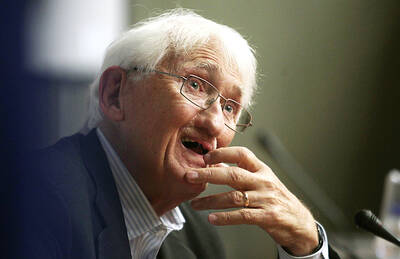
INFLUTENTIAL THEORIST: Habermas was particularly critical of the ‘limited interest’ shown by German politicians in ‘shaping a politically effective Europe Jurgen Habermas, whose work on communication, rationality and sociology made him one of the world’s most influential philosophers and a key intellectual figure in his native Germany, has died. He was 96. Habermas’ publisher, Suhrkamp, said he died on Saturday in Starnberg, near Munich. Habermas frequently weighed in on political matters over several decades. His extensive writing crossed the boundaries of academic and philosophical disciplines, providing a vision of modern society and social interaction. His best-known works included the two-volume Theory of Communicative Action. Habermas, who was 15 at the time of Nazi Germany’s defeat, later recalled the dawn of

The Chinese public maintains relatively warm sentiments toward Taiwan and strongly prefers non-military paths to improving cross-strait relations, a recent survey conducted by the Atlanta, Georgia-based Carter Center and Emory University showed. The “China Pulse” research project, which polled 2,506 adults between Oct. 27 last year and Jan. 1 this year, found that 86 percent of respondents support strengthening cultural ties, while 81 percent favor deepening economic interaction. The report, co-authored by political scientists at Emory University and advisors at the Carter Center, indicates that the Chinese public views Taiwan’s importance through a lens of shared history and culture rather than geopolitical

Cannabis-based medicines have shown little evidence of effectiveness for treating most mental health and substance-use disorders, according to a large review of past studies published in a major medical journal on Monday. Medical use of cannabinoids has been expanding, including in the US, Canada and Australia, where many patients report using cannabis products to manage conditions such as anxiety, post-traumatic stress disorder and sleep problems. Researchers reviewed data from 54 randomized clinical trials conducted between 1980 and May last year involving 2,477 participants for their analysis published in The Lancet. The studies assessed cannabinoids as a primary treatment for mental disorders or substance-use


 RSS
RSS