


Rescuers say they have expanded a search for trapped survivors in quake-rocked Vanuatu to “numerous places of collapse” beyond the capital yesterday, after the death toll climbed to at least 10.
A magnitude 7.3 earthquake struck off the main island on Tuesday, toppling concrete buildings in Port Vila and setting off landslides.
It has damaged water supplies, knocked out mobile networks, halted operations at the capital’s main shipping port and led to a suspension of commercial flights.
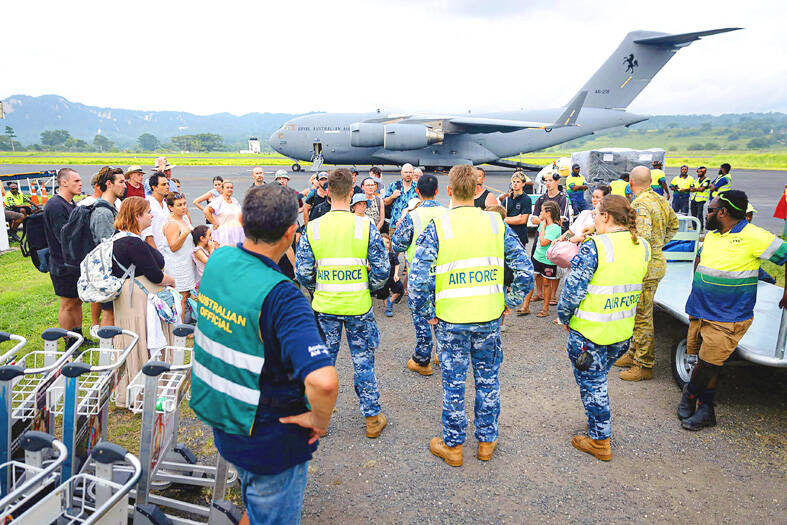
Photo: Australian Department of Foreign Affairs and Trade / AFP
Ten people have been confirmed killed so far, Vanuatuan Ministry of Health figures said on Thursday by the UN humanitarian affairs office.
Two of the dead were Chinese and one was French, their embassies have confirmed.
Toll figures issued by the authorities have sometimes been contradictory, as officials grapple with the disaster.
Vanuatuan President Nikenike Vurobaravu in a televised address said there were “around 16 dead,” citing the police.
About 80,000 people have been directly affected by the earthquake in the archipelago of 320,000, which sits in the Pacific’s quake-prone Ring of Fire, the UN said.
More than 14,000 of them are children.
Australia and New Zealand have dispatched more than 100 personnel, along with rescue gear, dogs and aid supplies, to help hunt for survivors and make emergency repairs.
There are “several major collapse sites where buildings are fully pancaked,” Australia’s 69-strong rescue team leader Douglas May said yesterday.
“Outside of that, there’s a lot of smaller collapses around the place,” May said. “We’re now starting to spread out to see whether there’s further people trapped and further damage. And we’ve found numerous places of collapse east and west out of the city.”
In Port Vila, rescuers have focused on two disaster areas: a four-storey building housing a supermarket, hotel and garage in the north in which the ground floor was flattened, and a two-floor shopping block in the city center that crumbled into a flat pile of concrete.
The shopping block is where “most of the lives have been lost,” Vanuatu Emergency Services Association acting manager Jeff Mabbett said.
His rescue team was on-site minutes after the quake hit, rescuing those they could. Four days on, the unit was still digging through landslides and the rubble of buildings.
The rescue effort was being hampered by “limited access to heavy machinery, very small spaces, poor lighting and multiple large aftershocks,” Mabbett said.
A second team was providing medical support, including setting up a field hospital for survivors.
“We have seen over 100 patients in the three days post-earthquake, with a range of ailments,” he said. “We are lucky to have had the kind support from tourists who are paramedics, doctors and nurses from Australia and New Zealand who have assisted us with clinical staffing until their repatriation flights took off.”
Rescuers were tired, but in “good spirits,” he said.
The quake also wrecked a building housing the US, French, British, Australian and New Zealand diplomatic missions. The ground floor along half of that four-storey structure was flattened, but no deaths were reported.
The government has declared a seven-day state of emergency and a night-time curfew.
“One concern now is that there are reports of 900 people displaced out of their houses and who have been sleeping outside for the last few days and nights, without proper access to water and sanitation facilities,” World Health Organization Vanuatu medical officer Philippe Guyant said.
Vanuatu has usually been able to set up refuge for disasters such as cyclones, he said.
“But this time there was no evacuation center, and people have stayed out for so long. There is a mix of people, some fearing to go back to ... their houses destroyed in the earthquake, ” Guyant said.
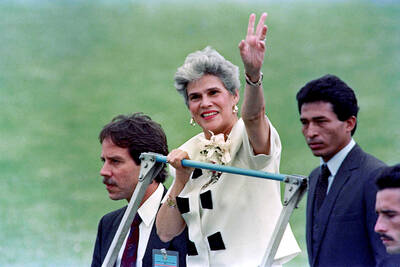
Former Nicaraguan president Violeta Chamorro, who brought peace to Nicaragua after years of war and was the first woman elected president in the Americas, died on Saturday at the age of 95, her family said. Chamorro, who ruled the poor Central American country from 1990 to 1997, “died in peace, surrounded by the affection and love of her children,” said a statement issued by her four children. As president, Chamorro ended a civil war that had raged for much of the 1980s as US-backed rebels known as the “Contras” fought the leftist Sandinista government. That conflict made Nicaragua one of
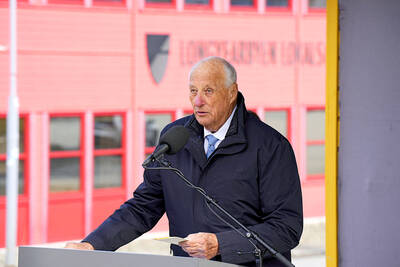
COMPETITION: The US and Russia make up about 90 percent of the world stockpile and are adding new versions, while China’s nuclear force is steadily rising, SIPRI said Most of the world’s nuclear-armed states continued to modernize their arsenals last year, setting the stage for a new nuclear arms race, the Stockholm International Peace Research Institute (SIPRI) said yesterday. Nuclear powers including the US and Russia — which account for about 90 percent of the world’s stockpile — had spent time last year “upgrading existing weapons and adding newer versions,” researchers said. Since the end of the Cold War, old warheads have generally been dismantled quicker than new ones have been deployed, resulting in a decrease in the overall number of warheads. However, SIPRI said that the trend was likely
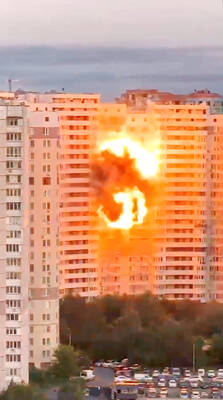
BOMBARDMENT: Moscow sent more than 440 drones and 32 missiles, Volodymyr Zelenskiy said, in ‘one of the most terrifying strikes’ on the capital in recent months A nighttime Russian missile and drone bombardment of Ukraine killed at least 15 people and injured 116 while they slept in their homes, local officials said yesterday, with the main barrage centering on the capital, Kyiv. Kyiv City Military Administration head Tymur Tkachenko said 14 people were killed and 99 were injured as explosions echoed across the city for hours during the night. The bombardment demolished a nine-story residential building, destroying dozens of apartments. Emergency workers were at the scene to rescue people from under the rubble. Russia flung more than 440 drones and 32 missiles at Ukraine, Ukrainian President Volodymyr Zelenskiy
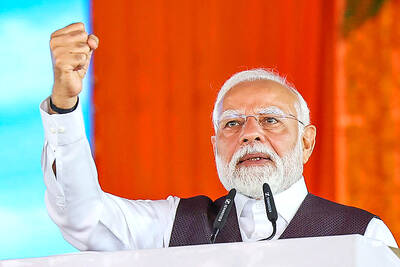
Indian Prime Minister Narendra Modi is to visit Canada next week, his first since relations plummeted after the assassination of a Canadian Sikh separatist in Vancouver, triggering diplomatic expulsions and hitting trade. Analysts hope it is a step toward repairing ties that soured in 2023, after then-Canadian prime minister Justin Trudeau pointed the finger at New Delhi’s involvement in murdering Hardeep Singh Nijjar, claims India furiously denied. An invitation extended by new Canadian Prime Minister Mark Carney to Modi to attend the G7 leaders summit in Canada offers a chance to “reset” relations, former Indian diplomat Harsh Vardhan Shringla said. “This is a


 RSS
RSS