


Japanese Princess Yuriko, the wife of wartime Emperor Hirohito’s brother and the oldest member of the imperial family, died yesterday after her health deteriorated recently, palace officials said.
She was 101.
Yuriko died at a Tokyo hospital, the Imperial Household Agency said. It did not announce the cause of death, but Japanese media said she died of pneumonia.
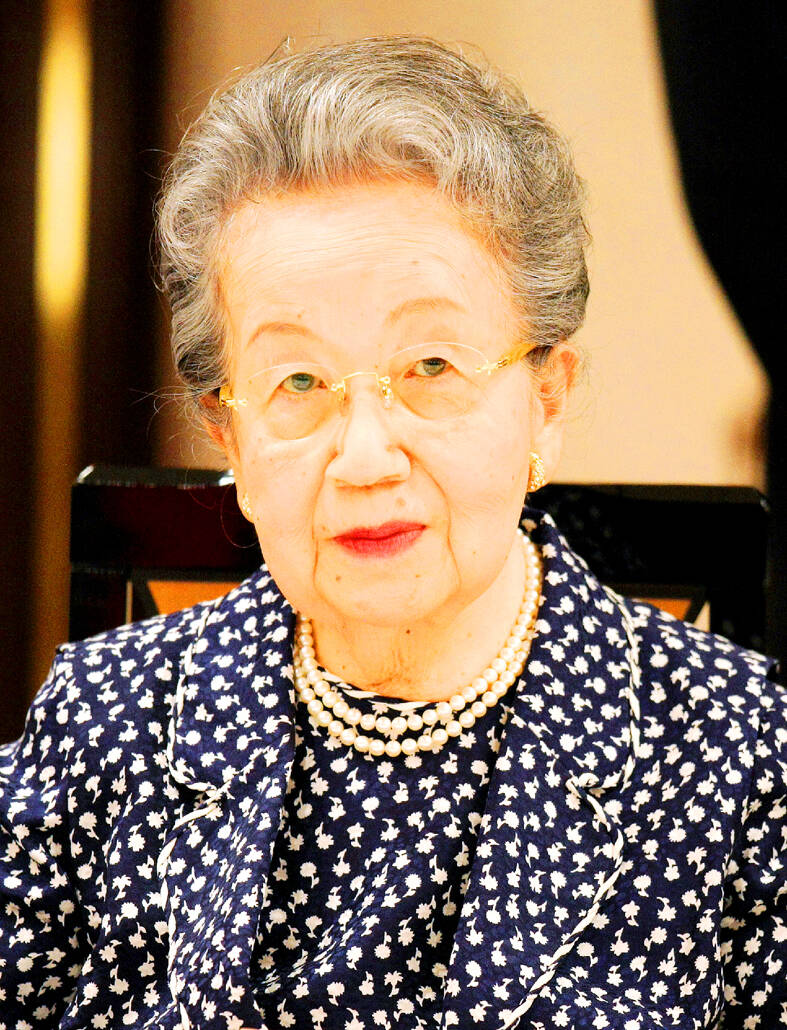
Photo: EPA-EFE
Born in 1923 as an aristocrat, Yuriko married at age 18 to Prince Mikasa, the younger brother of Hirohito and the uncle of Japanese Emperor Naruhito, months before the start of World War II.
She has recounted living in a shelter with her husband and their baby daughter after their residence was burned down in the US fire bombings of Tokyo in the final months of the war in 1945.
Yuriko raised five children and supported Mikasa’s research into ancient Near Eastern history, while also serving her official duties and taking part in philanthropic activities, including promotion of maternal and child health.
She outlived her husband and all three sons.
Her death reduces Japan’s rapidly dwindling imperial family to 16 people, including four men, as the country faces the dilemma of how to maintain the royal family while conservatives in the governing party insist on retaining male-only succession.
The 1947 Imperial House Law allows only males to take the throne and forces female royal family members who marry commoners to lose their royal status.
The youngest male member of the imperial family, Prince Hisahito — the nephew of Emperor Naruhito — is the last heir apparent, posing a major problem for a system that does not allow empresses.
The government is debating how to keep succession stable without relying on women.
Japanese Prime Minister Shigeru Ishiba, visiting South America to attend the APEC and G20 summits, issued a statement expressing “heartfelt condolences.”
“I cannot help but feel saddened to hear of the loss. I extend my heartfelt condolences along with other Japanese citizens,” Ishiba said.
Yuriko had lived a healthy life as a centenarian before having a stroke and contracting pneumonia in March.
She enjoyed exercise in the morning while watching a daily fitness program on television, the Imperial Household Agency said.
She also continued to read multiple newspapers and magazines, and enjoyed watching news and baseball on TV.
On sunny days, she sat in the palace garden or was wheeled in her wheelchair.
Yuriko was hospitalized after her stroke and had been in and out of intensive care since then.
Her overall condition deteriorated over the past week, the Imperial Household Agency said.

An American scientist convicted of lying to US authorities about payments from China while he was at Harvard University has rebuilt his research lab in Shenzhen, China, to pursue technology the Chinese government has identified as a national priority: embedding electronics into the human brain. Charles Lieber, 67, is among the world’s leading researchers in brain-computer interfaces. The technology has shown promise in treating conditions such as amyotrophic lateral sclerosis and restoring movement in paralyzed people. It also has potential military applications: Scientists at the Chinese People’s Liberation Army have investigated brain interfaces as a way to engineer super soldiers by boosting

Indonesian police have arrested 13 people after shocking images of alleged abuse against small children at a daycare center went viral, sparking outrage across the nation, officials said on Monday. Police on Friday last week raided Little Aresha, a daycare center in Yogyakarta on Java island, following a report from a former employee. CCTV footage circulating on social media showed children, most younger than two, lying on the floor wearing only diapers, their hands and feet bound with rags. The police have confirmed that the footage is authentic. Police said they also found 20 children crammed into a room just 3m by 3m. “So
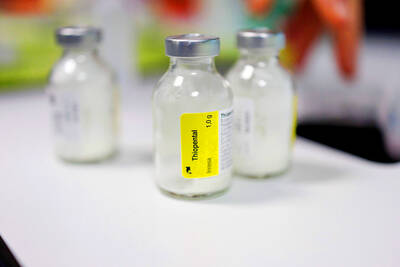
A grieving mother has ended her life at a clinic in Switzerland four years after the death of her only child. Wendy Duffy, 56, a physically healthy woman, died at the Pegasos clinic in Basel after struggling to cope with the death of her 23-year-old son, Marcus. The former care worker, from the West Midlands, England, had previously attempted to take her own life. The case comes as assisted dying would not become law in England and Wales after proposed legislation, branded “hopelessly flawed” by opponents, ran out of time. Ruedi Habegger, the founder of Pegasos, described Duffy’s death as

From post offices and parks to stations and even the summit of Mount Fuji, Japan’s vending machines are ubiquitous, but with the rapid pace of inflation cooling demand for their drinks, operators are being forced to rethink the business. Last month beverage giant DyDo Group Holdings announced it would remove about 20,000 vending machines — about 7 percent of their stock nationwide — by January next year, to “reconstruct a profitable network.” Pokka Sapporo Food & Beverage, based in Nagoya, also said last month it would sell its 40,000-machine operation to Osaka-based Lifedrink Co. “The strength of the vending machine


 RSS
RSS