


North Korea blew up sections of roads in its own territory that are part of links once used to connect the southern part of the peninsula with the north, in a show of defiance after it accused Seoul of flying drones over Pyongyang.
North Korea detonated bombs north of its eastern and western borders at around noon yesterday, South Korea’s Joint Chiefs of Staff (JCS) said.
South Korea’s military later fired off warning shots within its border, said the JCS, which also confirmed there were no reports of damage in South Korea from the detonations.
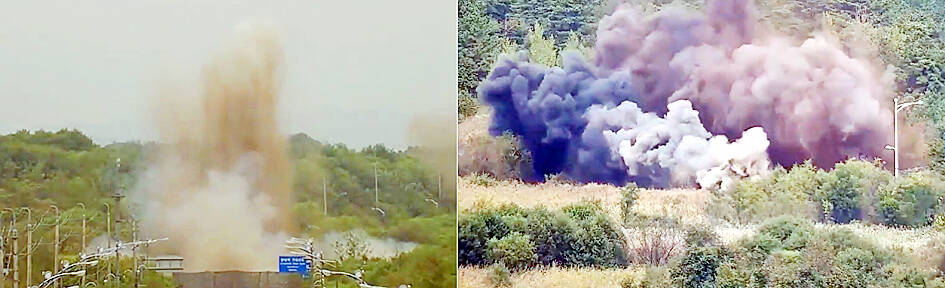
Photo: EPA-EFE
A video released by the South Korean military showed smoke billowing from roads following an explosion, with North Korean troops monitoring the operations nearby.
South Korea strongly condemned the move, calling it an “extremely abnormal” act that violates inter-Korean agreements. The roads were built as a cooperative project between the two Koreas, with Seoul providing materials and equipment for construction.
While the incidents reflect an escalation of tensions on the peninsula, they do not signal the imminent start of a military conflict, analysts said. North Korea has tended in the past to engage in provocative acts in the runup to major political events overseas, including US elections.
“The explosion is a symbolic move to highlight that Pyongyang now sees South Korea as an enemy state,” said Park Won-gon, a professor at South Korea’s Ewha Womans University, specializing in international relations. “It was not a direct provocation to South Korea, so Seoul is unlikely to overreact to it to further escalate tensions.”
Hours after the explosions, South Korea’s Gyeonggi Province declared cities and surrounding areas that border North Korea a risk zone, and banned sending anti-Pyongyang leaflets across the border. North Korean leader Kim Jong-un’s regime has long criticized the campaign as a threat to its sovereignty.
“It is a serious situation where the lives and safety of the residents in the border regions are threatened due to the rapidly deteriorating inter-Korean relations,” the province said in a statement. “We see sending anti-North Korea leaflets as an extremely dangerous act that could cause a military conflict.”
Kin has been pushing to sunder ties with his neighbor, ruling out the possibility of a peaceful unification. On Monday, he held a meeting on defense and security to discuss military action plans in response to alleged drone flights, state media Korean Central News Agency said.
North Korea has bristled at what it claimed to be the infiltration of drones in its airspace by Seoul and ordered artillery units along the border to “get fully ready to open fire” in an immediate strike if necessary.
South Korea has not said whether it sent drones across the border.


Showcasing phallus-shaped portable shrines and pink penis candies, Japan’s annual fertility festival yesterday teemed with tourists, couples and families elated by its open display of sex. The spring Kanamara Matsuri near Tokyo features colorfully dressed worshipers carrying a trio of giant phallic-shaped objects as they parade through the street with glee. The festival, as legend has it, honors a local blacksmith in the Edo Period (1603-1868) who forged an iron dildo to break the teeth of a sharp-toothed demon inhabiting a woman’s vagina that had been castrating young men on their wedding nights. A 1m black steel phallus sits in the courtyard of

HIGH HOPES: The power source is expected to have a future, as it is not dependent on the weather or light, and could be useful for places with large desalination facilities A Japanese water plant is harnessing the natural process of osmosis to generate renewable energy that could one day become a common power source. The possibility of generating power from osmosis — when water molecules pass from a less salty solution to a more salty one — has long been known. However, actually generating energy from that has proved more complicated, in part due the difficulty of designing the membrane through which the molecules pass. Engineers in Fukuoka, Japan, and their private partners think they might have cracked it, and have opened what is only the world’s second osmotic power plant. It generates

JAN. 1 CLAUSE: As military service is voluntary, applications for permission to stay abroad for over three months for men up to age 45 must, in principle, be granted A little-noticed clause in sweeping changes to Germany’s military service policy has triggered an uproar after it emerged that the law requires men aged up to 45 to get permission from the armed forces before any significant stay abroad, even in peacetime. The legislation, which went into effect on Jan. 1 aims to bolster the military and demands all 18-year-old men fill out a questionnaire to gauge their suitability to serve in the armed forces, but stops short of conscription. If the “modernized” model fails to pull in enough recruits, parliament will be compelled to discuss the reintroduction of compulsory service, German

Hundreds of Filipinos and tourists flocked to a sun-bleached field north of Manila yesterday, on Good Friday, to witness one of the country’s most blood-soaked displays of religious fervor, undeterred by rising fuel prices. Scores of bare-chested flagellants with covered faces walked barefoot through the dusty streets of Pampanga Province’s San Fernando as they flogged their backs with bamboo whips in the scorching heat. Agence France-Presse (AFP) journalists said they saw devotees deliberately puncturing their skin with glass shards attached to a small wooden paddle to ensure their bleeding during the ritual, a way to atone for sins and seek miracles from


 RSS
RSS