


A French-Chinese satellite yesterday blasted off on a hunt for the mightiest explosions in the universe, in a notable example of cooperation between a Western power and the Asian giant.
Developed by engineers from both countries, the Space Variable Objects Monitor (SVOM) would seek out gamma-ray bursts (GRBs), the light from which has traveled billions of light years to reach Earth.
The 930kg satellite carrying four instruments — two French, two Chinese — took off at about 3pm aboard a Chinese Long March 2-C rocket from a space base in Xichang, China, Agence France-Presse journalists witnessed.
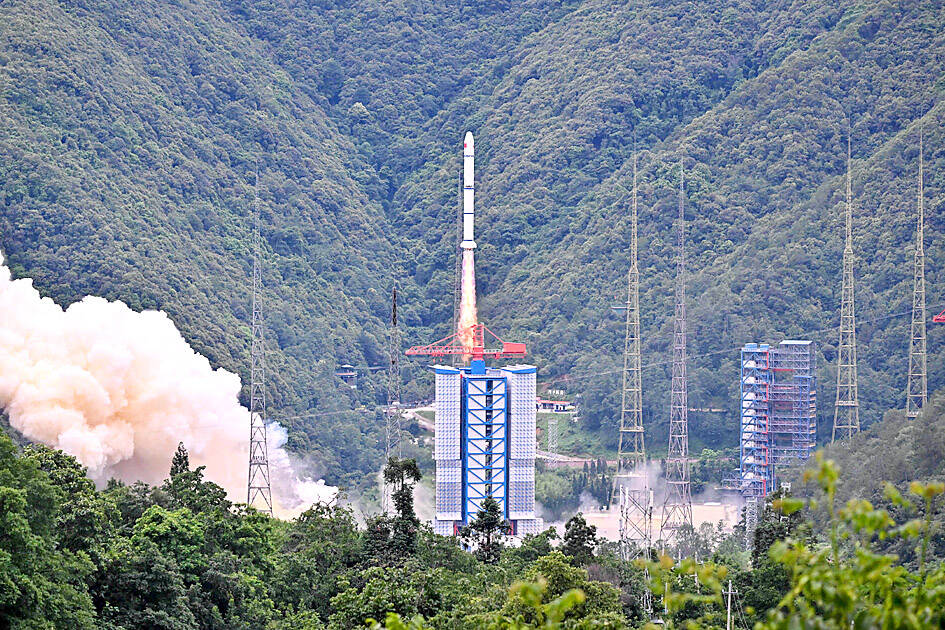
Photo: AFP
Gamma-ray bursts generally occur after the explosion of huge stars — those more than 20 times as big as the sun — or the fusion of compact stars. The extremely bright cosmic beams can give off a blast of energy equivalent to more than a a quintillion suns.
Observing them is like “looking back in time, as the light from these objects takes a long time to reach us,” said Ore Gottlieb, an astrophysicist at the Flatiron Institute’s Center for Astrophysics in New York.
The rays carry traces of the gas clouds and galaxies they pass through on their journey through space — valuable data for better understanding the history and evolution of the universe.
“SVOM has the potential to unravel several mysteries in the field of [gamma-ray bursts], including detecting the most distant GRBs in the universe, which correspond to the earliest GRBs,” Gottlieb said.
The most distant bursts identified to date were produced just 630 million years after the Big Bang — when the universe was in its infancy.
“We are ... interested in gamma-ray bursts for their own sake, because they are very extreme cosmic explosions which allow us to better understand the death of certain stars,” said Frederic Daigne, an astrophysicist at the Institut d’Astrophysique de Paris.
“All of this data makes it possible to test the laws of physics with phenomena that are impossible to reproduce in the laboratory on Earth,” Daigne said.
Once analyzed, the data could help us to better understand the composition of space, the dynamics of gas clouds or other galaxies.
The project stems from a partnership between the French and Chinese space agencies, as well as other scientific and technical groups from both nations.
Space cooperation at this level between the West and China is fairly uncommon, especially since the US banned all collaboration between NASA and Beijing in 2011.
Once in orbit 625km above the Earth, the satellite would send its data back to observatories. The main challenge is that gamma-ray bursts are extremely brief, leaving scientists in a race against time to gather information.
Once a burst is detected, SVOM would send an alert to a team on duty around the clock. Within five minutes, they would have to rev up a network of telescopes on the ground that would align precisely with the axis of the burst’s source to make more detailed observations.


PHISHING: The con might appear convincing, as the scam e-mails can coincide with genuine messages from Apple saying you have run out of storage For a while you have been getting messages from Apple saying “your iCloud storage is full.” They say you have exceeded your storage plan, so documents are no longer being backed up, and photos you take are not being uploaded. You have been resisting Apple’s efforts to get you to pay a minimum of £0.99 (US$1.33) a month for more storage, but it seems that you cannot keep putting off the inevitable: You have received an e-mail which says your iCloud account has been blocked, and your photos and videos would be deleted very soon. To keep them you need
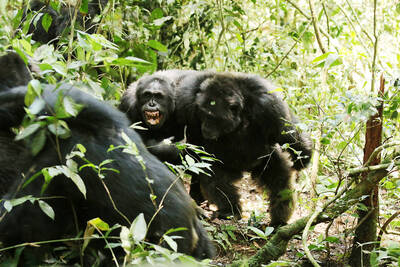
For two decades, researchers observed members of the Ngogo chimpanzee group of Kibale National Park in Uganda spend their days eating fruits and leaves, resting, traveling and grooming in their tropical rainforest abode, but this stable community then fractured and descended into years of deadly violence. The researchers are now describing the first clearly documented example of a group of wild chimpanzees splitting into two separate factions, with one launching a series of coordinated attacks against the other. Adult males and infants were targeted, with 28 deaths. “Biting, pounding the victim with their hands, dragging them, kicking them — mostly adult males,

The Israeli military has demolished entire villages as part of its invasion of south Lebanon, rigging homes with explosives and razing them to the ground in massive remote detonations. The Guardian reviewed three videos posted by the Israeli military and on social media, which showed Israel carrying out mass detonations in the villages of Taybeh, Naqoura and Deir Seryan along the Israel-Lebanon border. Lebanese media has reported more mass detonations in other border villages, but satellite imagery was not readily available to verify these claims. The demolitions came after Israeli Minister of Defense Israel Katz called for the destruction of

SUPERFAN: The Japanese PM played keyboard in a Deep Purple tribute band in middle school and then switched to drums at university, she told the British rock band Legendary British rock band Deep Purple yesterday made Japanese Prime Minister Sanae Takaichi’s day with a brief visit to their high-profile superfan as they returned to the nation they first toured more than half a century ago. Takaichi’s reputation as an amateur drummer, and a fan of hard rock and heavy metal has been well documented, and she has referred to Deep Purple as one of her favorite bands along with the likes of Black Sabbath and Iron Maiden. “You are my god,” a giddy Takaichi said in English to Deep Purple drummer Ian Paice, presenting him with a set of made-in-Japan


 RSS
RSS