


UNITED STATES
Kennedy reveals suspicion
Independent US presidential candidate Robert Kennedy Jr believed he might have been attacked by a worm that ate part of his brain and then died inside his head, the media reported on Wednesday. Kennedy, 70, made the claim in a 2012 deposition as part of his divorce from his second wife, according to the New York Times, which said the scion of the storied political clan reported severe memory loss and mental fog. A New York surgeon who reviewed his brain scans told Kennedy his health issues could have been “caused by a worm that got into my brain and ate a portion of it and then died,” he reportedly told attorneys. AFP has not independently reviewed the deposition.
UNITED STATES
Apple ad causes backlash
An ad for the new iPad Pro on Wednesday caused an uproar for showing an industrial-sized hydraulic press crushing objects linked to human creativity — such as a record player and trumpet — into a sleek tablet. Social media users immediately criticized the ad, which was posted on X by Apple CEO Tim Cook, as painfully tone-deaf at a time when the creative community is worried about its future with the emergence of generative artificial intelligence. “The destruction of the human experience. Courtesy of Silicon Valley,” actor Hugh Grant wrote on X. Set to the song All I Ever Need is You by Sonny and Cher, the one-minute ad titled Crush sees the pile of creative artifacts, also including a piano and paint cans, explode under the pressure of Apple’s press. “I’m not sure ‘wanton destruction of all the good and beautiful things in this world’ was really the vibe you were trying for,” X user Judd Baroff wrote.
JAPAN
Rat parts found in bread
More than 100,000 packets of sliced bread have been recalled after parts of a black rat’s body were discovered inside two of them, the manufacturer said on Wednesday. Food recalls are rare in Japan, a country with famously high standards of sanitation, and Pasco Shikishima Corp said it was investigating how the rodent remains had crept into its products. The company said it was so far unaware of anyone falling sick after eating its processed white chojuku bread, long a staple of Japanese breakfast tables. About 104,000 packs of the bread have been recalled in mainland Japan, from Tokyo to the northern Aomori region. “We would like to apologize deeply for causing trouble to our customers and clients,” the company said in a statement on Tuesday. Then on Wednesday, Pasco confirmed that parts of a black rat had contaminated the two packs.
VIETNAM
Senior official arrested
Police have arrested a senior official involved in talks with international organizations on labor reforms, state media said yesterday, adding that the action was linked to disclosure of classified information. The detention of Ministry of Labour, Invalids and Social Affairs Legal Affairs Department Director Nguyen Van Binh follows months of arrests of prominent experts and activists, in what some diplomats see as a further crackdown on civil society amid a major reshuffle of top political leaders in the communist-ruled country. Binh, 51, was charged with overseeing reforms to labor law on which he worked closely with the International Labour Organization, the ministry said on its Web site. Binh was detained on charges of intentionally revealing state secrets, the state-run Tuoi Tre newspaper said.

SHAKE-UP: Lam, who would be the third president in less than two years, emerged as one of the country’s most important officials after leading an anti-corruption effort Vietnam has nominated the enforcer of the Communist Party’s anti-corruption drive as the next president and proposed a new head of the National Assembly, in appointments that could ease months of political turmoil and allow policymakers to refocus on a struggling economy. Unprecedentedly for a one-party nation once known for its stable politics, two state presidents and a National Assembly speaker have stepped down in less than 18 months, all for unspecified “wrongdoing” amid a major anti-graft campaign which is unnerving foreign investors because of its chilling effect on bureaucracy. After approval from the National Assembly, which could come this week, Vietnamese

MOSTLY SYMBOLIC: The ruling party has a large enough majority to override the veto of the legislation, which the president said contradicts the constitution Georgia’s president on Saturday vetoed a so-called “Russian law” targeting media that has sparked weeks of mass protests. The legislation would require media and non-governmental organizations to register as “pursuing the interests of a foreign power” if they receive more than 20 percent of their funding from abroad. Critics of the bill say it closely resembles legislation used by the Kremlin to silence opponents, and that it would obstruct Georgia’s bid to join the EU. Georgian President Salome Zourabichvili, who is increasingly at odds with the ruling Georgian Dream party, said that the legislation contradicts the country’s constitution and “all European standards,” adding
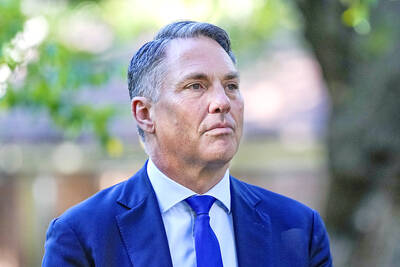
Australian Minister for Defence Richard Marles yesterday said that newly elected Solomon Islands Prime Minister Jeremiah Manele had told him the Pacific Island nation is undertaking a security review that would determine the future of policing cooperation. A security pact struck with China in 2022 by then-Solomon Islands prime minister Manasseh Sogavare, who was pro-Beijing and encouraged Chinese infrastructure projects, alarmed Canberra and Washington amid concerns over China’s naval ambitions in the region. The Solomon Islands’ biggest aid donor, Australia provided policing support for national elections last month. China also has a policing presence on the archipelago, strategically located 1,600km northeast of

A powerful armed ethnic group in Myanmar yesterday said it had won control over a town in the western state of Rakhine after weeks of fighting, denying accusations it had targeted members of the Muslim-minority Rohingya during the offensive. Khine Thu Kha, a spokesman for the Arakan Army (AA), said its soldiers had taken Buthidaung near Myanmar’s border with Bangladesh, marking another battlefield defeat for the ruling junta that is fighting opposition groups on multiple fronts. “We have conquered all the bases in Buthidaung and also took over the town yesterday,” Khine Thu Kha said by telephone. Some Rohingya activists accuse the AA


 RSS
RSS