


Ecuadoran authorities on Friday stormed the Mexican embassy in Quito to arrest former Ecuadoran vice president Jorge Glas, who was taking refuge there, prompting Mexico to sever diplomatic ties after the “violation of international law.”
Images taken by Agence France-Presse showed police special forces massed outside the embassy and at least one of them scaling its walls, which were already surrounded by police and military.
Mexican President Andres Manuel Lopez Obrador said authorities “forcibly entered” the building to arrest Glas.
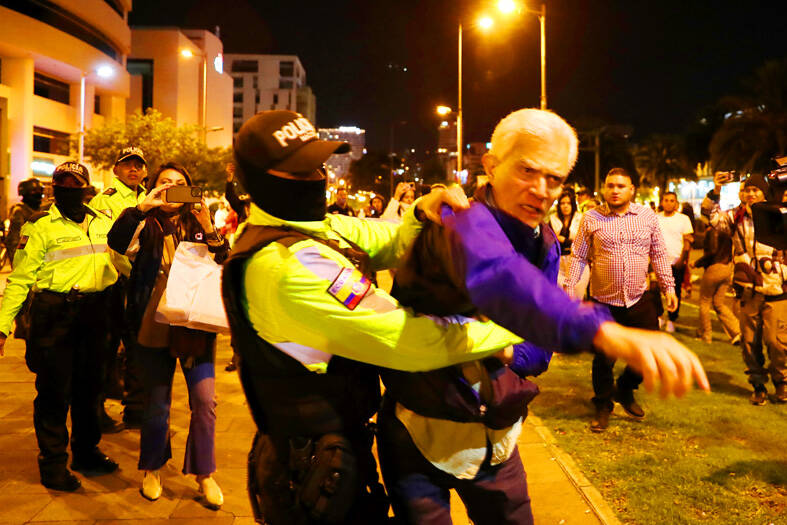
Photo: EPA-EFE
“This is a flagrant violation of international law and the sovereignty of Mexico,” he wrote on X.
Mexican Secretary of Foreign Affairs Alicia Barcena later wrote on X that “given the flagrant violation of the Vienna Convention on Diplomatic Relations and the injuries suffered by Mexican diplomatic personnel in Ecuador, Mexico announces the immediate breaking of diplomatic relations with Ecuador.”
She added that Mexican diplomatic personnel would immediately leave the South American country and asked Quito to “offer the necessary guarantees” for their movement.
Mexico had complained earlier in the day of “harassment” due to an increased police presence outside its embassy.
The former Ecuadoran vice president — who served under leftist president Rafael Correa — sought refuge in the Mexican embassy in December last year after authorities issued a warrant for his arrest for alleged corruption.
His asylum request was formally granted on Friday, angering Quito and deepening the diplomatic dispute between the two Latin American nations.
Ecuadoran President Daniel Noboa’s administration called the move an “illicit act.”
Mexico said it had granted political asylum to Glas “after a thorough analysis” of the situation.
Ecuador’s presidential communications office said in a statement that Glas “has been arrested tonight and placed under the orders of the competent authorities.”
Local media showed Roberto Canseco, head of the Mexican diplomatic mission, running behind vehicles believed to be transporting Glas from the site, shouting: “It’s an outrage.”
Agents prevented Canseco from approaching one of the vehicles and in the ensuing struggle he is seen falling to the ground.
Earlier on Friday, Ecuador said that according to international conventions, “it is not legal to grant asylum to people convicted or prosecuted for common crimes and by competent ordinary courts.”
Lopez Obrador had irked Quito a day before Mexico granted the asylum request with comments equating political violence in the two countries.
On Wednesday, he drew a comparison between election violence in Ecuador last year, when a presidential candidate was murdered, and crime in Mexico ahead of the June 2 legislative and presidential elections.
Violence and “manipulation” by some media caused a drop in the popularity of leftist candidate Luisa Gonzalez and the rise of Noboa, Lopez Obrador said.
The Ecuadoran government criticized his comments as offensive and said the country was still in “mourning” for the slain presidential candidate, Fernando Villavicencio, a fierce opponent of corruption.
Glas was released from prison in November last year after serving time for corruption in a vast scandal involving the Brazilian construction giant Odebrecht.
He faces another arrest warrant for allegedly diverting funds that were intended for reconstruction efforts after a devastating earthquake in 2015.

Kehinde Sanni spends his days smoothing out dents and repainting scratched bumpers in a modest autobody shop in Lagos. He has never left Nigeria, yet he speaks glowingly of Burkina Faso military leader Ibrahim Traore. “Nigeria needs someone like Ibrahim Traore of Burkina Faso. He is doing well for his country,” Sanni said. His admiration is shaped by a steady stream of viral videos, memes and social media posts — many misleading or outright false — portraying Traore as a fearless reformer who defied Western powers and reclaimed his country’s dignity. The Burkinabe strongman swept into power following a coup in September 2022

TRUMP EFFECT: The win capped one of the most dramatic turnarounds in Canadian political history after the Conservatives had led the Liberals by more than 20 points Canadian Prime Minister Mark Carney yesterday pledged to win US President Donald Trump’s trade war after winning Canada’s election and leading his Liberal Party to another term in power. Following a campaign dominated by Trump’s tariffs and annexation threats, Carney promised to chart “a new path forward” in a world “fundamentally changed” by a US that is newly hostile to free trade. “We are over the shock of the American betrayal, but we should never forget the lessons,” said Carney, who led the central banks of Canada and the UK before entering politics earlier this year. “We will win this trade war and

‘FRAGMENTING’: British politics have for a long time been dominated by the Labor Party and the Tories, but polls suggest that Reform now poses a significant challenge Hard-right upstarts Reform UK snatched a parliamentary seat from British Prime Minister Keir Starmer’s Labor Party yesterday in local elections that dealt a blow to the UK’s two establishment parties. Reform, led by anti-immigrant firebrand Nigel Farage, won the by-election in Runcorn and Helsby in northwest England by just six votes, as it picked up gains in other localities, including one mayoralty. The group’s strong showing continues momentum it built up at last year’s general election and appears to confirm a trend that the UK is entering an era of multi-party politics. “For the movement, for the party it’s a very, very big

The Philippines yesterday slammed an “irresponsible” Chinese state media report claiming a disputed reef in the South China Sea was under Beijing’s control, saying the “status quo” was unchanged. Tiexian Reef (鐵線礁), also known as Sandy Cay Reef, lies near Thitu Island, or Pagasa, where the Philippines stations troops and maintains a coast guard monitoring base. Chinese state broadcaster CCTV on Saturday said that the China Coast Guard had “implemented maritime control” over Tiexian Reef in the middle of this month. The Philippines and China have been engaged in months of confrontations over the South China Sea, which Beijing claims nearly in its


 RSS
RSS