


Harvard University said it has removed human skin from the binding of a 19th-century book about the afterlife that has been in its collections since the 1930s. The decision came after a review found ethical concerns with the book’s origin and history.
The book, Des Destinees de L’ame, meaning “Destinies of the Soul,” was written by Arsene Houssaye, a French novelist and poet, in the early 1880s.
The printed text was given to a physician, Ludovic Bouland, who ”bound the book with skin he took without consent from the body of a deceased female patient in a hospital where he worked,” Harvard said in a recent statement.
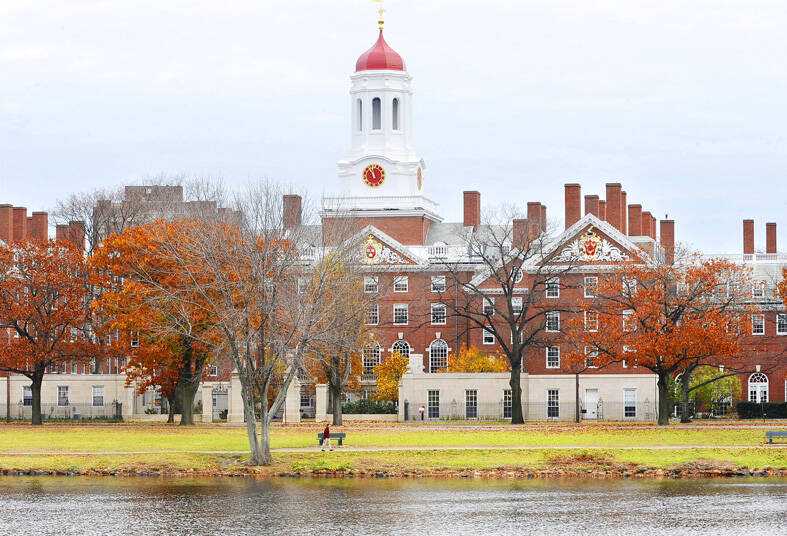
Photo: AP
The book has been kept at the university’s Houghton Library.
Bouland included a handwritten note inside the book.
It said “a book about the human soul deserved to have a human covering,” university associate librarian Thomas Hyry on Wednesday said in a published question-and-answer segment online.
The note also detailed the process behind preparing the skin for binding.
Scientific analysis done in 2014 confirmed that the binding was made of human skin, the university said.
In its statement, Harvard said the library noted several ways in which its stewardship practices failed to meet its ethical standards.
“Until relatively recently, the library has made the book available to anyone who asked for it, regardless of their reason for wishing to consult it,” Harvard said. “Library lore suggests that decades ago, students employed to page collections in Houghton’s stacks were hazed by being asked to retrieve the book without being told it included human remains.”
When the testing confirmed the book was bound by human skin, “the library published posts on the Houghton blog that utilized a sensationalistic, morbid and humorous tone that fueled similar international media coverage,” the university said.
The removed skin is now in “secure storage at Harvard Library,” Houghton Library associate librarian Anne-Marie Eze said in the question-and-answer session.
The library said it would be conducting additional research into the book, Bouland and the anonymous female patient, and is also working with French authorities to determine a “final respectful disposition.”
Harvard said the skin removal was prompted by a library review following a Harvard University report on human remains in its museum collections, released in 2022.
“Harvard Library and the Harvard Museum Collections Returns Committee concluded that the human remains used in the book’s binding no longer belong in the Harvard Library collections, due to the ethically fraught nature of the book’s origins and subsequent history,” Harvard’s statement said.

‘CROSSING THE LINE’: China’s embassy in Seoul criticized US Forces Korea Commander General Xavier Brunson, asking if his ‘hostile’ remarks were authorized by Washington South Korea and the US are in talks over recent public remarks by the commander of US Forces Korea, Seoul’s presidential office said yesterday, after the comments drew sharp criticism from China. In a recent podcast interview, US Forces Korea Commander General Xavier Brunson described South Korea as “the dagger in the heart of Asia” from China’s east coast, prompting the Chinese embassy in Seoul to say that he had “truly crossed the line.” The interview came amid growing speculation that Washington might seek to expand the role of US Forces Korea in countering the growing regional influence of China, a key

SEEKING ORDER: Rodrigo Paz said that ‘anyone who wants to destroy the nation will have to deal with this president and the full force of the constitution’ Bolivian President Rodrigo Paz on Wednesday said that the nation was at a “breaking point” after nearly a month of protests that have caused shortages of food, fuel and medicine. Paz, who took office six months ago amid the worst economic crisis there in four decades, is battling a groundswell of fury over his policies. The political capital, La Paz, has been besieged by low-income workers and members of the indigenous majority calling for his resignation. “The country needs order and is reaching breaking point,” the 58-year-old said at a public event in La Paz, renewing his appeal for dialogue. On Tuesday, the Bolivian
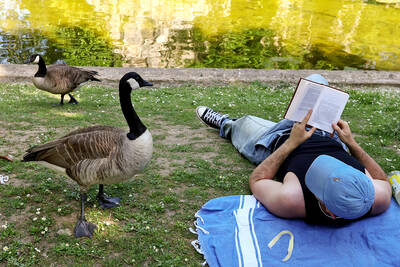
Forecasters in Europe yesterday warned of exceptional heat as record temperatures driven by a “heat dome” push temperatures well above seasonal norms across the continent. The surge follows a record-breaking Monday, with France logging its hottest day in the month of May on record, its weather agency said, and the UK also posting unprecedented highs. A so-called “heat dome” of warm air from northern Africa trapped under a high-pressure system over western Europe is behind the high temperatures not usually seen until high summer. Restrictions on outdoor work were imposed in parts of Italy, beaches in southwest France filled earlier than usual and

Australian researchers have trained lab-grown brain cells on a silicon computer chip to play the 1990s shooter game Doom and said they are just scratching the surface of what the neurons could be capable of doing. It is the science-fiction work of biotech boffins at Cortical Labs, who researched and developed the technology that harnesses the workings of the brain’s networking system. Each so-called “biological computer” contains about 200,000 living human brain cells, grown from stem cells that were harvested from blood donations. Having mastered the simple computer game Pong, where a paddle is moved up and down to send a ball


 RSS
RSS