


Yemen’s Houthi rebels claim to have a new, hypersonic missile in their arsenal, Russia’s state media reported on Thursday, potentially raising the stakes in their attacks on shipping in the Red Sea and surrounding waterways against the backdrop of Israel’s war with Hamas in the Gaza Strip.
The report by the state-run RIA Novosti news agency cited an unidentified official, but provided no evidence for the claim. It comes as Moscow maintains an aggressively counter-Western foreign policy amid its grinding war on Ukraine.
However, the Houthis have for weeks hinted about “surprises” they plan for the battles at sea to counter the US and its allies, which have so far been able to down any missile or bomb-carrying drone that comes near their warships in Middle East waters.
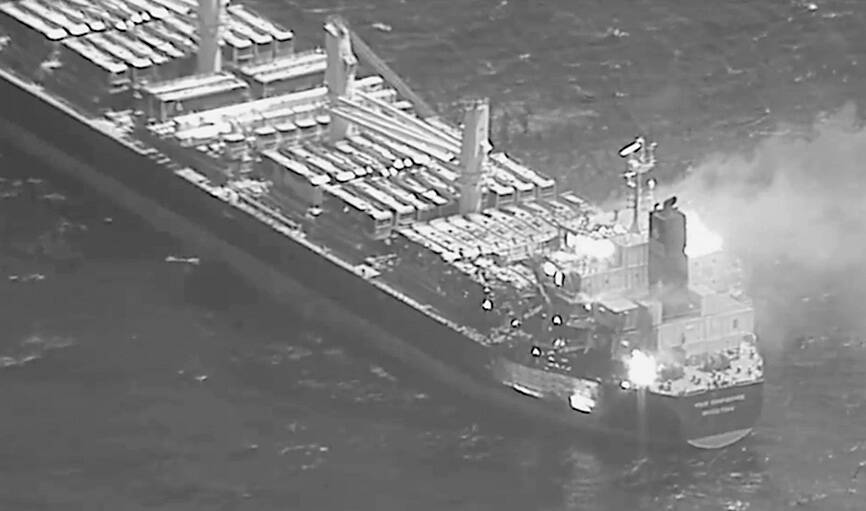
Photo: AP
On Thursday, Abdul Malik al-Houthi, the Houthis’ secretive supreme leader, said the rebels would start hitting ships heading toward the Cape of Good Hope in Africa’s southern tip. Until now, the rebels have largely struck ships heading into the Red Sea toward the Suez Canal, and such an escalation would target the longer, alternative route used by some vessels. It remains unclear how they would carry any possible assault out.
Meanwhile, Iran and the US reportedly held indirect talks in Oman, the first in months amid their long-simmering tensions over Tehran’s rapidly advancing nuclear program and attacks by its proxies.
Iran, the Houthis’ main benefactor, claims to have a hypersonic missile and has widely armed the rebels with the missiles they now use.
“The group’s missile forces have successfully tested a missile that is capable of reaching speeds of up to Mach 8 and runs on solid fuel,” a military official close to the Houthis said, according to the RIA report.
The Houthis “intend to begin manufacturing it for use during attacks in the Red Sea and the Gulf of Aden, as well as against targets in Israel,” the official said.
Mach 8 is eight times the speed of sound. Hypersonic weapons, which fly at speeds higher than Mach 5, could pose crucial challenges to missile defense systems because of their speed and maneuverability.
Ballistic missiles fly on a trajectory in which anti-missile systems like the US-made Patriot can anticipate their path and intercept them. The more irregular the missile’s flight path, such as a hypersonic missile with the ability to change directions, the more difficult it becomes to intercept.
China is believed to be pursuing the weapons, as is the US. Russia claims it has already used them.
In Yemen, al-Houthi boasted that his fighters “continue to expand the effectiveness and scope of our operations to areas and locations the enemy never expects.”
He said they would prevent ships “connected to the Israeli enemy even crossing the Indian Ocean ... heading toward the Cape of Good Hope.”
The Houthis have attacked ships since November, saying they want to force Israel to end its offensive in Gaza, launched in response to Hamas’ Oct. 7 attack on southern Israel. However, the ships targeted by the Houthis have increasingly had little or no connection to Israel, the US or other nations involved in the war. The rebels have also fired missiles toward Israel, though they have largely fallen short or been intercepted.
The UK Navy yesterday said that a commercial ship was hit by a missile in the southern Red Sea in another suspected attack by Houthi militants.
The vessel said it “sustained some damage,” UK Maritime Trade Operations (UKMTO), a part of the navy that provides maritime security information, said on X. “The crew are reported safe and the vessel is proceeding to its next port of call.”
The assault happened at about 4am yesterday and 76 nautical miles (141km) off the Houthi-
controlled port of Hodeidah.
UKMTO did not name the vessel or give more information about it.
It was the second incident in the span of hours. Earlier, UKMTO said another ship reported two rockets flying over it.
Additional reporting by Bloomberg

ROCKY RELATIONS: The figures on residents come as Chinese tourist numbers drop following Beijing’s warnings to avoid traveling to Japan The number of Chinese residents in Japan has continued to rise, even as ties between the two countries have become increasingly fractious, data released on Friday showed. As of the end of December last year, the number of Chinese residents had increased by 6.5 percent from the previous year to 930,428. Chinese people accounted for 22.6 percent of all foreign residents in Japan, making them by far the largest group, Japanese Ministry of Justice data showed. Beijing has criticized Tokyo in increasingly strident terms since Japanese Prime Minister Sanae Takaichi last year suggested that a military conflict around Taiwan could

A pro-Iran hacking group claimed to breach FBI Director Kash Patel’s personal e-mail inbox and posted some of the contents online. The e-mails provided by the hacking group include travel details, correspondence with leasing agents in Washington and global entry, and loyalty account numbers. The e-mail address the hackers claim to have compromised has been previously tied to Patel’s personal details, and the leaked e-mails contain photos of Patel and others, in addition to correspondence with family members and colleagues. “The FBI is aware of malicious actors targeting Director Patel’s personal email information,” the agency said in a statement on

RIVALRY: ‘We know that these are merely symbolic investigations initiated by China, which is in fact the world’s most profligate disrupter of supply chains,’ a US official said China has started a pair of investigations into US trade practices, retaliating against similar probes by US President Donald Trump’s administration as the superpowers stake out positions before an expected presidential summit in May. The move, announced by the Chinese Ministry of Commerce on Friday, is a direct mirror of steps Trump took to revive his tariff agenda after the US Supreme Court last month struck down some of his duties. “China expresses its strong dissatisfaction and firm opposition to these actions,” a ministry spokesperson said in a statement, referring to the so-called Section 301 investigations initiated on March 11.

When a hiker fell from a 55m waterfall in wild New Zealand bush, rescuers were forced to evacuate the badly hurt woman without her dog, which could not be found. After strangers raised thousands of dollars for a search, border collie Molly was flown to safety by a helicopter pilot who was determined to reunite the pet and the owner. A week earlier, an emergency rescue helicopter found the woman with bruises and lacerations after a fall at a rocky spot at the waterfall on the South Island’s West Coast. She was airlifted on March 24, but they were forced to


 RSS
RSS