


Iran has provided Russia with a large number of powerful surface-to-surface ballistic missiles, six sources told Reuters, deepening the military cooperation between the two US-sanctioned countries.
Iran’s provision of about 400 missiles includes many from the Fateh-110 family of short-range ballistic weapons, such as the Zolfaghar, three Iranian sources said.
The road-mobile missile is capable of striking targets 300km to 700km away, experts say.
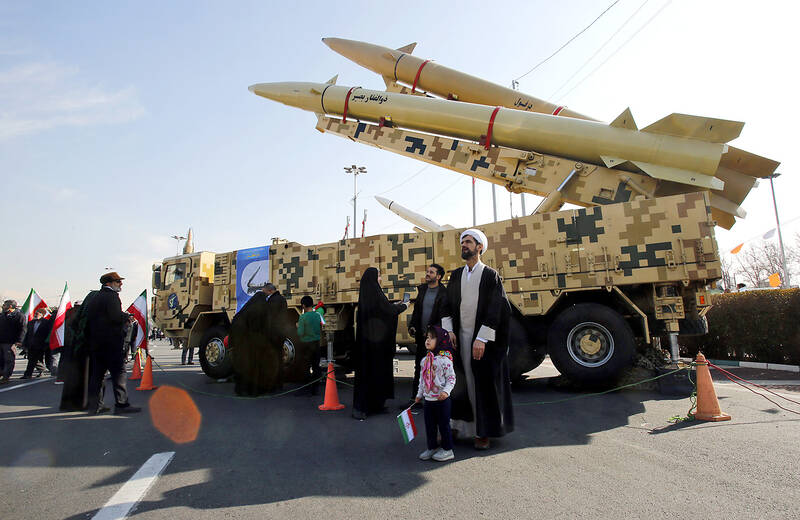
Photo: EPA
The Iranian Ministry of Defense and the Revolutionary Guards — an elite force that oversees Iran’s ballistic missile program — declined to comment.
Russia’s Ministry of Defense did not immediately respond to a request for comment.
The shipments began early last month after a deal was finalized in meetings late last year between Iranian and Russian military and security officials that took place in Tehran and Moscow, one of the Iranian sources said.
An Iranian military official — who, like the other sources, asked not to be identified because of the sensitivity of the information — said there had been at least four shipments of missiles and there would be more in the coming weeks. He declined to provide further details.
Another senior Iranian official said some of the missiles were sent to Russia by ship via the Caspian Sea, while others were transported by plane.
“There will be more shipments,” the second Iranian official said. “There is no reason to hide it. We are allowed to export weapons to any country that we wish to.”
UN Security Council restrictions on Iran’s export of some missiles, drones and other technologies expired in October last year.
However, the US and the EU retained sanctions on Iran’s ballistic missile program amid concerns over exports of weapons to its proxies in the Middle East and to Russia.
A fourth source who is familiar with the matter confirmed that Russia had received a large number of missiles from Iran recently, but did not provide further details.
US National Security Council spokesman John Kirby said early last month that Washington was concerned that Moscow was close to acquiring short-range ballistic weapons from Iran, in addition to missiles already sourced from North Korea.
A US official told Reuters that Washington had seen evidence of talks actively advancing, but no indication yet of deliveries having taken place.
The Pentagon did not immediately respond to a request for comment on the missile deliveries.
Ukraine’s top prosecutor on Friday last week said the ballistic missiles supplied by North Korea to Russia had proven unreliable on the battlefield, with only two of 24 hitting their targets.
Moscow and Pyongyang have both denied that North Korea has provided Russia with munitions used in Ukraine.
By contrast, Jeffrey Lewis, an expert with the Middlebury Institute of International Studies at Monterey, said the Fateh-110 family of missiles and the Zolfaghar were precision weapons.
“They are used to point at things that are high value and need precise damage,” Lewis said, adding that 400 munitions could inflict considerable harm if used in Ukraine.
He added that Russian bombardments were already “pretty brutal.”
A Ukrainian military source said that Kyiv had not registered any use of Iranian ballistic missiles by Russian forces in the conflict. The Ukrainian Ministry of Defense did not immediately reply to Reuters’ request for comment.
Following the publication of this story, a spokesperson for Ukraine’s air force told national television that it had no official information on Russia obtaining such missiles.
He added that ballistic missiles would pose a serious threat to Ukraine.
Former Ukrainian minister of defense Andriy Zagorodnyuk said that Russia wanted to supplement its missile arsenal at a time when delays in approving a major package of US military aid in Congress has left Ukraine short of ammunition and other material.
“The lack of US support means shortages of ground-based air defense in Ukraine, so they want to accumulate a mass of rockets and break through Ukrainian air defense,” said Zagorodnyuk, who chairs the Kyiv-based Center for Defence Strategies, a security think tank, and advises the government.
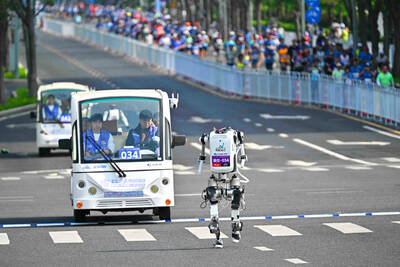
A humanoid robot that won a half-marathon race for robots in Beijing on Sunday ran faster than the human world record in a show of China’s technological leaps. The winner from Honor, a Chinese smartphone maker, completed the 21km race in 50 minutes and 26 seconds, said a WeChat post by the Beijing Economic-Technological Development Area, also known as Beijing E-Town, where the race began. That was faster than the human world record holder, Ugandan Jacob Kiplimo, who finished the same distance in about 57 minutes in March at the Lisbon road race. The performance by the robot marked a significant step forward

Four contenders are squaring up to succeed Antonio Guterres as secretary-general of the UN, which faces unprecedented global instability, wars and its own crushing budget crisis. Chile’s Michelle Bachelet, Argentina’s Rafael Grossi, Costa Rica’s Rebeca Grynspan and Senegal’s Macky Sall are each to face grillings by 193 member states and non-governmental organizations for three hours today and tomorrow. It is only the second time the UN has held a public question-and-answer, a format created in 2016 to boost transparency. Ultimately the five permanent members of the UN’s top body, the Security Council, hold the power, wielding vetoes over who leads the
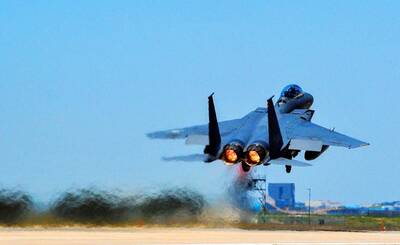
South Korea’s air force yesterday apologized for a 2021 midair collision involving two fighter jets, a day after auditors said the pilots were taking selfies and filming during the flight and held them responsible for the accident. “We sincerely apologize to the public for the concern caused by the accident that occurred in 2021,” an air force spokesman told a news conference, adding that one of the pilots involved had been suspended from flying duties, received severe disciplinary action and has since left the military. The apology followed a report released on Wednesday by the South Korean Board of Audit and Inspection,
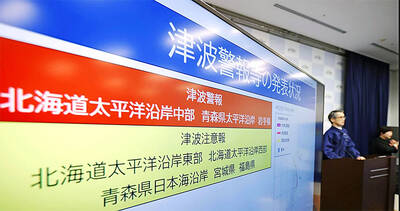
An earthquake registering a preliminary magnitude of 7.7 off northern Japan on Monday prompted a short-lived tsunami alert and the advisory of a higher risk of a possible mega-quake for coastal areas there. The Cabinet Office and the Japan Meteorological Agency said there was a 1% chance for a mega-quake, compared to a 0.1% chance during normal times, in the next week or so following the powerful quake near the Chishima and Japan trenches. Officials said the advisory was not a quake prediction but urged residents in 182 towns along the northeastern coasts to raise their preparedness while continuing their daily lives. Prime


 RSS
RSS