


As pro-EU parties prepare to take power in Poland, a new star has shot to fame: a parliament speaker whose wit has drawn thousands of new followers to the chamber’s social media channels.
Polish Marshal of the Sejm Szymon Holownia is no stranger to a wide audience as a former TV personality who notably hosted the Polish edition of the Got Talent! franchise.
The 47-year-old left show business for politics four years ago, and now enjoys the spotlight chairing plenary proceedings following his success in the Oct. 15 parliamentary elections.
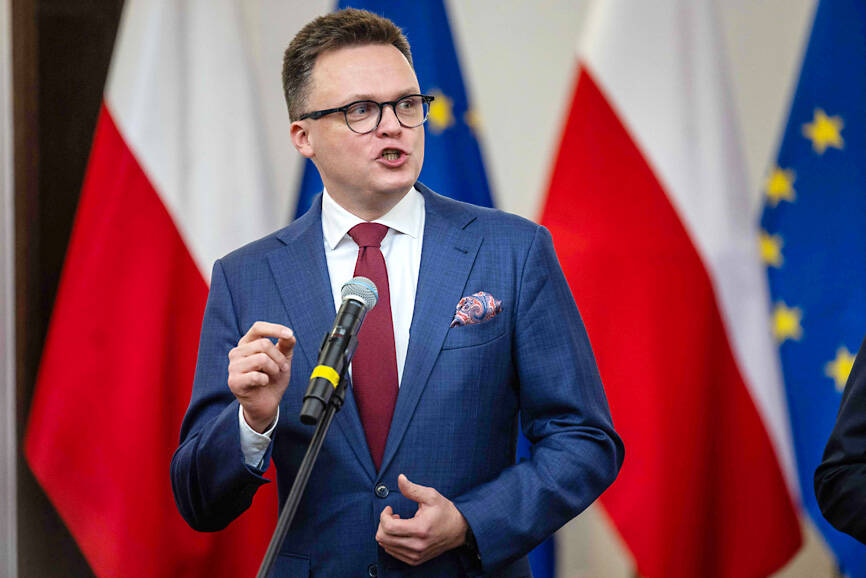
Photo: AFP
“Ladies and gentlemen, stock up on popcorn ... because I suspect there will be a lot of action,” Holownia said of the upcoming sitting during one of his now almost daily news conferences.
His quips and comebacks in the plenary have been going viral — including an instance when he corrected a conservative lawmaker for mistakenly calling a colleague a “Jay-Z” instead of a member of Generation Z.
On another occasion, as lawmakers heckled him, Holownia retorted saying they were becoming “a tad monothematic.”
“I encourage you to be more original, to do more intellectual work. Insulting takes skill, too,” he said, drawing applause from the pro-EU lawmakers.
In the matter of weeks that Holownia has spent as speaker, the parliament’s YouTube channel streaming the debates saw its followers surge almost tenfold, from 45,000 to 435,000 subscribers.
The sudden rise in popularity of the parliamentary proceedings prompted an unorthodox move by a Warsaw cinema to organize a screening of today’s confidence vote for the conservative minority government.
“We’ve never done this before,” Kinoteka spokeswoman Karolina Fornal said, adding that the cinema had already run out of free tickets for the screenings.
“We allotted two rooms for the viewings, that means over 500 seats ... and we’ve received around 1,500 requests,” Fornal said, adding that the cinema would add parliamentary-themed snacks to its offer that day.
Holownia has been quick to capitalize on his own fame too: He has launched a behind-the-scenes podcast on the ins and outs of parliamentary life — with the first episode hitting nearly 1 million downloads.
For experts, Holownia’s fame as a celebrity-turned-politician follows a familiar pattern.
“It’s a bit like [Ukrainian President Volodymyr] Zelenskiy and how he made a name for himself. Holownia also stood out because he had the experience, he knew how media work,” said Adam Szynol, a media analyst from the University of Wroclaw. “He knows that he has to speak briefly, that he needs a punchline or a joke from time to time.”
Yet Holownia’s flashy style has also drawn criticism — notably from current conservative Polish Prime Minister Mateusz Morawiecki.
“Instead of real work we have the popcorn, a show and circuses. Is this what politics is about?” Morawiecki wrote on social media.
Szynol said that there was a risk that young people are watching parliament sittings “just for fun, to see who landed a heavier blow or came up with a meme.”
However, he said an increased interest among a generation that often switches off from politics should not be dismissed.
“The young people who went out and voted, currently want to see how their voice is acted upon — and that will be the key part,” Szynol said.

Through the noise of rushing papers and whirring belts at a print factory in Kyoto, two creators watch their photo essay come to life in broadsheet form — part of an effort to win new audiences in the age of artificial intelligence (AI). Despite the decline of the publishing industry, self-publication and handmade “zine” magazines are growing in popularity in Japan, reflecting the nation’s enduring love of paper in the digital era. While speaking to Agence France-Presse at the plant, his hands black with ink, one of the creators, Kazuma Obara, said: “I think [paper] is a medium that engages all five

‘ABSURD MISTAKE’: The election commission said that there had been a failure to anticipate turnout after 14 polling stations ran short of ballot papers South Korean riot police yesterday cleared protesters from a Seoul polling station after a 35-hour blockade sparked by a shortage of ballot papers during local elections earlier this week. Wednesday’s election was the first nationwide vote since South Korean President Lee Jae-myung took office following the ouster of Yoon Suk-yeol over his short-lived martial law declaration. Lee’s ruling Democratic Party swept most races, but failed to flip the crucial Seoul mayoral seat. The South Korean National Election Commission apologized, blaming a failure to anticipate turnout after 14 polling stations in Seoul ran short of ballot papers. Some polling stations stayed open until 10pm to

Australian researchers have trained lab-grown brain cells on a silicon computer chip to play the 1990s shooter game Doom and said they are just scratching the surface of what the neurons could be capable of doing. It is the science-fiction work of biotech boffins at Cortical Labs, who researched and developed the technology that harnesses the workings of the brain’s networking system. Each so-called “biological computer” contains about 200,000 living human brain cells, grown from stem cells that were harvested from blood donations. Having mastered the simple computer game Pong, where a paddle is moved up and down to send a ball

France experienced its hottest spring on record, the French weather service said on Tuesday, after an exceptional early heat wave that also broke highs for the season in England and Wales. Meteo-France said the average nationwide temperature over March to May was 13.8°C — about 1.7°C above the norm, and surpassing records set in 2011 and 2020. “The warmest spring since records began in 1900,” it said in a bulletin. All three months were warmer than average, but the onset of an “unprecedented heatwave” late last month pushed the mercury to highs typically seen at the height of the summer. “Our country had never


 RSS
RSS