


A surprise offensive by armed groups in Myanmar that has blocked two strategically vital roads to the country’s biggest trading partner, China, is choking cross-border commerce and denying the cash-strapped junta taxes and foreign exchange.
Fighting has raged across northern Shan state for two weeks, displacing almost 50,000 people, the US has said, and posing the most serious military challenge to the generals since they seized power in 2021.
The blockage to key transport arteries is already leading to higher prices in markets and hampering the junta’s ability to send reinforcements to tackle the offensive.
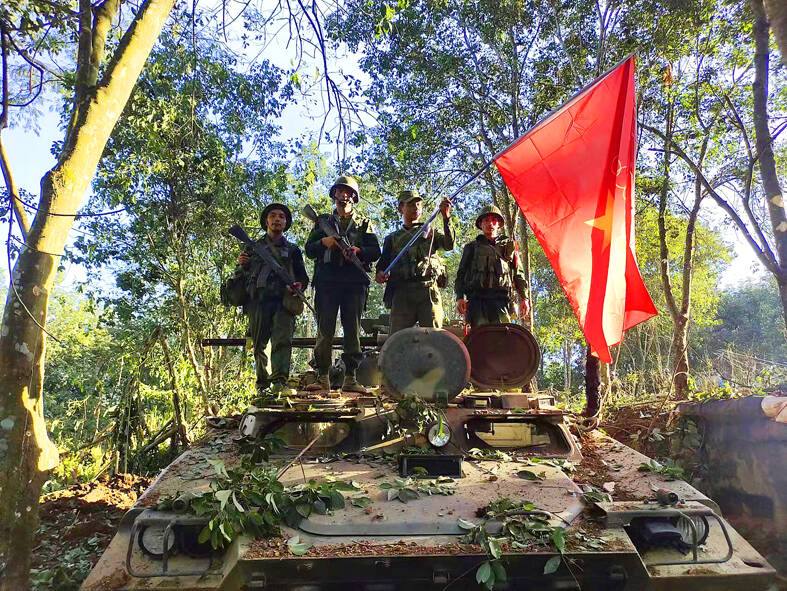
Photo: The Kokang online media via AP
“We haven’t seen any [goods] trucks since the fighting started” on Oct. 27, a resident of Muse town on the border with China said.
“There is no trade crossing,” and artillery and gunfire were heard regularly from the town, they said, requesting anonymity for safety reasons.
Hundreds of trucks a day normally pass through, taking fruit and vegetables into China or bringing back electronic equipment, medicine and consumer goods.
In the town of Lashio, about 160km away by road, residents said they were feeling the effects of the fighting.
“One bag of rice was 160,000 kyat [US$76] before fighting,” one resident said, also requesting anonymity for safety reasons.
“The current price is 190,000 kyat... if there is going to be long fighting, we will have a hard time to survive,” they said.
Goods traffic from Muse has all but halted since fighters from the Arakan Army, Myanmar National Democratic Alliance Army (MNDAA) and Ta’ang National Liberation Army launched their offensive on Oct. 27.
Chinshwehaw, another hub on the border with China’s Yunnan Province, is also closed for business.
Last week, the MNDAA posted footage of its fighters raising their flag at the border gate. The junta later said that it had lost control of the town.
A longer border closure would “negatively impact Myanmar balance of trade, current account and availability of foreign exchange,” said Richard Horsey, senior adviser for Myanmar at the International Crisis Group.
Of more immediate strategic importance is the military’s loss of control of the roads along which it sends troops, analysts say.
“Deploying troops into northern Shan has become increasingly difficult, and the military is now relying on helicopters to send reinforcements into the border area,” said Jason Tower, country director for the Burma program at the United States Institute of Peace.
The military would find it “difficult” to take back border infrastructure lost in the previous two weeks, he said.
“While it could launch air strikes to take back positions, it would risk infuriating China by destroying critical infrastructure,” he said.
Meanwhile, a close ally of Myanmar’s top general has been imprisoned for five years on corruption charges, state media said yesterday.
Former Burmese deputy prime minister and minister for home affairs Soe Htut was removed from the ruling State Administration Council, as the junta calls itself, in a September reshuffle.
“He was indicted under relevant sections of laws and the Court Martial adjudicated his cases and sentenced him to five years imprisonment,” state media outlet The Global New Light of Myanmar reported yesterday.
Soe Htut ordered subordinates to issue passports to companies operating in the country by “inappropriately applying his rank and authority,” the newspaper said.
It added that he “took bribes and failed to supervise the undertakings not aligned with the financial rules and regulations for the staff welfare fund of the Ministry of Home Affairs.”

‘GROSS NEGLIGENCE?’ Despite a spleen typically being significantly smaller than a liver, the surgeon said he believed Bryan’s spleen was ‘double the size of what is normal’ A Florida surgeon who is facing criminal charges after allegedly removing a patient’s liver instead of his spleen has said he is “forever traumatized” by that person’s death. In a deposition from November last year that was recently obtained by NBC, 44-year-old Thomas Shaknovsky described the death of 70-year-old William Bryan as an “incredibly unfortunate event that I regret deeply.” Bryan died after the botched surgery; and last month, a grand jury in Tallahassee indicted Shaknovsky on a charge of manslaughter. “I’m forever traumatized by it and hurt by it,” Shaknovsky added, also saying that wrong-site surgeries can happen “during

Kouri Richins, a Utah mother who published a children’s book about grief after the death of her husband is to serve a life sentence for his murder without the possibility of parole, a judge ruled on Wednesday. Richins was convicted in March of aggravated murder for lacing a cocktail given to her husband, Eric Richins, with five times the lethal dose of fentanyl at their home near Park City in 2022. A jury also found her guilty of four other felonies, including insurance fraud, forgery and attempted murder for trying to poison her husband weeks earlier on Feb. 14, 2022, with a

‘PERSONAL MISTAKES’: Eileen Wang has agreed to plead guilty to the felony, which comes with a maximum sentence of 10 years in federal prison A southern California mayor has agreed to plead guilty to acting as an illegal agent for the Chinese government and has resigned from her city position, officials said on Monday. Eileen Wang (王愛琳), mayor of Arcadia, was charged last month with one count of acting in the US as an illegal agent of a foreign government. She was accused of doing the bidding of Chinese officials, such as sharing articles favorable to Beijing, without prior notification to the US government as required by law. The 58-year-old was elected in November 2022 to a five-person city council, from which the mayor is selected

DELA ROSA CASE: The whereabouts of the senator, who is wanted by the ICC, was unclear, while President Marcos faces a political test over the senate situation Philippine authorities yesterday were seeking confirmation of reports that a top politician wanted by the International Criminal Court (ICC) had fled, a day after gunfire rang out at the Philippine Senate where he had taken refuge fearing his arrest. Senator Ronald “Bato” dela Rosa, the former national police chief and top enforcer of former Philippine president Rodrigo Duterte’s “war on drugs,” has been under Senate protection and is wanted for crimes against humanity, the same charges Duterte is accused of. “Several sources confirmed that the senator, Senator Bato, is no longer in the Senate premises, but we are still getting confirmation,” Presidential


 RSS
RSS