


A YouTuber with 2.4 million subscribers yesterday apologized after a video of him and three others free-riding around Japan became the latest example of fame-seeking foreigners riling locals.
The YouTuber known by the username Fidias posted a video over the weekend of the four riding trains and buses around Japan — in some cases without paying.
In the video, Fidias hides in a toilet of a bullet train, pretends to be ill when confronted by a ticket collector, and then escapes to board another train where he pulls the same trick.
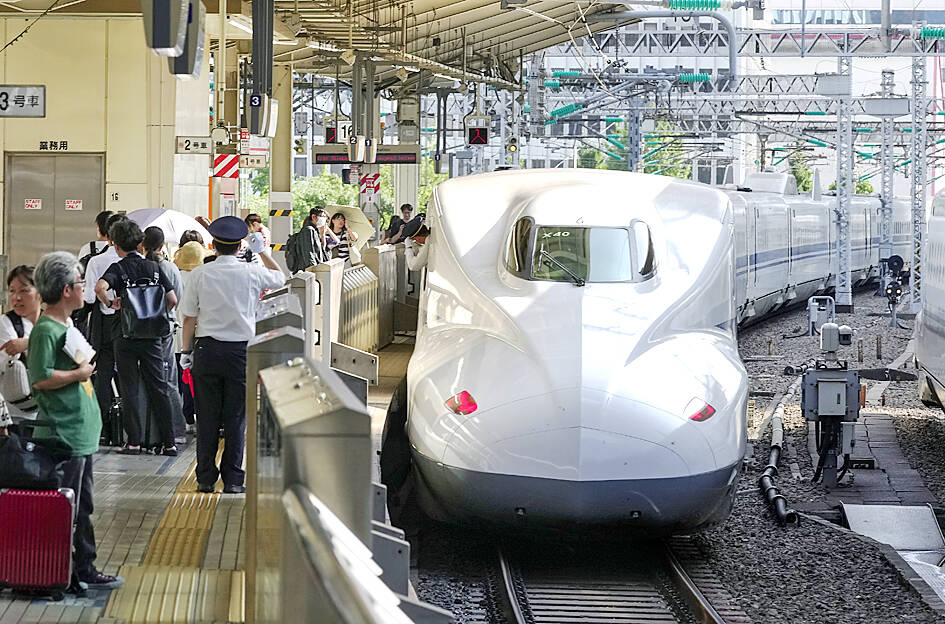
Photo: EPA-EFE
Another clip shows him entering a hotel and pretending to be a guest to get free breakfast.
“I just [got] access to a five-star Japanese buffet. And we’re leaving the hotel without getting caught and without any problem,” he triumphantly tells the camera.
Other parts of the video show the four, one of whom appears to be the YouTuber Night Scape who has 1.7 million followers, begging money from locals to pay for tickets.
It was unclear when the footage was shot or whether the three men and one woman were still in Japan.
“Another strange, annoying YouTuber from abroad emerged. In addition to this guy Fidias, the three others should be arrested,” one social media user said in Japanese.
“Surprisingly, comments section to his [online post] is full of applause. [Police] should arrest him to prevent copycat crimes from happening,” another social media user said.
Regional train operator JR Kyushu said it was studying the footage before deciding whether to inform the police.
“We are aware of the case and investigating facts around it,” a spokesman said.
Fidias posted an apology on his channel, saying: “Hello beautiful people i apologize to the Japanese people if we made them feel bad that was not our goal! from now on i am going to be make more research to the cultures we go to and try to prevent this from happening again.”
The incident came a month after Japanese police arrested a US livestreamer known as Johnny Somali for allegedly trespassing into a construction site.
According to video footage, Ismael Ramsey Khalid, 23, wore a mask and repeatedly shouted “Fukushima” to construction workers who urged him to leave the site, police officer Genta Hayashi said, referring to the stricken nuclear power plant.
Another clip shows Khalid, who describes himself as a former child soldier, harassing train passengers with references to the US atomic bombings of Japan in 1945.
Khalid has only 12,500 followers on YouTube and 10,800 on another platform known as Kick, where his account is marked “offline.”
His Twitch account was reportedly taken down.
In 2017, US YouTuber Logan Paul attracted controversy with a video he posted of a dead body in a Japanese “suicide forest” that drew 6 million views before being taken down.
Incidents of foreigners behaving badly, including by drinking in public and littering, are a regular cause of annoyance in largely law-abiding Japan, not least on Mount Fuji.
ROCKY RELATIONS: The figures on residents come as Chinese tourist numbers drop following Beijing’s warnings to avoid traveling to Japan The number of Chinese residents in Japan has continued to rise, even as ties between the two countries have become increasingly fractious, data released on Friday showed. As of the end of December last year, the number of Chinese residents had increased by 6.5 percent from the previous year to 930,428. Chinese people accounted for 22.6 percent of all foreign residents in Japan, making them by far the largest group, Japanese Ministry of Justice data showed. Beijing has criticized Tokyo in increasingly strident terms since Japanese Prime Minister Sanae Takaichi last year suggested that a military conflict around Taiwan could

A pro-Iran hacking group claimed to breach FBI Director Kash Patel’s personal e-mail inbox and posted some of the contents online. The e-mails provided by the hacking group include travel details, correspondence with leasing agents in Washington and global entry, and loyalty account numbers. The e-mail address the hackers claim to have compromised has been previously tied to Patel’s personal details, and the leaked e-mails contain photos of Patel and others, in addition to correspondence with family members and colleagues. “The FBI is aware of malicious actors targeting Director Patel’s personal email information,” the agency said in a statement on

RIVALRY: ‘We know that these are merely symbolic investigations initiated by China, which is in fact the world’s most profligate disrupter of supply chains,’ a US official said China has started a pair of investigations into US trade practices, retaliating against similar probes by US President Donald Trump’s administration as the superpowers stake out positions before an expected presidential summit in May. The move, announced by the Chinese Ministry of Commerce on Friday, is a direct mirror of steps Trump took to revive his tariff agenda after the US Supreme Court last month struck down some of his duties. “China expresses its strong dissatisfaction and firm opposition to these actions,” a ministry spokesperson said in a statement, referring to the so-called Section 301 investigations initiated on March 11.

When a hiker fell from a 55m waterfall in wild New Zealand bush, rescuers were forced to evacuate the badly hurt woman without her dog, which could not be found. After strangers raised thousands of dollars for a search, border collie Molly was flown to safety by a helicopter pilot who was determined to reunite the pet and the owner. A week earlier, an emergency rescue helicopter found the woman with bruises and lacerations after a fall at a rocky spot at the waterfall on the South Island’s West Coast. She was airlifted on March 24, but they were forced to


 RSS
RSS