


Japanese Prime Minister Fumio Kishida shuffled his Cabinet and key party posts yesterday in an apparent move to strengthen his position before a key party leadership vote next year, while appointing more women to showcase his effort for women’s advancement in his conservative party.
It is the second Cabinet shuffle since Kishida took office in October 2021 when he promised fairer distribution of economic growth, measures to tackle Japan’s declining population and a stronger national defense. Russia’s war in Ukraine, rising energy prices and Japan’s soaring defense costs have created challenges in his tenure, keeping his support ratings at low levels.
Kishida’s three-year term as Liberal Democratic Party (LDP) president expires in September next year, when he would seek a second term. His faction is only the fourth largest in the LDP, so he must stay on good terms with the others to maintain his position.
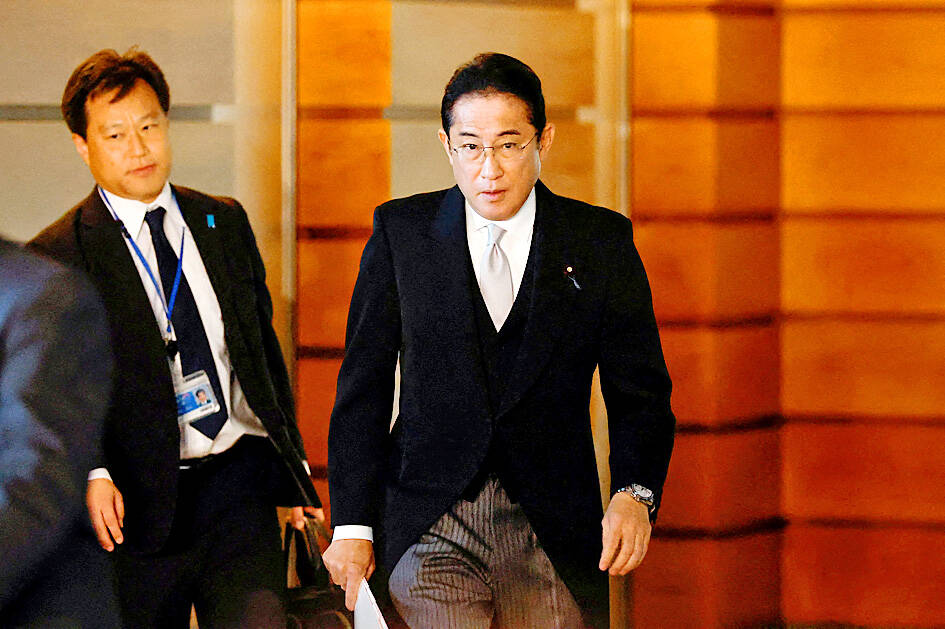
Photo: Reuters
He distributed Cabinet posts to reflect the balance of power, and nearly half of the positions are shared between the two largest factions associated with former prime ministers Shinzo Abe and Taro Aso.
Kishida appointed five women to the 19-member Cabinet, part of his attempt to buoy sagging support ratings for his previous male-dominated Cabinet, which had only two women. The five females match the number in two earlier Japanese Cabinets — in 2014 and 2001. Women still hold only one-quarter of the total posts in the new Cabinet.
One of the five, Yoko Kamikawa, a former justice minister, takes the post of foreign minister to replace Yoshimasa Hayashi. Both Kamikawa and Hayashi are from Kishida’s own faction.
The LDP supports traditional family values and gender roles, and the omission of female politicians is often criticized by women’s rights groups as democracy without women.
Minister of Economy, Trade and Industry Yasutoshi Nishimura, Minister of Finance Shunichi Suzuki, Minister for Digital Transformation Taro Kono as well as Minister of Economic Security Sanae Takaichi, were among the six who stayed.
Kishida’s Cabinet had resigned en masse in a ceremonial meeting yesterday before retained Chief Cabinet Secretary Hirokazu Matsuno announced the new lineup.
Kishida also kept his main intraparty rival Toshimitsu Motegi at the No. 2 post in the party and retained faction heavyweights like Aso in other key party posts.
Kishida is expected to compile a new economic package to deal with rising gasoline and food prices, which would be necessary to have wage increase continue and support low-income households in order to regain public support.
Two figures who lost posts in the shakeup had been touched by recent scandals.
Former agriculture, forestry and fisheries minister Tetsuro Nomura was reprimanded by Kishida and apologized after calling the treated radioactive wastewater being released from the Fukushima Dai-ichi nuclear power plant “contaminated,” a term China uses to characterize the water as unsafe.
Magazine reports have contained allegations that former deputy chief cabinet secretary Seiji Kihara influenced a police investigation of his wife over her ex-husband’s suspicious death.
Kishida last shuffled his Cabinet a year ago after Abe’s assassination revealed ties between senior ruling party members and the Unification Church, a South Korea-based ultra-conservative sect.


Through the noise of rushing papers and whirring belts at a print factory in Kyoto, two creators watch their photo essay come to life in broadsheet form — part of an effort to win new audiences in the age of artificial intelligence (AI). Despite the decline of the publishing industry, self-publication and handmade “zine” magazines are growing in popularity in Japan, reflecting the nation’s enduring love of paper in the digital era. While speaking to Agence France-Presse at the plant, his hands black with ink, one of the creators, Kazuma Obara, said: “I think [paper] is a medium that engages all five
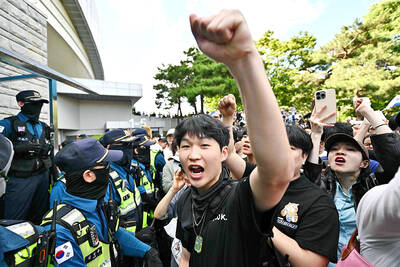
‘ABSURD MISTAKE’: The election commission said that there had been a failure to anticipate turnout after 14 polling stations ran short of ballot papers South Korean riot police yesterday cleared protesters from a Seoul polling station after a 35-hour blockade sparked by a shortage of ballot papers during local elections earlier this week. Wednesday’s election was the first nationwide vote since South Korean President Lee Jae-myung took office following the ouster of Yoon Suk-yeol over his short-lived martial law declaration. Lee’s ruling Democratic Party swept most races, but failed to flip the crucial Seoul mayoral seat. The South Korean National Election Commission apologized, blaming a failure to anticipate turnout after 14 polling stations in Seoul ran short of ballot papers. Some polling stations stayed open until 10pm to

France experienced its hottest spring on record, the French weather service said on Tuesday, after an exceptional early heat wave that also broke highs for the season in England and Wales. Meteo-France said the average nationwide temperature over March to May was 13.8°C — about 1.7°C above the norm, and surpassing records set in 2011 and 2020. “The warmest spring since records began in 1900,” it said in a bulletin. All three months were warmer than average, but the onset of an “unprecedented heatwave” late last month pushed the mercury to highs typically seen at the height of the summer. “Our country had never

A Sherpa guide was found crawling to base camp on Mount Everest a week after he went missing and was reunited with his family, who had given up hope he would return. Dawa Sherpa was last seen on Friday last week descending the mountain, but he did not reach base camp even though his client did. The pair were among the last climbers on the mountain as the climbing season came to an end and the route was dismantled. Dawa was located by a cleaning crew on Thursday morning as he was crawling down the snowy slopes around the Khumbu Icefall, just above


 RSS
RSS