


The crash of Russia’s Luna-25 spacecraft into the moon over the weekend is not just a setback for Russian President Vladimir Putin’s ambitions to overcome war-related sanctions. It is also an embarrassment for Chinese President Xi Jinping (習近平) — Putin’s partner in building a proposed base on the moon meant to challenge the US and its space allies.
The Russian spacecraft was aiming to be the first to land near the south pole, the intended location of a joint base that space agencies in China and Russia announced in 2021 they had agreed to build together.
Wu Yanhua (吳艷華), the chief designer of China’s major deep space exploration project, led a delegation to the Vostochny Cosmodrome in Russia’s far east to attend the launch and discuss deepening cooperation between the two countries’ space programs, Chinese media reported earlier this month.
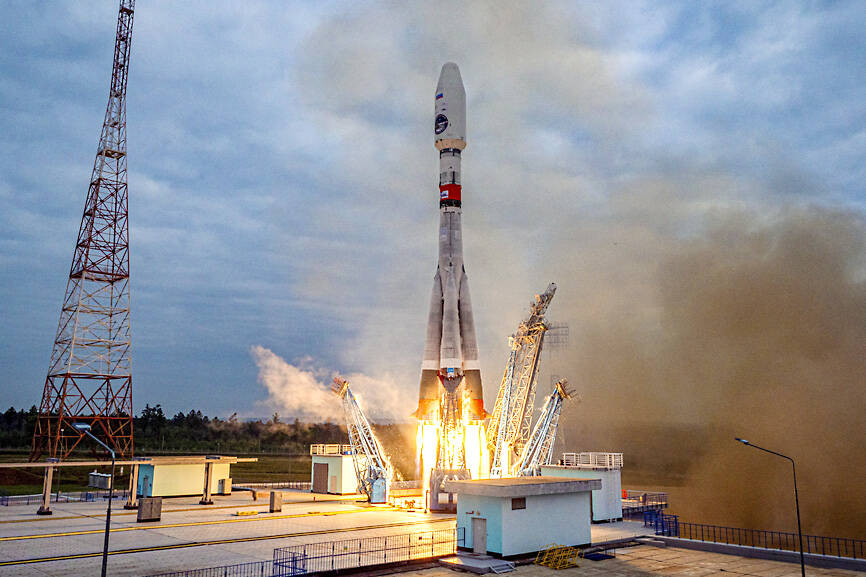
Photo: AP
Now that the mission has ended in failure, Chinese media reports on the crash have been far and few between, with Xinhua news agency only carrying a terse five-sentence missive on Sunday.
“This failure is expected to deal a blow to Russia’s ambitions,” Hu Xijin (胡錫進), the former editor of the Chinese Communist Party-controlled Global Times, wrote in an opinion piece for the newspaper, while adding that “the West should not underestimate Russia just because its lunar program has failed.”
Luna-25 was the first Russian spacecraft to attempt a moon landing since the end of the Soviet Union.
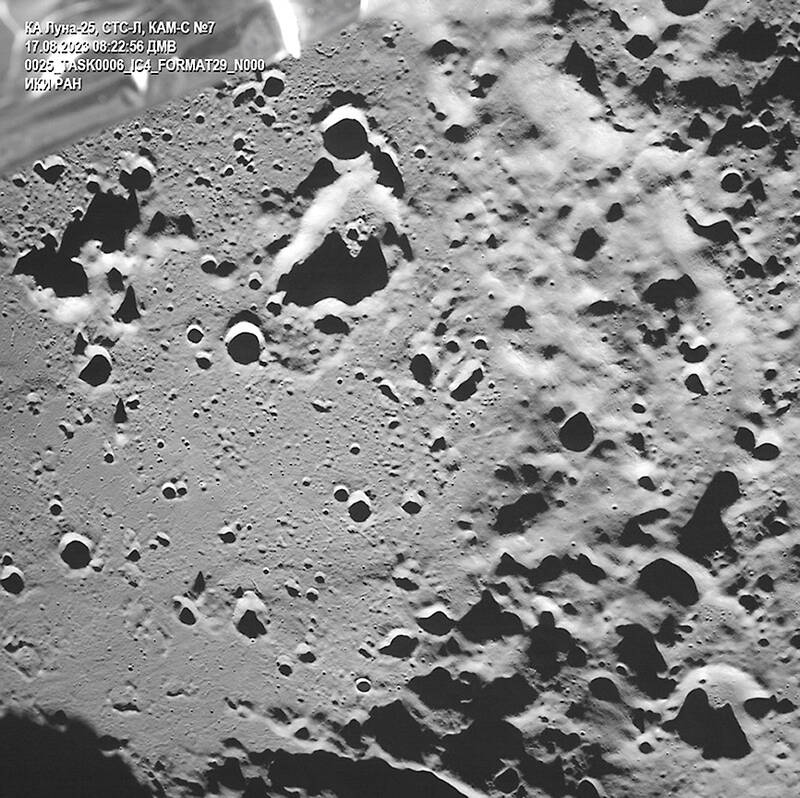
Photo: AP
“We will have to learn everything again,” space historian Alexander Zheleznyakov told privately owned Russian media group RBC. “We must learn how to confidently fly to the moon, land confidently on its surface, and only after that proceed with the implementation of grandiose plans alone, either with China or with other countries.”
Russia’s space program has stagnated because of corruption, mismanagement and sanctions, said Bruce McClintock, lead of the RAND Space Enterprise Initiative and a senior policy researcher at the RAND Corp.
“For Russia, this is really bad,” he said. “This was their long-awaited, near-last chance to regain any credibility when it comes to outer space exploration.”
Since the invasion of Ukraine in February last year, Chinese media have downplayed Russia’s role in the lunar base.
Unlike Russia, China succeeded with its own attempt to beat others to the moon when it became the first country to land a spacecraft on the far side of the astronomical body in 2019. More than four years later, that mission’s Yutu-2 lunar rover remains active.
Behind the scenes, China already recognizes that Russia is of limited value as a space partner, said Pavel Luzin, a senior fellow with the Jamestown Foundation and a researcher on space policy.
“China is not interested in cooperating with Russia, because Russia can provide nothing to China,” he said.
While the Russians had intended on synchronizing their lunar missions with the Chinese ones to utilize resources more efficiently as the two nations worked toward establishing their join base at the moon’s south pole, that is no longer an option, Luzin said.
“There was an opportunity for synchronization, but currently it’s just impossible,” Luzin said.
Russia’s crash provides an opening for China’s biggest Asian rival, India, which now has the chance to be the first to land at the lunar south pole. India’s Chandrayaan-3, launched last month, is to attempt a landing as early as tomorrow.
Success would be a stark sign of the change in fortunes of the Russian and Indian space programs, as it was not that long ago that New Delhi was depending on taking part in the Luna program as its best way to get to the moon, McClintock said.
However, China is not about to give up on all forms of cooperation in space with Russia, as Moscow could be of help in developing space-based missile early warning systems, said Mark Hilborne, a lecturer in the Defence Studies Department at King’s College London.
However, in the more public areas of space exploration, “China may at least outwardly emphasize its collaboration with Russia to a lesser extent, partially due to international opprobrium over Ukraine and its recent lunar failure,” he said.

‘CROSSING THE LINE’: China’s embassy in Seoul criticized US Forces Korea Commander General Xavier Brunson, asking if his ‘hostile’ remarks were authorized by Washington South Korea and the US are in talks over recent public remarks by the commander of US Forces Korea, Seoul’s presidential office said yesterday, after the comments drew sharp criticism from China. In a recent podcast interview, US Forces Korea Commander General Xavier Brunson described South Korea as “the dagger in the heart of Asia” from China’s east coast, prompting the Chinese embassy in Seoul to say that he had “truly crossed the line.” The interview came amid growing speculation that Washington might seek to expand the role of US Forces Korea in countering the growing regional influence of China, a key

Through the noise of rushing papers and whirring belts at a print factory in Kyoto, two creators watch their photo essay come to life in broadsheet form — part of an effort to win new audiences in the age of artificial intelligence (AI). Despite the decline of the publishing industry, self-publication and handmade “zine” magazines are growing in popularity in Japan, reflecting the nation’s enduring love of paper in the digital era. While speaking to Agence France-Presse at the plant, his hands black with ink, one of the creators, Kazuma Obara, said: “I think [paper] is a medium that engages all five

Australian researchers have trained lab-grown brain cells on a silicon computer chip to play the 1990s shooter game Doom and said they are just scratching the surface of what the neurons could be capable of doing. It is the science-fiction work of biotech boffins at Cortical Labs, who researched and developed the technology that harnesses the workings of the brain’s networking system. Each so-called “biological computer” contains about 200,000 living human brain cells, grown from stem cells that were harvested from blood donations. Having mastered the simple computer game Pong, where a paddle is moved up and down to send a ball

France experienced its hottest spring on record, the French weather service said on Tuesday, after an exceptional early heat wave that also broke highs for the season in England and Wales. Meteo-France said the average nationwide temperature over March to May was 13.8°C — about 1.7°C above the norm, and surpassing records set in 2011 and 2020. “The warmest spring since records began in 1900,” it said in a bulletin. All three months were warmer than average, but the onset of an “unprecedented heatwave” late last month pushed the mercury to highs typically seen at the height of the summer. “Our country had never


 RSS
RSS