


The operator of the wrecked Fukushima Dai-ichi nuclear power plant on Monday began tests of newly constructed facilities for discharging treated radioactive wastewater into the sea, a plan strongly opposed by local fishing communities and neighboring nations.
The tests at the nuclear power plant use fresh water instead of the treated water, operator Tokyo Electric Power Co Holdings (TEPCO) said.
Plant workers examined pumps and emergency shutdown equipment at the newly constructed seaside facility, which would dilute the treated water with large amounts of seawater. The diluted water then enters an undersea tunnel and is released into the ocean about 1km from the coast.
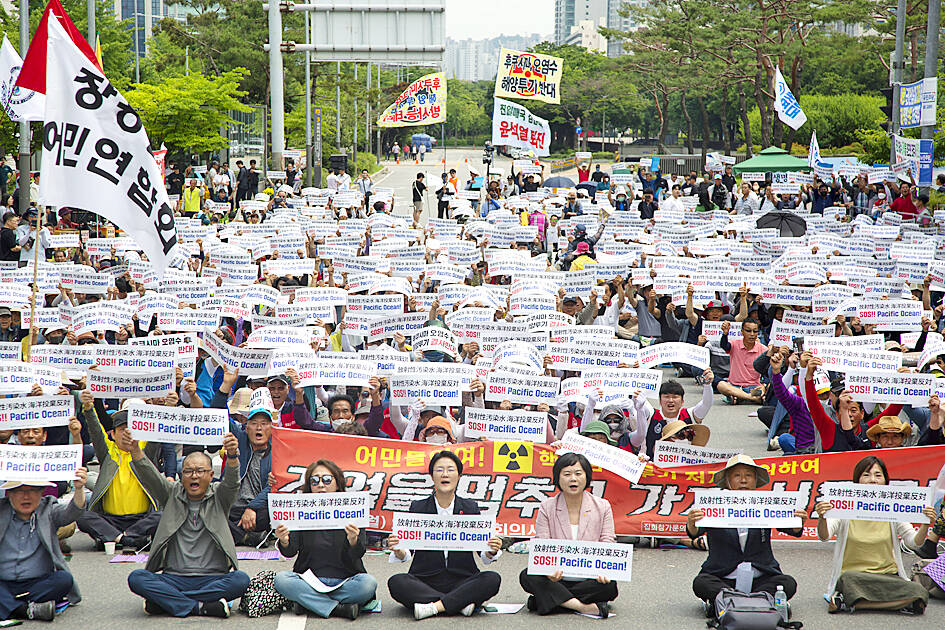
Photo: EPA-EFE
The undersea tunnel and other key facilities are near completion. TEPCO says the voluntary tests are expected to continue for about two weeks ahead of mandatory preoperation checks to be conducted by Japan’s Nuclear Regulation Authority, possibly early next month.
The Japanese government in April 2021 announced plans to gradually release the treated, but still slightly radioactive water following its dilution to what it says are safe levels.
Japanese officials say the water, stored in about 1,000 tanks at the plant, needs to be removed to prevent accidental leaks in case of an earthquake and to make room for the plant’s decommissioning.
The plan has faced fierce protests from local fishing communities concerned about safety and reputational damage. Nearby nations, including Taiwan, South Korea, China and Pacific Island nations, have also raised safety concerns.
The Japanese government has set up a fund to promote Fukushima seafood and provide compensation if sales fall due to safety concerns.
Fishing officials said they remain opposed to the plan when they met Japanese Minister of Economy, Trade and Industry Yasutoshi Nishimura on Saturday when he visited Fukushima, and the neighboring prefectures of Ibaraki and Miyagi.
“We stand by our opposition,” Tetsu Nozaki, head of the Fukushima Prefectural Fisheries Association, told Nishimura.
However, Nozaki said the association supports progress in the nuclear power plant’s decommissioning and hopes to continue the dialogue.
“At the moment, our positions remain wide apart,” he said.
Nishimura told reporters that he hopes to gain an understanding of fishing communities while working to prevent reputational damage.
In South Korea, fishers on Monday staged a rally in front of the National Assembly in Seoul against the plan to release treated radioactive water.
Japanese officials say that the diluted water would be released into the ocean over decades, making it harmless to people and marine life. Japan has sought support from the International Atomic Energy Agency to gain credibility and ensure safety measures meet international standards.
Some scientists say the impact of long-term, low-dose exposure to radionuclides is unknown and the release should be delayed.
A massive March 11, 2011, earthquake and tsunami destroyed the Fukushima Dai-ichi nuclear power plant’s cooling systems, causing three reactors to melt down and releasing large amounts of radiation. The tanks storing the water used since the accident to cool the reactor cores are to reach their capacity early next year.

When a hiker fell from a 55m waterfall in wild New Zealand bush, rescuers were forced to evacuate the badly hurt woman without her dog, which could not be found. After strangers raised thousands of dollars for a search, border collie Molly was flown to safety by a helicopter pilot who was determined to reunite the pet and the owner. A week earlier, an emergency rescue helicopter found the woman with bruises and lacerations after a fall at a rocky spot at the waterfall on the South Island’s West Coast. She was airlifted on March 24, but they were forced to

CONFIDENCE BOOSTER: ’After parkour ... you dare to do a lot of things that you think only young people can do,’ a 67-year-old parkour enthusiast said In a corner of suburban Singapore, Betty Boon vaults a guardrail, crawls underneath a slide, executes forward shoulder rolls and scales a steep slope, finishing the course to applause. “Good job,” the 69-year-old’s coach cheers. This is “geriatric parkour,” where about 20 retirees learned to tackle a series of relatively demanding exercises, building their agility and enjoying a sense of camaraderie. Boon, an upbeat grandmother, said learning parkour has aided her confidence and independence as she ages. “When you’re weak, you will be dependent on someone,” she said after sweating it out with her parkour classmates in suburban Toa Payoh,

Chinese dissident artist Gao Zhen (高兟), famous for making provocative satirical sculptures of former Chinese leader Mao Zedong (毛澤東), was tried on Monday over accusations of “defaming national heroes and martyrs,” his wife and a rights group said. Gao, 69, who was detained in 2024 during a visit from the US, faces a maximum three-year prison sentence, said his wife, Zhao Yaliang (趙雅良), and Shane Yi, a researcher at the Chinese Human Rights Defenders group which operates outside the nation. The closed-door, one-day trial took place at Sanhe City People’s Court in Hebei Province neighboring the capital, Beijing, and ended without a

‘TOXIC CLIMATE’: ‘I don’t really recognize Labour anymore... The idea that you can implement far-right ideas in order to stop the far right is nonsense,’ a protester said Tens of thousands of people on Saturday marched through central London to protest against the far right, weeks ahead of local elections and six months after Britain saw one of its largest far-right demonstrations. Organized by hundreds of civic groups, including trade unions, anti-racism campaigners and Muslim representative bodies, Saturday’s Together Alliance event was billed as the biggest in UK history to counter right-wing extremism. A separate pro-Palestinian march had also converged with the main rally. While organizers claimed 500,000 had turned out in total, the police gave a figure of about 50,000. Protesters carrying placards with slogans such as


 RSS
RSS