


The Australian House of Representatives yesterday voted overwhelmingly for a referendum to be held this year on creating an Indigenous Voice to Parliament, a federal advocacy body that would give the nation’s most disadvantaged ethnic minority more say on government policy.
While the Voice would advocate for indigenous interests, it would not have a vote on laws, and debate for and against the elected body has become increasingly heated and divisive.
The 121-to-25 House vote that approved the referendum being held does not reflect the level of lawmakers’ support for enshrining the Voice in the constitution. The opposition conservative Liberal Party voted in support of giving Australians a choice at a referendum, but is also campaigning for the Voice to be rejected by the public.
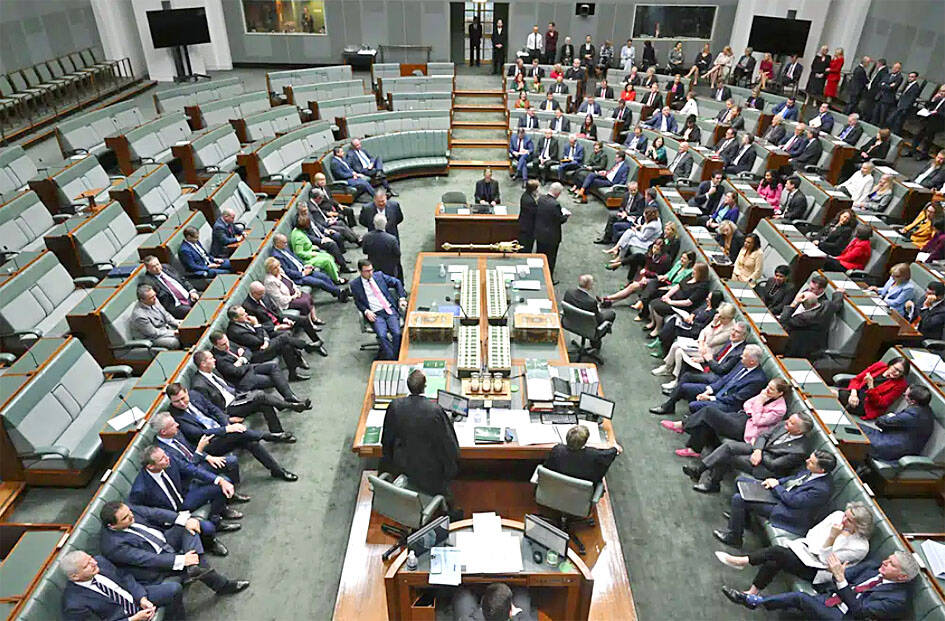
Photo: AP
The Australian Senate is this month scheduled to vote on the bill, which needs majority support to ensure that Australia’s first referendum since 1999 takes place between October and December this year. A majority of senators have already flagged their support.
The campaigning would begin in earnest with a successful Senate vote, said Minister for Indigenous Australians Linda Burney, the first indigenous woman to hold the role.
She said that she had “no doubt” the referendum would succeed.
“A yes vote at a referendum ... will move Australia forward for everyone. It will be a new chapter in our country’s story,” Burney told reporters.
“A yes vote will make a practical difference — I cannot stress that enough — the Voice will make a practical difference, because the solutions to so many of our challenges can be found in the knowledge and the wisdom of local [indigenous] communities,” she added.
Proponents hope the Voice will improve living standards for indigenous people, who account for 3.2 percent of Australia’s population and are the nation’s most disadvantaged ethnic group.
Australia’s Race Discrimination Commissioner Chin Tan (陳振良), a racism law watchdog, has said that focusing the public debate on race emboldens racists, and exposes the indigenous population to abuse and vilification.
The Liberal Party and the National Party, which formed a conservative coalition government for nine years until elections a years ago, say the Voice would create a racial divide.
Australian Prime Minister Anthony Albanese, who committed his center-left Australian Labor Party government on election night last year to holding the referendum, said “scare campaigns” would not find traction.
“Australians won’t succumb to their appeals to fear and their ever-more ludicrous invitations to jump at our own shadows,” Albanese said in a recent speech.
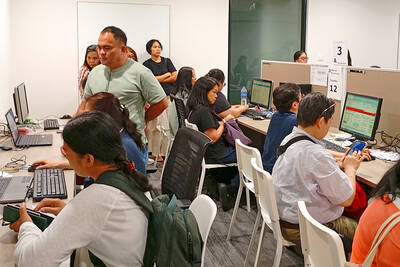
A new online voting system aimed at boosting turnout among the Philippines’ millions of overseas workers ahead of Monday’s mid-term elections has been marked by confusion and fears of disenfranchisement. Thousands of overseas Filipino workers have already cast their ballots in the race dominated by a bitter feud between President Ferdinand Marcos Jr and his impeached vice president, Sara Duterte. While official turnout figures are not yet publicly available, data from the Philippine Commission on Elections (COMELEC) showed that at least 134,000 of the 1.22 million registered overseas voters have signed up for the new online system, which opened on April 13. However,
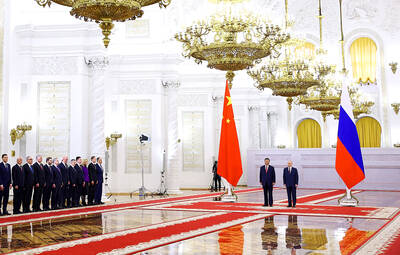
ALLIES: Calling Putin his ‘old friend,’ Xi said Beijing stood alongside Russia ‘in the face of the international counter-current of unilateralism and hegemonic bullying’ Chinese President Xi Jinping (習近平) yesterday was in Moscow for a state visit ahead of the Kremlin’s grand Victory Day celebrations, as Ukraine accused Russia’s army of launching air strikes just hours into a supposed truce. More than 20 foreign leaders were in Russia to attend a vast military parade today marking 80 years since the defeat of Nazi Germany in World War II, taking place three years into Russia’s offensive in Ukraine. Putin ordered troops into Ukraine in February 2022 and has marshaled the memory of Soviet victory against Nazi Germany to justify his campaign and rally society behind the offensive,
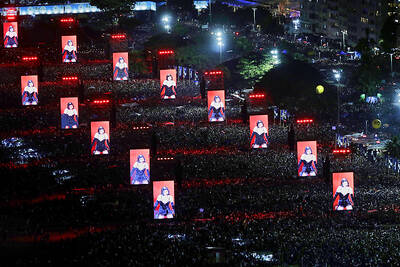
ENTERTAINMENT: Rio officials have a history of organizing massive concerts on Copacabana Beach, with Madonna’s show drawing about 1.6 million fans last year Lady Gaga on Saturday night gave a free concert in front of 2 million fans who poured onto Copacabana Beach in Rio de Janeiro for the biggest show of her career. “Tonight, we’re making history... Thank you for making history with me,” Lady Gaga told a screaming crowd. The Mother Monster, as she is known, started the show at about 10:10pm local time with her 2011 song Bloody Mary. Cries of joy rose from the tightly packed fans who sang and danced shoulder-to-shoulder on the vast stretch of sand. Concert organizers said 2.1 million people attended the show. Lady Gaga

CONFLICTING REPORTS: Beijing said it was ‘not familiar with the matter’ when asked if Chinese jets were used in the conflict, after Pakistan’s foreign minister said they were The Pakistan Army yesterday said it shot down 25 Indian drones, a day after the worst violence between the nuclear-armed rivals in two decades. Pakistani Prime Minister Shehbaz Sharif vowed to retaliate after India launched deadly missile strikes on Wednesday morning, escalating days of gunfire along their border. At least 45 deaths were reported from both sides following Wednesday’s violence, including children. Pakistan’s military said in a statement yesterday that it had “so far shot down 25 Israeli-made Harop drones” at multiple location across the country. “Last night, India showed another act of aggression by sending drones to multiple locations,” Pakistan military spokesman Ahmed


 RSS
RSS