


Scaffolding in a niche of the Vatican Museums’ Round Hall conceal from view the work of restorers who are removing centuries of grime from the largest known bronze statue of the ancient world: the gilded Hercules Mastai Righetti.
For more than 150 years, the 4m-tall figure of the half-human Roman divine hero has stood in that niche, barely garnering notice among other antiquities because of the dark coating it had acquired.
However, it was only after removing a layer of wax and other material from a 19th-century restoration that Vatican experts understood the statue’s true splendor as one of the most significant gilded statues of its time.
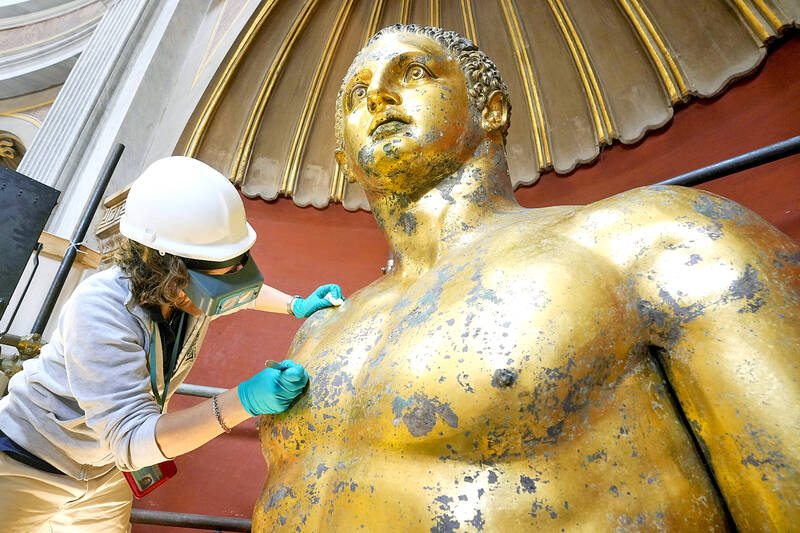
Photo: AP
Museumgoers would be able to see its grandeur for themselves once the restoration is finished, which is expected in December.
“The original gilding is exceptionally well-preserved, especially for the consistency and homogeneity,” Vatican Museum restorer Alice Baltera said.
The discovery of the colossal bronze statue in 1864 during work on a banker’s villa near Rome’s Campo dei Fiori square made global headlines.
Visitors drawn to the ancient wonder at the time included pope Pius IX, who later added the work to the papal collection. In recognition of its nonancient roots, the statue depicting Hercules after he finished his labors had the surnames of the pope — Mastai — and of the banker, Pietro Righetti, added to its title.
The statue has been variously dated from the end of the first to the beginning of the third centuries. Even in its day, the towering Hercules was treated with reverence.
The inscription “FCS” accompanying the statue on a slab of travertine marble indicates that it was struck by lightning, said Claudia Valeri, curator of the Vatican Museums’ department of Greek and Roman antiquities.
As a result, it was buried in a marble shrine according to Roman rites that saw lightning as an expression of divine forces, she said.
FCS stands for “fulgur conditum summanium,” a Latin phrase meaning “Here is buried a Summanian thunderbolt.” Summanus was the ancient Roman god of nocturnal thunder. The ancient Romans believed that not only was any object stricken imbued with divinity, but also the spot where it was hit and buried.
“It is said that sometimes being struck by lightning generates love, but also eternity,” Vatican Museums archeologist Giandomenico Spinola said.
The Hercules Mastai Righetti “got his eternity ... because having been struck by lightning, it was considered a sacred object, which preserved it until about 150 years ago,” he said.
The burial protected the gilding, but also caused dirt to build up on the statue, which Baltera said is very delicate and painstaking to remove.
“The only way is to work precisely with special magnifying glasses, removing all the small encrustations one by one,” Baltera said.
The work to remove the wax and other materials that were applied during the 19th century restoration is complete.
Restorers are planning to make fresh casts out of resin to replace the plaster patches that covered the statue’s missing pieces, including on part of the nape of the neck and the pubis.
The most astonishing finding to emerge during the preliminary phase of the restoration was the skill with which the smelters fused mercury to gold, making the gilded surface more enduring.
“The history of this work is told by its gilding... It is one of the most compact and solid gildings found to date,’’ said Ulderico Santamaria, a University of Tuscia professor who heads the Vatican Museums’ scientific research laboratory.

‘CROSSING THE LINE’: China’s embassy in Seoul criticized US Forces Korea Commander General Xavier Brunson, asking if his ‘hostile’ remarks were authorized by Washington South Korea and the US are in talks over recent public remarks by the commander of US Forces Korea, Seoul’s presidential office said yesterday, after the comments drew sharp criticism from China. In a recent podcast interview, US Forces Korea Commander General Xavier Brunson described South Korea as “the dagger in the heart of Asia” from China’s east coast, prompting the Chinese embassy in Seoul to say that he had “truly crossed the line.” The interview came amid growing speculation that Washington might seek to expand the role of US Forces Korea in countering the growing regional influence of China, a key

Through the noise of rushing papers and whirring belts at a print factory in Kyoto, two creators watch their photo essay come to life in broadsheet form — part of an effort to win new audiences in the age of artificial intelligence (AI). Despite the decline of the publishing industry, self-publication and handmade “zine” magazines are growing in popularity in Japan, reflecting the nation’s enduring love of paper in the digital era. While speaking to Agence France-Presse at the plant, his hands black with ink, one of the creators, Kazuma Obara, said: “I think [paper] is a medium that engages all five

Australian researchers have trained lab-grown brain cells on a silicon computer chip to play the 1990s shooter game Doom and said they are just scratching the surface of what the neurons could be capable of doing. It is the science-fiction work of biotech boffins at Cortical Labs, who researched and developed the technology that harnesses the workings of the brain’s networking system. Each so-called “biological computer” contains about 200,000 living human brain cells, grown from stem cells that were harvested from blood donations. Having mastered the simple computer game Pong, where a paddle is moved up and down to send a ball
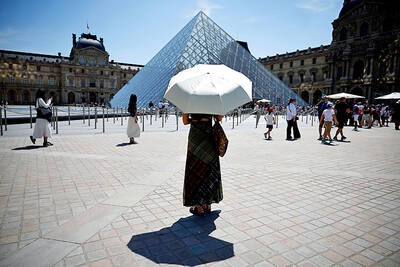
France experienced its hottest spring on record, the French weather service said on Tuesday, after an exceptional early heat wave that also broke highs for the season in England and Wales. Meteo-France said the average nationwide temperature over March to May was 13.8°C — about 1.7°C above the norm, and surpassing records set in 2011 and 2020. “The warmest spring since records began in 1900,” it said in a bulletin. All three months were warmer than average, but the onset of an “unprecedented heatwave” late last month pushed the mercury to highs typically seen at the height of the summer. “Our country had never


 RSS
RSS