


As a young girl, Iraqi Kurd Shylan Kamal would help her mother knead bread until one day she realized the work was a way to build up muscles — and she liked it.
Now 46 and herself a mother, Kamal sees her passion for bodybuilding as a matter of gender equality in Iraq’s autonomous Kurdistan region.
“Having muscles is good for women, too,” she said during a session at a gym in the provincial capital, Erbil, where she spends four hours training every day.
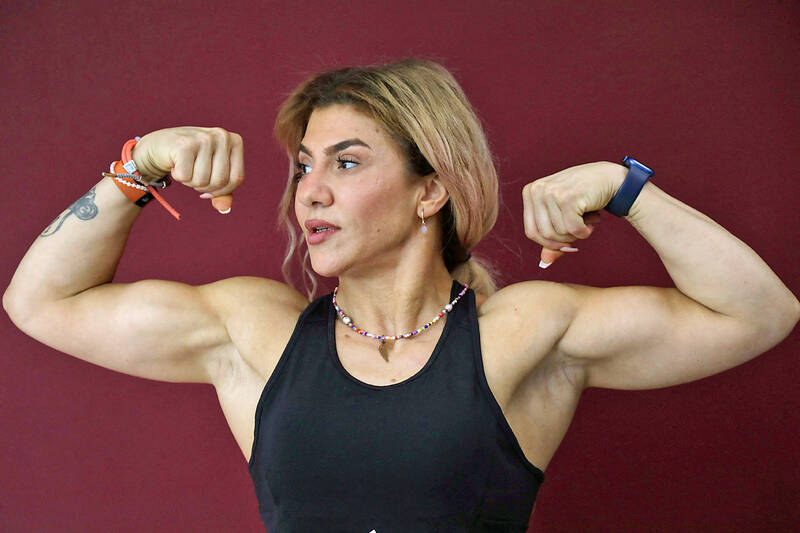
Photo: AFP
“We can express our beauty through bodybuilding,” Kamal said.
The nutritionist and former photographer returned to Kurdistan from Germany three years ago and found a conservative and patriarchal society where her passion for bodybuilding raised some eyebrows, but she refused to let opinions stop her.
“I don’t care at all what people say, I have my own opinions,” she said, adding that she dislikes the traditional beauty norms society imposes on women.
“I hate that people consider women as inferior beings or sex symbols, and that they’re expected to look after the children and make themselves beautiful for their husbands,” she said. “Why can’t women be both beautiful and strong at the same time?”
Kamal has trained since the age of 22. On Instagram she can be seen posing in a bikini and flexing her muscles at bodybuilding competitions across Europe, sometimes also waving the flag of Iraqi Kurdistan.
After a warm-up, she alternates between weight machines, lifting dumbbells and doing pushups, her hair cascading over powerful shoulders.
In recent months, she has competed in three events in Britain and Germany, each time placing third. The most recent was last month’s FIBO Global Fitness show in Cologne, Germany.
“People here are not used to seeing women in bathing suits showing off their muscles,” Kamal said, regretting the prejudice in her homeland — and also from people abroad who are surprised to learn she is Iraqi.
Originally from Sulaimaniyah, Iraqi Kurdistan’s second city, Kamal emigrated to Germany with her uncle when she was 14.
Two years later she married. Her three children are now aged in their 20s.
While living in Germany, she went to university and became a photographer, working at a studio in Duesseldorf.
Kamal said she has received only support from her family in her endeavors.
“Since I was a kid I’ve been full of energy, and I need an outlet for that energy,” she said. “When I was helping my mom knead the dough to make bread I could feel my muscles developing — and that made me happy.”
Acceptance of women’s sports is progressing slowly in Iraqi society. Recent years have seen a rise in the number of women playing soccer, boxing, kickboxing and weightlifting.
The relative stability in Kurdistan — largely spared the ravages of conflict afflicting other parts of Iraq since the 2003 US-led invasion — has allowed the region to develop sporting infrastructure.
Ranjbar Ali trains in the same gym as Kamal and said he is “happy” to see “women like Shylan breaking down barriers and preconceived ideas to reach world-class level.”
Ali, muscles bulging from his black singlet, offered his support to Kamal’s efforts to achieve gender equality in bodybuilding.
“Some people think it shameful for women to show off their bodies and their muscles, but why does that not also apply to men?” the 45-year-old said.
For Kamal, her advice to aspiring women bodybuilders, from Kurdistan and beyond, is simple — hit the gym and practice.
“It’s a physically demanding discipline that needs concentration and a healthy diet,” she said, adding that the routine would help physical and mental health.
“I’m convinced that going to the gym is more beneficial than going to the beauty salon,” she said.

An American scientist convicted of lying to US authorities about payments from China while he was at Harvard University has rebuilt his research lab in Shenzhen, China, to pursue technology the Chinese government has identified as a national priority: embedding electronics into the human brain. Charles Lieber, 67, is among the world’s leading researchers in brain-computer interfaces. The technology has shown promise in treating conditions such as amyotrophic lateral sclerosis and restoring movement in paralyzed people. It also has potential military applications: Scientists at the Chinese People’s Liberation Army have investigated brain interfaces as a way to engineer super soldiers by boosting

Indonesian police have arrested 13 people after shocking images of alleged abuse against small children at a daycare center went viral, sparking outrage across the nation, officials said on Monday. Police on Friday last week raided Little Aresha, a daycare center in Yogyakarta on Java island, following a report from a former employee. CCTV footage circulating on social media showed children, most younger than two, lying on the floor wearing only diapers, their hands and feet bound with rags. The police have confirmed that the footage is authentic. Police said they also found 20 children crammed into a room just 3m by 3m. “So

From post offices and parks to stations and even the summit of Mount Fuji, Japan’s vending machines are ubiquitous, but with the rapid pace of inflation cooling demand for their drinks, operators are being forced to rethink the business. Last month beverage giant DyDo Group Holdings announced it would remove about 20,000 vending machines — about 7 percent of their stock nationwide — by January next year, to “reconstruct a profitable network.” Pokka Sapporo Food & Beverage, based in Nagoya, also said last month it would sell its 40,000-machine operation to Osaka-based Lifedrink Co. “The strength of the vending machine

A highway bomb attack in a restive region of southwestern Colombia on Saturday killed 14 people and injured at least 38, the latest spate of violence ahead of next month’s presidential election. Authorities blamed the attack in the Cauca department — a conflict-ridden, coca-growing region — on dissidents of the now-disbanded FARC guerrilla army, who have been sowing violence across the country. “Those who carried out this attack ... are terrorists, fascists and drug traffickers,” Colombian President Gustavo Petro said on social media. “I want our very best soldiers to confront them,” he added. The leftist leader blamed the bombing


 RSS
RSS