


Seoul’s city government has effectively blocked South Korea’s largest annual LGBT festival from taking place outside city hall this year after granting a permit for a Christian youth concert instead, the LGBT event’s organizers said this week.
Clashes over the Seoul Queer Culture Festival have become a yearly symbol of the battle for LGBT rights in a country where same-sex marriage is not recognized and efforts to pass anti-discrimination laws face strong resistance from conservative religious groups and others.
As in several past years, the festival’s organizers jockeyed with religious groups in seeking permission to hold events in downtown Seoul on July 1. Since 2015, the event has been held in front of the city hall, except for 2020 and 2021, when COVID-19 pandemic rules prevented any gatherings.
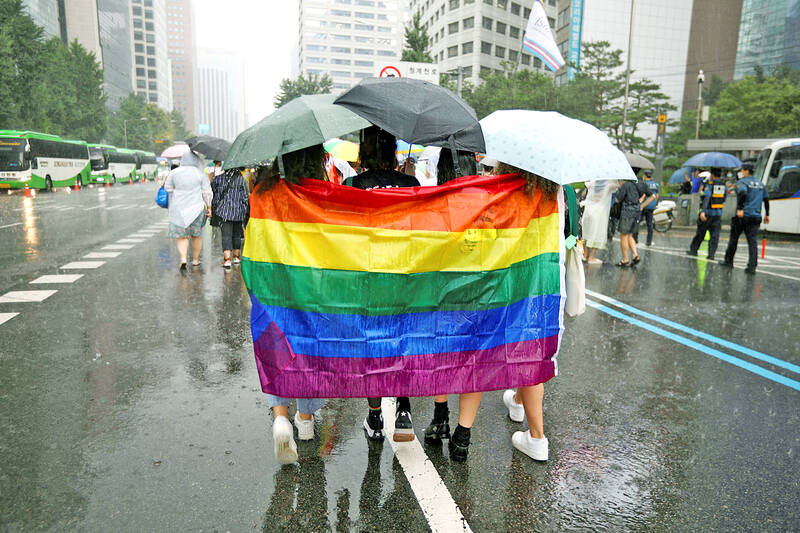
Photo: Reuters
Yang Sun-woo, chief organizer of the Seoul Queer Culture Festival, said the city’s move is an act of discrimination.
“Each year, we struggle to secure a venue to hold the event,” she said.
A concert for young people is scheduled to take place outside the city hall on that day instead.
That event is being hosted by the CTS Cultural Foundation, an organization linked to local Christian broadcaster CTS, which has vocally opposed homosexuality and the festival.
A representative for the CTS Cultural Foundation said that the timing was not aimed at blocking the LGBT festival.
The organizing bodies for both events had requested to use the space on the same day. The decision was made by a citizen council, which includes some members of the city council.
The LGBT festival has since 2015 drawn thousands of attendees to downtown Seoul each summer, supported by human rights groups, university clubs and foreign embassies. It routinely draws protests, and a police presence is often heavy.

‘CROSSING THE LINE’: China’s embassy in Seoul criticized US Forces Korea Commander General Xavier Brunson, asking if his ‘hostile’ remarks were authorized by Washington South Korea and the US are in talks over recent public remarks by the commander of US Forces Korea, Seoul’s presidential office said yesterday, after the comments drew sharp criticism from China. In a recent podcast interview, US Forces Korea Commander General Xavier Brunson described South Korea as “the dagger in the heart of Asia” from China’s east coast, prompting the Chinese embassy in Seoul to say that he had “truly crossed the line.” The interview came amid growing speculation that Washington might seek to expand the role of US Forces Korea in countering the growing regional influence of China, a key

SEEKING ORDER: Rodrigo Paz said that ‘anyone who wants to destroy the nation will have to deal with this president and the full force of the constitution’ Bolivian President Rodrigo Paz on Wednesday said that the nation was at a “breaking point” after nearly a month of protests that have caused shortages of food, fuel and medicine. Paz, who took office six months ago amid the worst economic crisis there in four decades, is battling a groundswell of fury over his policies. The political capital, La Paz, has been besieged by low-income workers and members of the indigenous majority calling for his resignation. “The country needs order and is reaching breaking point,” the 58-year-old said at a public event in La Paz, renewing his appeal for dialogue. On Tuesday, the Bolivian

Through the noise of rushing papers and whirring belts at a print factory in Kyoto, two creators watch their photo essay come to life in broadsheet form — part of an effort to win new audiences in the age of artificial intelligence (AI). Despite the decline of the publishing industry, self-publication and handmade “zine” magazines are growing in popularity in Japan, reflecting the nation’s enduring love of paper in the digital era. While speaking to Agence France-Presse at the plant, his hands black with ink, one of the creators, Kazuma Obara, said: “I think [paper] is a medium that engages all five

Australian researchers have trained lab-grown brain cells on a silicon computer chip to play the 1990s shooter game Doom and said they are just scratching the surface of what the neurons could be capable of doing. It is the science-fiction work of biotech boffins at Cortical Labs, who researched and developed the technology that harnesses the workings of the brain’s networking system. Each so-called “biological computer” contains about 200,000 living human brain cells, grown from stem cells that were harvested from blood donations. Having mastered the simple computer game Pong, where a paddle is moved up and down to send a ball


 RSS
RSS