


The remains of the founder of Spain’s fascist Falange party were moved yesterday from a grandiose basilica, where the body of former Spanish dictator Francisco Franco once lay, and transferred to an understated grave.
The operation came after the approval of a law designed to tackle the legacy of the 1936 to 1939 civil war and the decades of dictatorship that followed.
Jose Antonio Primo de Rivera founded the Falange party in 1933, which became one of the pillars of Francisco Franco’s brutal regime, along with the military and the Roman Catholic Church.
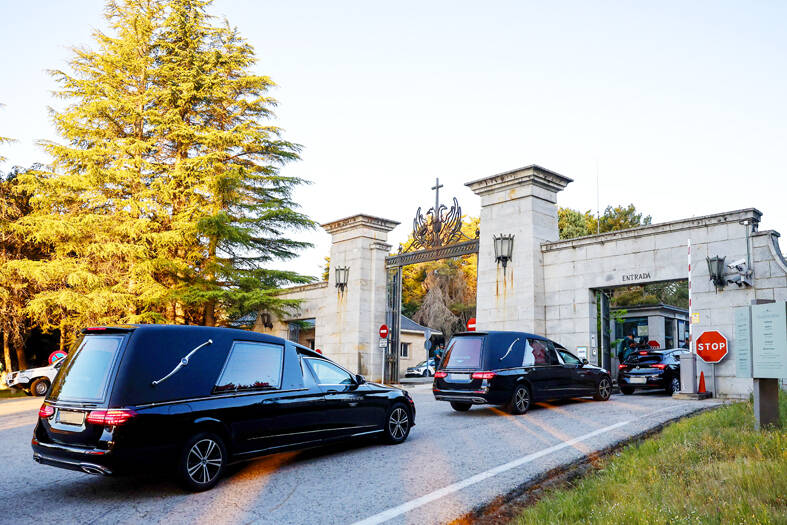
Photo: EPA-EFE
Executed in November 1936 at the start of the war for conspiring against the elected Republican government, Primo de Rivera was in 1959 buried inside the basilica in the Valley of the Fallen, 50km northwest of Madrid.
His remains were being relocated to Madrid’s San Isidro cemetery, Spanish media reported.
The basilica is part of a vast hillside mausoleum built after the civil war by Franco’s regime — in part by the forced labor of 20,000 political prisoners.
When the dictator died in 1975, he was also buried there, in a tomb by the altar, close to Primo de Rivera’s grave, with the site long being a draw for those nostalgic for the Franco era.
Cabinet minister Felix Bolanos said the operation “was another step” in the government’s efforts to strip the mausoleum of its status as a symbol of Francoism and far-right ideology.
“It should not be possible to pay tribute to any person evoking the dictatorship,” he said after the government announced the exhumation on Thursday last week.
Honoring those who died or suffered violence or repression during the civil war and dictatorship has been a top priority for the left-wing government of Spanish Prime Minister Pedro Sanchez, who came to power in 2018.
His government in 2019 relocated Franco’s remains from the basilica following a lengthy legal battle with the dictator’s family.
The basilica — topped by a 150m stone cross — and mausoleum also house the remains of more than 30,000 victims from both sides of the civil war.
It is a deeply divisive symbol of a past that Spain still finds difficult to digest.
The so-called law of democratic memory, which came into effect in October last year, aims to turn the Valley of the Fallen into a place of memory for the dark years of the dictatorship.
It also promotes the search for the regime’s victims who are buried in mass graves across Spain and annuls the criminal convictions of opponents of the Franco regime, but the law has been politically divisive, with right-wing parties saying it needlessly dredges up the past.
Santiago Abascal, leader of far-right Vox, accused the government of seeking to “once again desecrate tombs and dig up hatred” with Primo de Rivera’s exhumation.
The move came as Spain gears up for regional and local elections on May 28 and a year-end general election which polls suggest is likely to be tight.

‘CROSSING THE LINE’: China’s embassy in Seoul criticized US Forces Korea Commander General Xavier Brunson, asking if his ‘hostile’ remarks were authorized by Washington South Korea and the US are in talks over recent public remarks by the commander of US Forces Korea, Seoul’s presidential office said yesterday, after the comments drew sharp criticism from China. In a recent podcast interview, US Forces Korea Commander General Xavier Brunson described South Korea as “the dagger in the heart of Asia” from China’s east coast, prompting the Chinese embassy in Seoul to say that he had “truly crossed the line.” The interview came amid growing speculation that Washington might seek to expand the role of US Forces Korea in countering the growing regional influence of China, a key

SEEKING ORDER: Rodrigo Paz said that ‘anyone who wants to destroy the nation will have to deal with this president and the full force of the constitution’ Bolivian President Rodrigo Paz on Wednesday said that the nation was at a “breaking point” after nearly a month of protests that have caused shortages of food, fuel and medicine. Paz, who took office six months ago amid the worst economic crisis there in four decades, is battling a groundswell of fury over his policies. The political capital, La Paz, has been besieged by low-income workers and members of the indigenous majority calling for his resignation. “The country needs order and is reaching breaking point,” the 58-year-old said at a public event in La Paz, renewing his appeal for dialogue. On Tuesday, the Bolivian

Australian researchers have trained lab-grown brain cells on a silicon computer chip to play the 1990s shooter game Doom and said they are just scratching the surface of what the neurons could be capable of doing. It is the science-fiction work of biotech boffins at Cortical Labs, who researched and developed the technology that harnesses the workings of the brain’s networking system. Each so-called “biological computer” contains about 200,000 living human brain cells, grown from stem cells that were harvested from blood donations. Having mastered the simple computer game Pong, where a paddle is moved up and down to send a ball

Through the noise of rushing papers and whirring belts at a print factory in Kyoto, two creators watch their photo essay come to life in broadsheet form — part of an effort to win new audiences in the age of artificial intelligence (AI). Despite the decline of the publishing industry, self-publication and handmade “zine” magazines are growing in popularity in Japan, reflecting the nation’s enduring love of paper in the digital era. While speaking to Agence France-Presse at the plant, his hands black with ink, one of the creators, Kazuma Obara, said: “I think [paper] is a medium that engages all five


 RSS
RSS