


Washington’s top diplomat yesterday said that a US embassy convoy came under fire in Sudan and denounced “indiscriminate military operations” as the country’s armed forces and a powerful rival unleashed heavy weapons in urban areas for a fourth day.
The convoy of clearly marked embassy vehicles was attacked on Monday, and preliminary reports link the assailants to the Rapid Support Forces (RSF), the paramilitary group battling Sudan’s military, US Secretary of State Antony Blinken told reporters.
Everyone in the convoy was safe, Blinken said.

Photo: AFP
The convoy attack in Khartoum, along with earlier assaults on aid workers and the EU envoy’s residence in the Sudanese capital, signaled further descent into chaos since the battle by two rival generals for control of Africa’s third-largest country erupted over the weekend.
More than 185 people have been killed and more than 1,800 wounded, according to UN figures, which did not include a breakdown of civilians and combatants.
The Sudan Doctors’ Syndicate yesterday said that at least 144 civilians were killed and more than 1,400 wounded since Saturday.
The overall death toll could be much higher, because clashes in Khartoum have prevented the removal of bodies in some areas. The two sides have been using tanks, artillery and other heavy weapons in densely populated areas.
Late on Monday, fighter jets swooped overhead and anti-aircraft fire lit up the skies as darkness fell. Fighting resumed early yesterday around each side’s main bases and at strategic government buildings — all of which are in residential areas.
Satellite images from Maxar Technologies taken on Monday showed damage across Khartoum, including security service buildings. Tanks stood guard at a bridge over the White Nile River and other locations in the capital.
Satellite images from Planet Labs PBC, also taken on Monday, showed about 20 damaged aircraft at Khartoum International Airport, which also has a military side. Some had been completely destroyed, with one still belching smoke. At the El Obeid and Merowe air bases, north and south of Khartoum, several fighter jets were among the destroyed aircraft.
Top diplomats have urged the two rival generals — armed forces chief General Abdel-Fattah Burhan and RSF leader Gen. Mohammed Hamdan Dagalo — to halt fighting.
The US Department of State said late on Monday that Blinken spoke by phone separately with the two generals.
“I made very clear [in my calls] that any attacks or threats or dangers posed to our diplomats were totally unacceptable,” Blinken told reporters at the G7 meeting in Japan.
He appealed for an immediate 24-hour ceasefire, as a foundation for a longer truce and a return to negotiations. “Indiscriminate military operations have resulted in significant deaths and injuries, recklessly endangering civilians, diplomats, including US personnel, and humanitarian personnel,” he said.
Dagalo said in a series of tweets yesterday that he had approved a 24-hour humanitarian truce after speaking to Blinken, while the Sudanese military said more troops would join the battle and that it would “widen the scope of its operations” against the RSF.
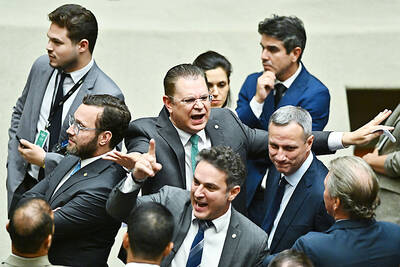
PARLIAMENT CHAOS: Police forcibly removed Brazilian Deputy Glauber Braga after he called the legislation part of a ‘coup offensive’ and occupied the speaker’s chair Brazil’s lower house of Congress early yesterday approved a bill that could slash former Brazilian president Jair Bolsonaro’s prison sentence for plotting a coup, after efforts by a lawmaker to disrupt the proceedings sparked chaos in parliament. Bolsonaro has been serving a 27-year term since last month after his conviction for a scheme to stop Brazilian President Luiz Inacio Lula da Silva from taking office after the 2022 election. Lawmakers had been discussing a bill that would significantly reduce sentences for several crimes, including attempting a coup d’etat — opening up the prospect that Bolsonaro, 70, could have his sentence cut to

A powerful magnitude 7.6 earthquake shook Japan’s northeast region late on Monday, prompting tsunami warnings and orders for residents to evacuate. A tsunami as high as three metres (10 feet) could hit Japan’s northeastern coast after an earthquake with an estimated magnitude of 7.6 occurred offshore at 11:15 p.m. (1415 GMT), the Japan Meteorological Agency (JMA) said. Tsunami warnings were issued for the prefectures of Hokkaido, Aomori and Iwate, and a tsunami of 40cm had been observed at Aomori’s Mutsu Ogawara and Hokkaido’s Urakawa ports before midnight, JMA said. The epicentre of the quake was 80 km (50 miles) off the coast of
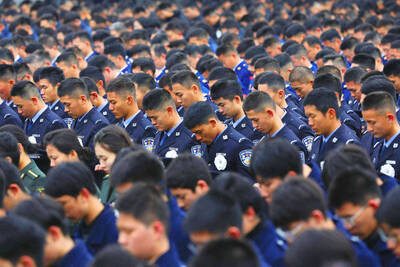
China yesterday held a low-key memorial ceremony for the 1937 Nanjing Massacre, with Chinese President Xi Jinping (習近平) not attending, despite a diplomatic crisis between Beijing and Tokyo over Taiwan. Beijing has raged at Tokyo since Japanese Prime Minister Sanae Takaichi last month said that a hypothetical Chinese attack on Taiwan could trigger a military response from Japan. China and Japan have long sparred over their painful history. China consistently reminds its people of the 1937 Nanjing Massacre, in which it says Japanese troops killed 300,000 people in what was then its capital. A post-World War II Allied tribunal put the death toll
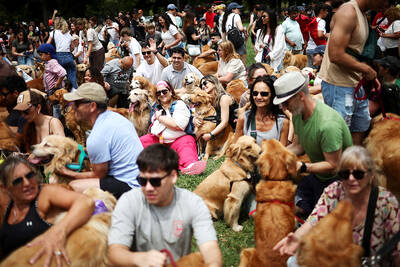
A passerby could hear the cacophony from miles away in the Argentine capital, the unmistakable sound of 2,397 dogs barking — and breaking the unofficial world record for the largest-ever gathering of golden retrievers. Excitement pulsed through Bosques de Palermo, a sprawling park in Buenos Aires, as golden retriever-owners from all over Argentina transformed the park’s grassy expanse into a sea of bright yellow fur. Dog owners of all ages, their clothes covered in dog hair and stained with slobber, plopped down on picnic blankets with their beloved goldens to take in the surreal sight of so many other, exceptionally similar-looking ones.


 RSS
RSS