


Modern Texas was built on oil, and its production has long been a source of immense pride.
However, areas that moved to the steady rhythm of oil derricks for more than a century are making the state a national leader in wind and solar energy.
A convergence of factors has led to this unexpected result: favorable weather (lots of wind and sun), relatively cheap land, the lure of federal clean-energy subsidies and a desire to backstop a utility system that failed dramatically during a 2021 cold snap.
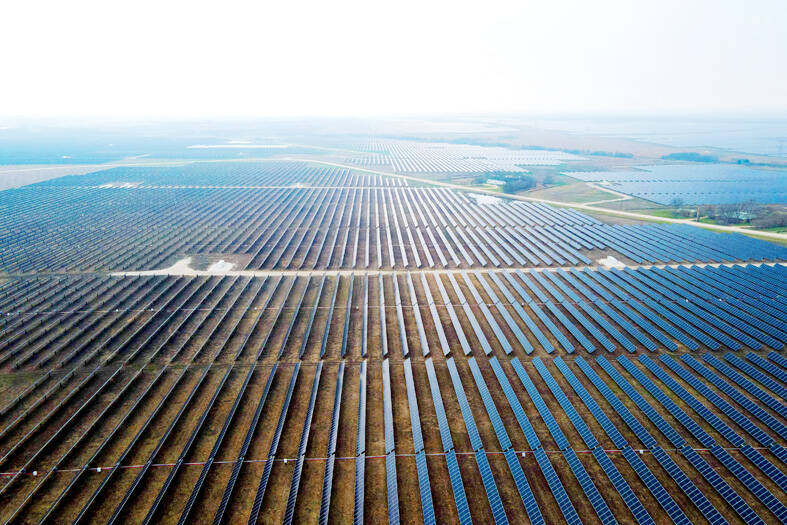
Photo: AFP
Two counties south of Dallas, Navarro and Limestone, symbolize this surprising shift. Inextricably part of the Texas petroleum industry since the late 19th century, they are now in the vanguard of the renewable revolution.
Wind and solar projects “have Navarro County leading the nation with renewables,” said John Boswell, director of economic development in the city government of Corsicanna, the county’s seat.
Symbolizing this push is a new wind farm inaugurated this month by French multinational energy company Engie, with 88 wind turbines capable of producing 300 megawatts (MW) of power.
A half-hour’s drive to the west, in the small town of Abbott, is a 250MW solar farm, also built by Engie.
Texas is the US’ leader — by far — in providing clean energy to corporate and industrial buyers, at 35 percent of the national total, data compiled by the American Clean Power organization showed.
Ohio has about half Texas’s number of corporate and industrial clean energy projects, just ahead of California in third place.
“It’s true that when we think about Texas, we think about this very large oil and gas state,” Engie executive vice president for transformation and geographies Frank Demaille said.
However, its natural resources are not all buried in the ground, he added.
“They’ve got lots of wind, lots of sun and are very good at managing all their different resources,” he said.
With its huge and sprawling petrochemical industry, a population of 30 million and a fierce history of independence, Texas in many ways stands apart from the rest of the US — for better or for worse. One way its go-it-alone mentality did not help became apparent in 2021, when a rare and intense cold wave swept through the state — whose power utility was not connected to two major national grids — provoking electric outages that affected millions and were blamed for more than 200 deaths.
Texas today remains primarily dependent on fossil fuels. As of early this year, gas was its leading source of energy at 42 percent, according to data by Ercot, which manages the state’s electrical grid.
Coal trails at 11 percent, but renewable sources have carved out a major role. Wind-generated power provides 29 percent of Texas’ needs, with solar at 11 percent. The remainder comes from nuclear and hydropower.
By comparison, wind was at 24 percent just two years ago, and solar at less than 5 percent.
Given Texas’ deep investments in and long history with carbon-based energy, experts do not expect it to give way to renewables anytime soon.
“I think what you’ll see in the future is a combination of both of those, because Texas is committed to both” sources, said Jeff Montgomery, whose Blattner Energy company is behind 400 renewable projects across the country.
Texas is a major supplier of natural gas to Europe.
Demaille said that “because of the war in Ukraine, we’re importing more gas from the US, and especially from Texas.”
However, legislation backed by the administration of US President Joe Biden and voted into law last year could accelerate the move to renewables through substantial federal subsidies.
Robert Lowry, superintendent of the Coolidge school district in Limestone County, said the tax revenues that renewable-energy projects generate can make a difference for school systems like his.
“We have the funds now to be able to do some great things for our kiddos that we’ve ever had before,” he said.
However, not everyone shares that enthusiasm.
John Null, an engineer who lives in Dawson, a town of 800 people in Navarro County, said locals are not seeing the immediate benefit they would hope for from the huge wind turbines visible from his window.
During an ice storm last month, the turbines kept turning, but, linked to a broader network, provided no energy to the neighboring community, he said, adding that wind power needs to be “properly pitched” to the public.
“Show me the value,” and people would support wind energy, he said.
In some areas, renewable projects are touted as providing power to poorer neighborhoods.
In a less-affluent part of Houston, the fourth-largest US city, a solar farm is to be built over a former dump. That project should begin providing 50MW of power next year, BQ Energy CEO Paul Curran said.
A former petroleum industry executive, Curran said fossil fuels and renewable energy sources need not be in competition.
“It’s not very difficult if you do wind and solar in the right places for the right market,” he said. “It’s very well received by energy experts and oil industry people.”

‘CROSSING THE LINE’: China’s embassy in Seoul criticized US Forces Korea Commander General Xavier Brunson, asking if his ‘hostile’ remarks were authorized by Washington South Korea and the US are in talks over recent public remarks by the commander of US Forces Korea, Seoul’s presidential office said yesterday, after the comments drew sharp criticism from China. In a recent podcast interview, US Forces Korea Commander General Xavier Brunson described South Korea as “the dagger in the heart of Asia” from China’s east coast, prompting the Chinese embassy in Seoul to say that he had “truly crossed the line.” The interview came amid growing speculation that Washington might seek to expand the role of US Forces Korea in countering the growing regional influence of China, a key

SEEKING ORDER: Rodrigo Paz said that ‘anyone who wants to destroy the nation will have to deal with this president and the full force of the constitution’ Bolivian President Rodrigo Paz on Wednesday said that the nation was at a “breaking point” after nearly a month of protests that have caused shortages of food, fuel and medicine. Paz, who took office six months ago amid the worst economic crisis there in four decades, is battling a groundswell of fury over his policies. The political capital, La Paz, has been besieged by low-income workers and members of the indigenous majority calling for his resignation. “The country needs order and is reaching breaking point,” the 58-year-old said at a public event in La Paz, renewing his appeal for dialogue. On Tuesday, the Bolivian

Through the noise of rushing papers and whirring belts at a print factory in Kyoto, two creators watch their photo essay come to life in broadsheet form — part of an effort to win new audiences in the age of artificial intelligence (AI). Despite the decline of the publishing industry, self-publication and handmade “zine” magazines are growing in popularity in Japan, reflecting the nation’s enduring love of paper in the digital era. While speaking to Agence France-Presse at the plant, his hands black with ink, one of the creators, Kazuma Obara, said: “I think [paper] is a medium that engages all five

Australian researchers have trained lab-grown brain cells on a silicon computer chip to play the 1990s shooter game Doom and said they are just scratching the surface of what the neurons could be capable of doing. It is the science-fiction work of biotech boffins at Cortical Labs, who researched and developed the technology that harnesses the workings of the brain’s networking system. Each so-called “biological computer” contains about 200,000 living human brain cells, grown from stem cells that were harvested from blood donations. Having mastered the simple computer game Pong, where a paddle is moved up and down to send a ball


 RSS
RSS