

A special US House of Representatives committee dedicated to countering China began its work on Tuesday with a prime-time hearing in which the panel’s chairman called on lawmakers to act with urgency, and framed the competition between the US and China as “an existential struggle over what life will look like in the 21st century.”
While some critics have expressed concern the hearings could escalate US-Chinese tensions, lawmakers sought to demonstrate unity, and the panel’s top Democrat made clear that he does not want a “clash of civilizations,” but a durable peace.
Tensions between the US and China have been rising for years, with both countries enacting retaliatory tariffs on an array of imports during former US president Donald Trump’s time in office.
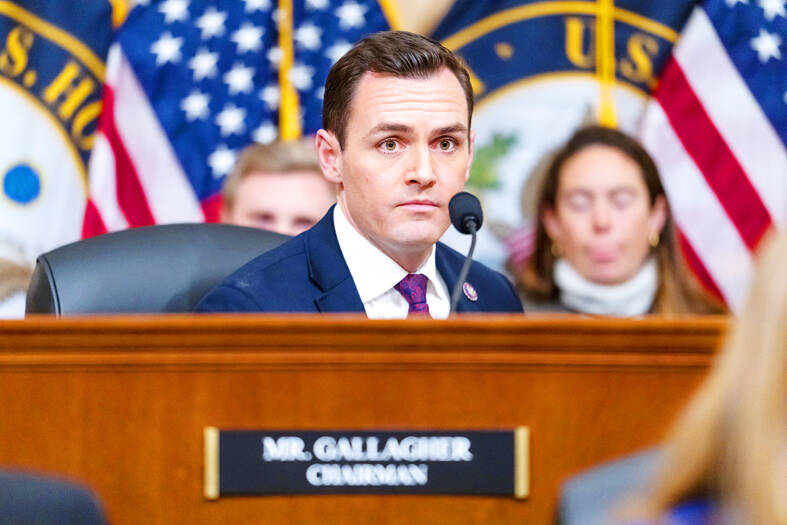
Photo: AP
China’s opaque response to the COVID-19 pandemic, its aggression toward Taiwan and the recent flight of a possible spy balloon over the US have fueled lawmakers’ desire to do more to counter the Chinese government.
The new House Select Committee on the Chinese Communist Party (CCP) is expected to be at the center of many of their efforts over the next two years.
The committee’s chairman, US Representative Mike Gallagher, opened the hearing with a call for action. Addressing the difficulty of finding common ground on China-focused legislation, he said the Chinese government has found friends on Wall Street and in lobbyists on Washington’s K Street who are ready to oppose the committee’s efforts.
“Time is not on our side. Just because this Congress is divided, we cannot afford to waste the next two years lingering in legislative limbo or pandering for the press,” Gallagher said. “We must act with a sense of urgency.”
Gallagher is looking for the committee to shepherd several bills over the finish line during the next two years and issue a set of recommendations on long-term policies.
Opponents on the Democratic side largely voiced the concern that the committee could stir an even greater rise in anti-Asian hate crimes.
Gallagher said he is committed to ensuring the focus is on the CCP, not on the people of China.
US Representative Raja Krishnamoorthi, the ranking Democrat on the committee, said both Republicans and Democrats have underestimated the CCP.
He said its goal is to pursue economic and trade policies that undermine the US economy.
“We do not want a war with the [People’s Republic of China], not a cold war, not a hot war,” Krishnamoorthi said. “We don’t want a clash of civilizations, but we seek a durable peace and that is why we have to deter aggression.”
The witnesses for Tuesday’s hearing included two former advisers to Trump: Matthew Pottinger, the deputy national security adviser who resigned immediately after the Jan. 6, 2021, insurrection at the US Capitol; and H.R. McMaster, who was national security adviser from February 2017 to April 2018.
Pottinger said the main emphasis of his testimony was to open people’s eyes to how the US has become too complacent.
“Before we can seize the initiative we have to react to the fact that our national interest has been deeply undermined over the course of the last quarter century,” he said.
Tong Yi (童屹), a Chinese human rights advocate, amplified human rights concerns at the hearing.
“In the US, we need to face the fact that we have helped feed the baby dragon of the CCP until it has grown into what it now is,” she said.
Scott Paul, president of an alliance formed by some manufacturing companies and the United Steelworkers labor union, testified that “51 years of wishful thinking by American leaders” has failed to alter the dynamic that the CCP represents a “clear and present danger to the American worker, our innovation base and our national security.”

The picturesque Lac des Brenets between France and Switzerland has dried up after a record-breaking hot summer, leaving locals crying out for help to save the lake. Indeed, the words “HELP” and “SOS” have been scratched out in the weeds now flourishing on the exposed lake bed. The drought has ruined pleasure boat tourism, while some question whether the lake will ever return to enduring full health. “It’s absolutely heartbreaking,” said historian David Favre, who lives in Les Brenets. “As children, we used to spend all our summers swimming at the beach, having fun by the water, diving, jumping in and sometimes even

STRAIN ON TIES: The police arrested a 20-year-old man who matched the description of a suspect caught on CCTV leaving a hotel in Naha with the victim’s belongings A US Marine stationed on Japan’s southern island of Okinawa was arrested on suspicion of the murder of a Japanese woman, police said yesterday. The suspect “killed the 39-year-old woman at a hotel in Naha and stole her wallet on Saturday,” a local police spokesman said. US Ambassador George Glass posted on social media that he had spoken with Japan’s foreign ministry and Okinawa’s governor to offer “our sincere condolences and pledging full cooperation as the investigation continues.” Japanese Prime Minister Sanae Takaichi called the crime “exceptionally brutal and vicious” on X. The government has urged the US “to provide maximum cooperation

A US lawmaker has called on Starbucks to close its first stores in Xinjiang, China, calling it a “morally bankrupt decision” to do business in a region where Uighurs face repression. China denies widespread accusations about abuses of the Uighurs, a mainly Muslim people, saying its policies there were aimed at combating terrorism, separatism and religious extremism. Starbucks opened its first two stores this week in Xinjiang’s capital, Urumqi, including one at the city centre’s grand bazaar and a second at its international airport. John Moolenaar, chairman of the Select Committee on China of the House of Representatives, called on Starbucks to “immediately

WARNING: Some analysts have expressed concern over what kind of investors the citizenship scheme would attract, saying it could bring in people of dubious origin Argentine President Javier Milei’s government on Friday said the country would offer citizenship to foreigners who invest at least US$350,000 in the country. Latin America’s third-largest economy lagged far behind Brazil and Mexico in the foreign direct investment stakes last year, according to the Organisation for Economic Co-operation and Development (OECD). Milei, a free-market radical, has slashed public spending, deregulated the economy and dismantled trade barriers in a bid to make Argentina more competitive and boost the Treasury’s dwindling dollar reserves. However, investors are still waiting for Argentina’s roller-coaster economy to “prove that what it’s doing will actually be sustainable over time,” economist


 RSS
RSS