


An ambulance screams toward a triage hub for wounded Ukrainian soldiers outside Bakhmut, the stage for the longest battle of Russia’s invasion, where there is no end in sight to a brutal stalemate.
Men with limbs lost to mines and artillery wounds are pulled from battlefields carved with trenches and scarred by shells in a fight drawing comparisons to infamous battles of World War I.
“It’s like Verdun out there,” said Ivan, an ambulance driver waiting on a roadside outside the battered industrial city in the eastern Donetsk region.
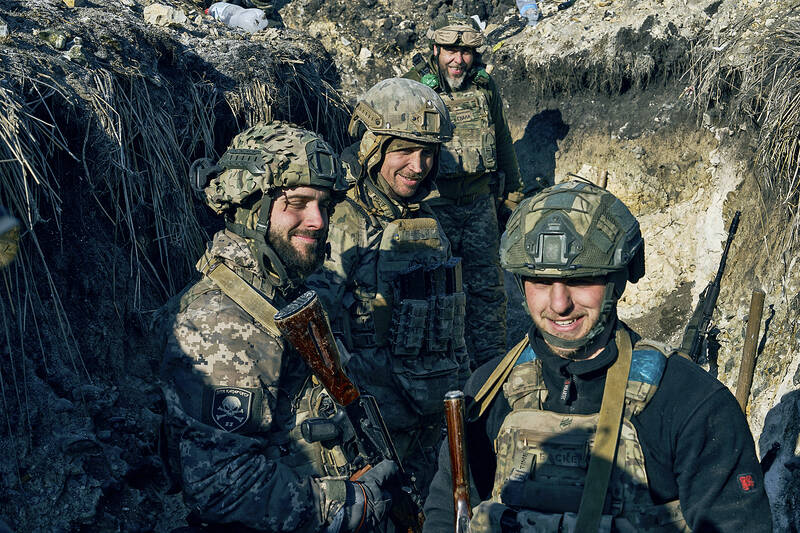
Photo: AP
Like the 1916 fight on the western front in France, the battle for Bakhmut, now in its seventh month, has been long, bloody and futile.
Victory over the city, pounded to ruin, would be merely symbolic as the anniversary of the invasion looms on Friday next week.
Yet even as the dead and wounded are rushed out or abandoned on the battlefield, both sides are digging in and flinging more troops at Bakhmut to break the deadlock.
Moscow has ramped up efforts to score its first significant victory after months of setbacks, while Kyiv is determined to hold its ground.
“It’s a classic World War I problem,” said Mark Cancian, a senior security program adviser at the Center for Strategic and International Studies.
When Moscow’s first attempt to encircle Ukrainian forces failed, Russia “kept attacking,” he said.
Even if the Russians do succeed, “it will mean nothing operationally and strategically,” he added.
“It has a lot of symbolism, so if they captured Bakhmut, they’d make it sound like it was important, but it wouldn’t be,” Cancian said.
However, he added that Ukraine’s options are limited.
“If that’s where the Russians are attacking, the Ukrainians don’t have a choice but to defend,” he said.
British intelligence has estimated Russia’s progress to be halting, but that has not eased the pressure on Ukrainian President Volodymyr Zelenskiy, who has called for more weapons from Western nations.
“If weapon [deliveries] are accelerated — namely long-range weapons — we will not only not withdraw from Bakhmut, we will begin to deoccupy Donbas,” he told senior EU leaders in Kyiv earlier this month, referring to the wider region, including Donetsk.
“We will fight as long as we can” for Bakhmut, he said.
To keep Russia at bay, Ukraine’s forces also need more standard artillery and ammunition, Ukrainian military analyst Oleksandr Kovalenko said.
“If this does not happen, then we will have serious problems in Bakhmut,” Kovalenko said.
The lack of firepower on the front is keenly felt.
“The enemy has a huge advantage in artillery,” Yuriy Kryzhberskyi, a 37-year-old Ukrainian officer, said near the front late last month. “You can sit in a basement in the village of Vasyukivka [north of Bakhmut] for half an hour and hear 40 incoming shells.”
Russia’s strength in numbers is also daunting, said a sergeant near Soledar with the call sign “Alkor.”
“We shoot, and shoot and shoot, but after five minutes, the next 20 people are coming toward us,” he said.
Moscow and the notorious Wagner mercenary group have been accused of using ill-prepared and poorly equipped recruits as “cannon fodder” — a claim Russian military analyst Alexander Khramtchikhine dismissed as “Western propaganda.”
Ukraine’s ranks have also faced losses.
Major Volodymyr Leonov of Ukraine’s Territorial Defense Forces said in three days last month he had dozens wounded.
The bodies of five of his fighters could not be retrieved from the battlefield.
“Our people are motivated. Everyone came to fight,” he said. But “when there is no fire support and when there are no armored vehicles, we are simply shot, like in a shooting range.”
Neither Ukraine nor Moscow has given death tolls, but both sides have described the battle for Bakhmut as the bloodiest of the war.
Near the front, north of Bakhmut — among broken trees and strewn grenades — a dozen bodies of alleged Wagner fighters lay abandoned on the frosted ground, a reporter witnessed late last month.
“Apparently, they were forbidden to retreat,” Ukrainian serviceman Vladislav said, as heavy shelling pounded nearby. “They didn’t even take their wounded and they died there eventually in the field.”
Wagner boss and ally of Russian President Vladimir Putin, Yevgeny Prigozhin, has described “fierce” fighting unfolding on “every street, every house, every stairwell.”
Evidence of the fighting is everywhere, from burning buildings to shell fragments and blood-soaked snow littered with medical equipment.
A city once known for sparkling wine and salt mines, and home to 70,000 people, half of the buildings in Bakhmut are damaged or destroyed, officials said.
Rows of Soviet-era housing blocks are charred and battered, their windows exploded out across the streets.
The bridge spanning the city’s river has been reduced to a jumble of boards, tires and pallets.
Natalia Shevchenko, who makes the crossing daily for clean water — the city having lost all supply, along with gas, electricity and telephone signals — is used to the whistle of falling shells.
“I am living in the basement right now. When I get out, I am like a mole — my eyes have to get used to the light,” she said.
She is one of about 6,500 people holding out in Bakhmut, even as life is squeezed from the city.
More civilians have left since fighting intensified last month, said Tetyana Scherbak, a volunteer at a humanitarian hub.
Some wait overnight at the hub for evacuation, huddled next to stoves with salvaged belongings. Others are retrieved from their homes by people who brave shelling to reach them — sometimes getting caught in the line of fire.
“It’s all about luck there,” said 24-year-old Ukrainian volunteer Mykola, at the memorial in Kyiv for one of two British volunteers killed in the town of Soledar last month.
Earlier this month, another humanitarian, American Pete Reed, died in Bakhmut.
Nataliia Yevtushenko, 38, has tried to leave Bakhmut twice.
The first time her 16-year-old son was killed with 60 others when nearby Kramatorsk railway station was struck by a Russian missile, and she returned home.
During a second attempt she was involved in a traffic accident.
“That’s enough trying,” she said.
She now volunteers at one of the humanitarian hubs, keeping people fed and warm as winter worsens their misery.
The troops in the trenches have no such shelter. They bear the bitter cold clutching volunteer-made candles in the snow and mud, peering out across no-man’s-land, sometimes barely sleeping for days.
Ukrainian forces are preparing for another onslaught in the hills beyond Bakhmut, digging into the cold earth to cut fresh trenches.
In nearby Sloviansk, under a gray sky last month, 28-year-old Azov battalion member Oleksandr Korovniy, who was killed in Bakhmut, was laid to rest in the frozen ground.
His friend, Oleksiy Storozh, gestured to a World War II memorial near where he had just buried his fellow soldier.
“History repeats itself,” he said. “What is it all for?”

‘CROSSING THE LINE’: China’s embassy in Seoul criticized US Forces Korea Commander General Xavier Brunson, asking if his ‘hostile’ remarks were authorized by Washington South Korea and the US are in talks over recent public remarks by the commander of US Forces Korea, Seoul’s presidential office said yesterday, after the comments drew sharp criticism from China. In a recent podcast interview, US Forces Korea Commander General Xavier Brunson described South Korea as “the dagger in the heart of Asia” from China’s east coast, prompting the Chinese embassy in Seoul to say that he had “truly crossed the line.” The interview came amid growing speculation that Washington might seek to expand the role of US Forces Korea in countering the growing regional influence of China, a key

SEEKING ORDER: Rodrigo Paz said that ‘anyone who wants to destroy the nation will have to deal with this president and the full force of the constitution’ Bolivian President Rodrigo Paz on Wednesday said that the nation was at a “breaking point” after nearly a month of protests that have caused shortages of food, fuel and medicine. Paz, who took office six months ago amid the worst economic crisis there in four decades, is battling a groundswell of fury over his policies. The political capital, La Paz, has been besieged by low-income workers and members of the indigenous majority calling for his resignation. “The country needs order and is reaching breaking point,” the 58-year-old said at a public event in La Paz, renewing his appeal for dialogue. On Tuesday, the Bolivian

Through the noise of rushing papers and whirring belts at a print factory in Kyoto, two creators watch their photo essay come to life in broadsheet form — part of an effort to win new audiences in the age of artificial intelligence (AI). Despite the decline of the publishing industry, self-publication and handmade “zine” magazines are growing in popularity in Japan, reflecting the nation’s enduring love of paper in the digital era. While speaking to Agence France-Presse at the plant, his hands black with ink, one of the creators, Kazuma Obara, said: “I think [paper] is a medium that engages all five

Australian researchers have trained lab-grown brain cells on a silicon computer chip to play the 1990s shooter game Doom and said they are just scratching the surface of what the neurons could be capable of doing. It is the science-fiction work of biotech boffins at Cortical Labs, who researched and developed the technology that harnesses the workings of the brain’s networking system. Each so-called “biological computer” contains about 200,000 living human brain cells, grown from stem cells that were harvested from blood donations. Having mastered the simple computer game Pong, where a paddle is moved up and down to send a ball


 RSS
RSS