


At least 13 people were reported dead as of Friday night as a result of the more than 150 wildfires burning across Chile that have destroyed homes and thousands of hectares of forest while the South American country is in the midst of a scorching heat wave.
Four of the deaths involved two separate vehicles in the Biobio region, about 560km south of the capital, Santiago.
“In one case they were burned because they were hit by the fire,” Minister of the Interior and Public Security Carolina Toha said.
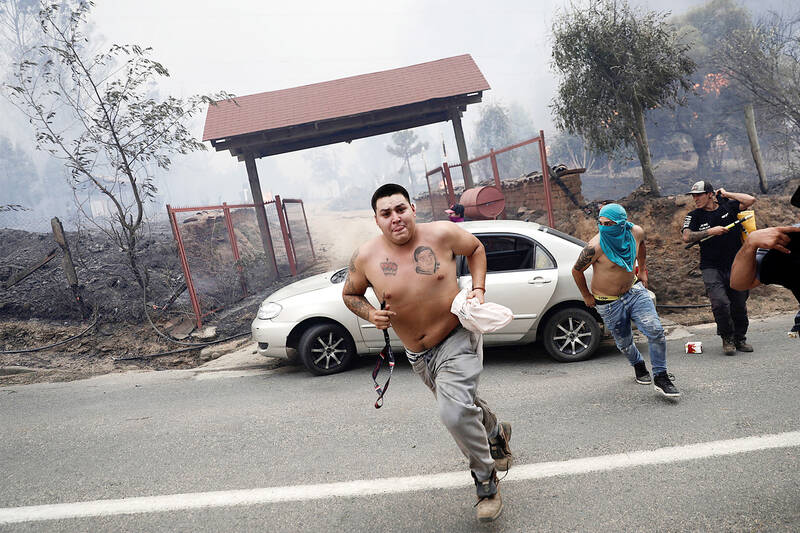
Photo: Reuters
In the other case, she said, the victims died in a crash, “probably trying to escape the fire.”
The fifth victim was a firefighter who was run over by a fire truck while fighting a blaze in the area.
Later in the afternoon, a helicopter that was helping combat the flames crashed in the Araucania region, killing the pilot, a Bolivian national, and a mechanic, who was Chilean.
At nightfall, the national agency responsible for emergencies raised the death toll to 13 without giving details on the latest deaths.
As of midday on Friday, 151 wildfires were burning throughout Chile, including 65 declared under control. The fires had blazed through more than 14,000 hectares.
Most of the wildfires are in Biobio and neighboring Nuble, where the government has declared states of catastrophe that allow greater coordination with the military and the suspension of certain constitutional rights.
The heat wave hitting Chile is set to continue with high temperatures and strong winds that could make the wildfires more challenging.
Chilean President Gabriel Boric on Friday suspended his vacation to travel to the affected areas and said there is “evidence” that some of the wildfires were sparked by unauthorized burnings.
“The full force of the state will be deployed to, first of all, fight the fires and to accompany all the victims,” Boric said.
It remained unclear how many houses and other structures had been destroyed.
“Families are having a very difficult time,” Ivonne Rivas, the mayor of Tome in Biobio, told local radio. “It’s hell what they are living through, the fire got away from us.”
The wildfires caused the suspension of a highly anticipated announcement by forensic experts who were expected to give the cause of death of Chilean poet Pablo Neruda, winner of a Nobel Prize for literature.
The experts were set to give their view on whether Neruda died of complications from prostate cancer or whether he was poisoned, potentially settling one of the great mysteries of post-coup Chile.
The doctor in charge of delivering the report’s findings was unable to connect to the Internet, because he is in a region affected by the wildfires, a spokesman for the country’s judiciary said.

Kouri Richins, a Utah mother who published a children’s book about grief after the death of her husband is to serve a life sentence for his murder without the possibility of parole, a judge ruled on Wednesday. Richins was convicted in March of aggravated murder for lacing a cocktail given to her husband, Eric Richins, with five times the lethal dose of fentanyl at their home near Park City in 2022. A jury also found her guilty of four other felonies, including insurance fraud, forgery and attempted murder for trying to poison her husband weeks earlier on Feb. 14, 2022, with a

DELA ROSA CASE: The whereabouts of the senator, who is wanted by the ICC, was unclear, while President Marcos faces a political test over the senate situation Philippine authorities yesterday were seeking confirmation of reports that a top politician wanted by the International Criminal Court (ICC) had fled, a day after gunfire rang out at the Philippine Senate where he had taken refuge fearing his arrest. Senator Ronald “Bato” dela Rosa, the former national police chief and top enforcer of former Philippine president Rodrigo Duterte’s “war on drugs,” has been under Senate protection and is wanted for crimes against humanity, the same charges Duterte is accused of. “Several sources confirmed that the senator, Senator Bato, is no longer in the Senate premises, but we are still getting confirmation,” Presidential

HELP DENIED? The US Department of State said that the Cuban leadership refuses to allow the US to provide aid to Cubans, ‘who are in desperate need of assistance’ US Secretary of State Marco Rubio on Wednesday said that Cuba’s leadership must change, as Washington renewed an offer of US$100 million in aid if the communist nation agrees to cooperate. Cuba has been suffering severe economic tumult led by an energy shortage that plunged 65 percent of the country into darkness on Tuesday. Cuba’s leaders have blamed US sanctions, but Rubio, a Cuban American and critic of the government established by Fidel Castro, said the system was to blame, including corruption by the military. “It’s a broken, nonfunctional economy, and it’s impossible to change it. I wish it were different,” he told

Myanmar yesterday published a parliamentary bill proposing the death sentence for those who detain or violently coerce people into working in online scam centers. Internet fraud factories have flourished in Myanmar, part of Southeast Asia’s scam economy, targeting Internet users worldwide with romance and cryptocurrency investment cons. The multibillion-dollar black market attracts many willing employees, but repatriated foreigners have also reported being trafficked to sites in Myanmar and tortured by scam center operators. The draft legislation would allow capital punishment for “violence, torture, unlawful arrest and detention, or cruel treatment against another person for the purpose of forcing them to commit online scams.” The


 RSS
RSS