


Heavy snow in large swaths of Japan has killed 17, injured more than 90 people and left hundreds of homes without power, disaster management officials said yesterday.
Powerful winter fronts have dumped heavy snow in northern regions since last week, stranding hundreds of vehicles on highways, delaying delivery services and causing 11 deaths by Saturday.
More snowfall over the Christmas weekend brought the number of dead to 17 and injured to 93 by yesterday morning, the Japanese Fire and Disaster Management Agency said.
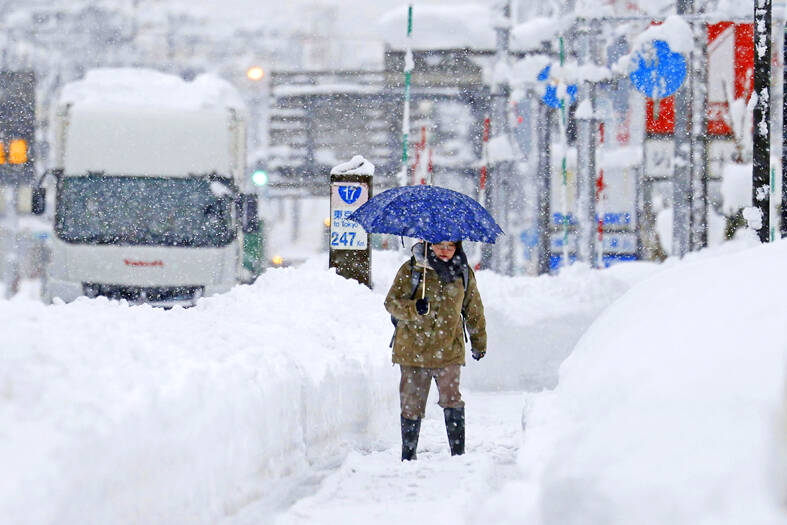
Photo: AP
Many of them had fallen while removing snow from the roofs or were buried underneath thick piles of snow sliding off rooftops.
Municipal offices in the snow-hit regions urged residents to use caution during snow removal activity and not to work alone.
The disaster management agency said a woman in her 70s was found dead buried underneath a thick pile of rooftop snow that suddenly fell on her in Yamagata Prefecture’s Nagai, about 300km north of Tokyo, where snow piled up higher than 80cm on Saturday.
In Niigata, known for rice growing, some makers of mochi, or sticky rice cakes that are staple for New Year celebration meals, said there have been delivery delays and their mochi might not reach their customers in time.
Many parts of northeastern Japan reported three times their average snowfall for the season.
Heavy snow knocked down an electric power transmission tower in Japan’s northernmost main island, leaving about 20,000 homes without power on Christmas morning, although electricity was restored in most areas later that day, the Japanese Ministry of Economy, Trade and Industry said.
Dozens of trains and flights were also suspended in northern Japan through Sunday, but services have since mostly resumed, the Japanese Ministry of Land, Infrastructure, Transport and Tourism said.
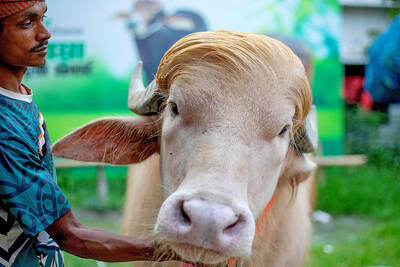
Crowds in Bangladesh are flocking to snap photographs with an unlikely social media star — an albino buffalo with flowing blond hair nicknamed “Donald Trump” that is due to be sacrificed within days. Owner Zia Uddin Mridha, 38, said his brother named the 700kg bull over its flowing helmet of hair resembling the signature look of the US president. “My younger brother picked this name because of the buffalo’s extraordinary hair,” he said at his farm in Narayanganj, just outside the capital, Dhaka. Mridha said that a constant stream of curious visitors — social media fans, onlookers and children — have come throughout
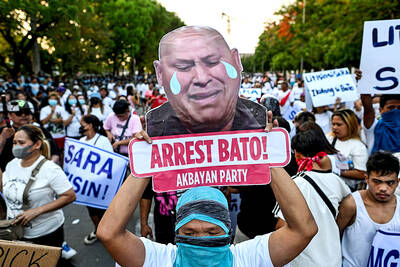
The Philippines said it has asked the country’s Supreme Court to allow it to arrest former Philippine president Rodrigo Duterte’s chief drug war enforcer to stand trial in an international tribunal. The International Criminal Court (ICC) last week unsealed an arrest warrant against Philippine Senator Ronald dela Rosa, accusing him along with Duterte and other “coperpetrators” of the “crime against humanity of murder.” Dela Rosa briefly sought refuge in the Philippine Senate last week while asking the Philippine Supreme Court to stop an ongoing attempt by government agents to arrest him. “By his own conduct, he has placed himself outside the protection of

The researchers in Ireland looked at their computer screen, marveling at a medieval book tracked down in a Roman library. They flipped through its digitized pages and found their sought-after treasure: the oldest surviving English poem. “We were extremely surprised. We were speechless. We couldn’t believe our eyes when we first saw that,” said Elisabetta Magnanti, a visiting research fellow at Trinity College Dublin’s school of English. The poem was also within the main body of Latin text, she said, calling it “extraordinary.” Composed in Old English by a Northumbrian agricultural worker in the 7th century, Caedmon’s Hymn appears within some copies of

It began as a satirical online project. Now millions of young people in India are flocking to it as an outlet for their frustration. A parody political party called the Cockroach Janta Party, with the insect as its symbol, has exploded across India’s social media by turning absurdist humor into protest. Memes and short videos mocking corruption, joblessness and political dysfunction have flooded social media sites, where millions of users are embracing the cockroach — known for its ability to survive harsh conditions — as a tongue-in-cheek symbol of endurance. The online movement’s rise has been unusually rapid. The Cockroach Janta Party (CJP)


 RSS
RSS