


Winter is closing in, but the sound of chainsaws still reverberates on the forest-covered slopes of the mountains in northern Bulgaria, while horses stand ready to transport the freshly cut wood down the steep paths.
Many in the EU’s poorest member country of 6.5 million people have rushed to stock up on firewood as Europe struggles with an energy crisis triggered by the war in Ukraine.
“Firewood remains the cheapest means of heating, and demand has increased three times compared to last year,” Bulgarian Minister of Agriculture Yavor Gechev said.
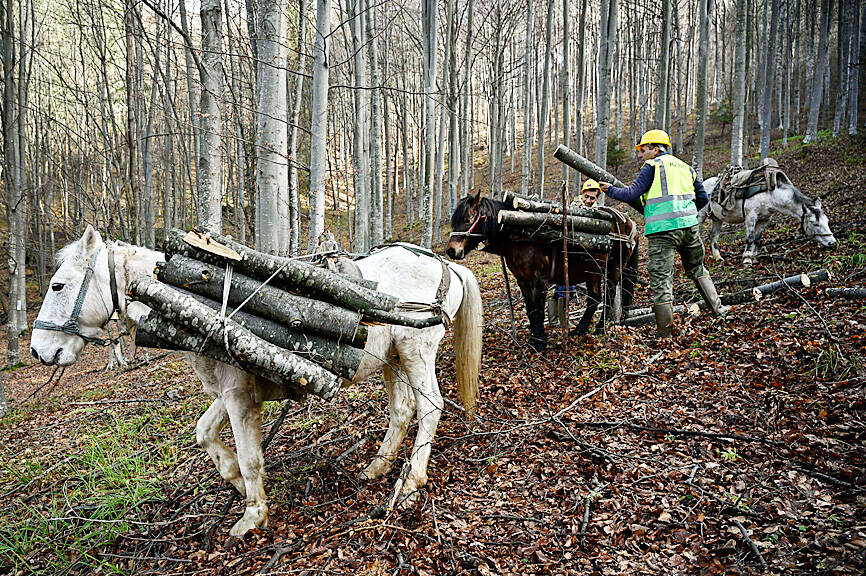
Photo: AFP
Gechev has pleaded for people not to buy more wood than they need as the usual coal deliveries from Ukraine’s Donbas region have largely failed to arrive.
More than half of the households in Bulgaria use coal and wood for heating, especially in rural areas where frequent cuts make electricity unreliable.
Even before the current crisis, one-quarter of Bulgarians were unable to heat their homes properly in winter, the highest percentage across the EU, Eurostat data showed.
In the mountainous region around Teteven, 4,800 households have placed orders for firewood, compared with less than 2,000 households last year, said Stoycho Moskovski, a media officer for the municipality of 18,000 residents.
A lack of snow so far this year has allowed logging to continue well into December, state forestry farm chief engineer Docho Dochev said.
After workers cut down young beech trees from the mountains around Teteven, the logs are cut into 1m-long pieces for transportation, mostly by horses because of the terrain.
On a crisp day earlier this month, workers loaded the logs on the saddles of a dozen horses that waited patiently. Then they started their short journey down a steep forest path to a place from where the wood can be loaded onto trucks.
Ten horses can transport about 3m2 of firewood at a time and usually make two trips per day, Dochev said.
In the nearby villages on the way down to Teteven, piles of logs were seen lining fences, and stocks of firewood, cut and ready for the stove, filled sheds, balconies and staircases.
However, not everyone has received their wood on time this year.
“Every year I use roughly the same amount of five cubic meters of firewood for heating, but this year I waited for quite some time, over two months, for the delivery,” pensioner Blagovesta Dogandzhiyska said as a trucker unloaded logs outside her house in Teteven.
This year, she is also paying double US$49 per cubic meter that she spent last year.
“It’s very hard [to heat my home], and it’s getting even harder,” she said.

‘CROSSING THE LINE’: China’s embassy in Seoul criticized US Forces Korea Commander General Xavier Brunson, asking if his ‘hostile’ remarks were authorized by Washington South Korea and the US are in talks over recent public remarks by the commander of US Forces Korea, Seoul’s presidential office said yesterday, after the comments drew sharp criticism from China. In a recent podcast interview, US Forces Korea Commander General Xavier Brunson described South Korea as “the dagger in the heart of Asia” from China’s east coast, prompting the Chinese embassy in Seoul to say that he had “truly crossed the line.” The interview came amid growing speculation that Washington might seek to expand the role of US Forces Korea in countering the growing regional influence of China, a key

SEEKING ORDER: Rodrigo Paz said that ‘anyone who wants to destroy the nation will have to deal with this president and the full force of the constitution’ Bolivian President Rodrigo Paz on Wednesday said that the nation was at a “breaking point” after nearly a month of protests that have caused shortages of food, fuel and medicine. Paz, who took office six months ago amid the worst economic crisis there in four decades, is battling a groundswell of fury over his policies. The political capital, La Paz, has been besieged by low-income workers and members of the indigenous majority calling for his resignation. “The country needs order and is reaching breaking point,” the 58-year-old said at a public event in La Paz, renewing his appeal for dialogue. On Tuesday, the Bolivian

Through the noise of rushing papers and whirring belts at a print factory in Kyoto, two creators watch their photo essay come to life in broadsheet form — part of an effort to win new audiences in the age of artificial intelligence (AI). Despite the decline of the publishing industry, self-publication and handmade “zine” magazines are growing in popularity in Japan, reflecting the nation’s enduring love of paper in the digital era. While speaking to Agence France-Presse at the plant, his hands black with ink, one of the creators, Kazuma Obara, said: “I think [paper] is a medium that engages all five

Australian researchers have trained lab-grown brain cells on a silicon computer chip to play the 1990s shooter game Doom and said they are just scratching the surface of what the neurons could be capable of doing. It is the science-fiction work of biotech boffins at Cortical Labs, who researched and developed the technology that harnesses the workings of the brain’s networking system. Each so-called “biological computer” contains about 200,000 living human brain cells, grown from stem cells that were harvested from blood donations. Having mastered the simple computer game Pong, where a paddle is moved up and down to send a ball


 RSS
RSS