


When it comes to ensuring the security of the regime, the Chinese Communist Party (CCP) does not skimp.
The extent of that lavish spending was put on display when the boldest street protests in decades broke out in Beijing and other cities, driven by anger over rigid and seemingly unending restrictions to combat COVID-19.
The Chinese government has been preparing for such challenges for decades, installing the machinery needed to quash large-scale upheavals.

Photo: REUTERS
After an initially muted response, with security personnel using pepper spray and tear gas, police and paramilitary troops flooded city streets with vans and armored vehicles in a massive show of force.
The officers fanned out, checking IDs and searching people’s mobile phones for photographs, messages or banned apps that might show involvement in, or even just sympathy for, the protests.
An unknown number of people were detained, and it is unclear if any will face charges.
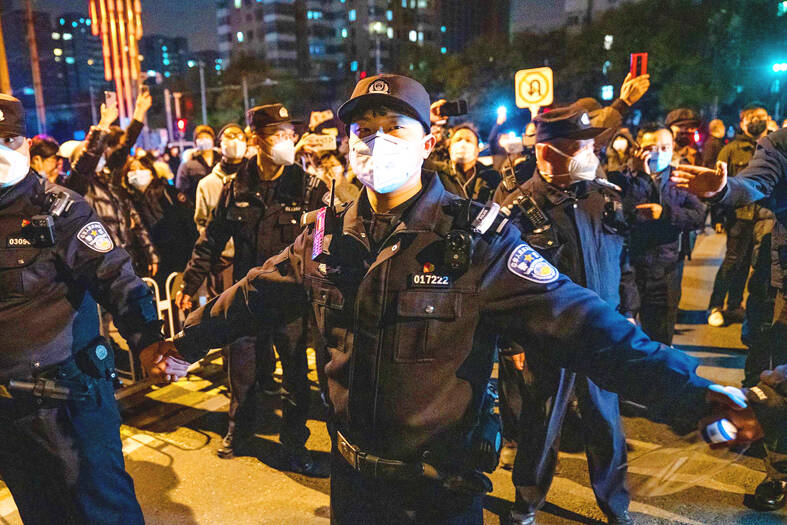
Photo: Bloomberg
Most protesters focused their anger on the government’s “zero COVID-19” policy, which seeks to eradicate the virus through sweeping lockdowns, travel restrictions and relentless testing.
However, some called for the CCP and its leader, Chinese President Xi Jinping (習近平), to step down, speech the party considers subversive and punishable by years in prison.
While much smaller in scale, the protests were the most significant since the 1989 student-led pro-democracy movement centered on Beijing’s Tiananmen Square, which the regime still views as its greatest existential crisis. With leaders and protesters at an impasse, the Chinese People’s Liberation Army in June 1989 crushed the demonstrations with tanks and troops, killing hundreds, possibly thousands.
After the Tiananmen Square Massacre, the CCP invested in the means to deal with unrest without resorting immediately to using deadly force.
During a wave of dissent by unemployed workers in the late 1990s and early 2000s, the authorities tested that approach, focusing on preventing organizers in several cities from linking up and arresting the leaders while letting rank-and-file protesters go largely untouched.
At times, however, they have been caught by surprise.
In 1999, members of the Falun Gong movement, whose membership came to rival the party’s in size, surrounded the leadership compound in Beijing in a show of defiance that then-Chinese president Jiang Zemin (江澤民) took as a personal affront.
A harsh crackdown followed. Leaders were given heavy prison sentences and members were subject to harassment and sometimes sent to re-education centers.
The government also responded with overwhelming force in 2008, when anti-government riots broke out in the Tibetan capital, Lhasa, and unrest swept through the region.
The next year, a police crackdown on protests by members of the Uighur Muslim minority in the capital of northwestern Xinjiang, Urumqi, led to bloody clashes in which at least 197 people were killed, mostly Han Chinese civilians.
In both cases, forces fired into crowds, searched door-to-door and seized an unknown number of suspects, who were either sentenced to heavy terms or simply not heard from again. Millions of people were interned in camps, placed under surveillance and forbidden from traveling.
China has been able to muster such resources thanks to a massive internal security budget that has reportedly tripled over the past decade, surpassing that for national defense. Xinjiang alone saw a 10-fold increase in domestic security spending during the early 2000s, according to Western estimates.
The published figure for internal security exceeded the defense budget for the first time in 2010. By 2013, China stopped providing a breakdown.
The US-based Jamestown Foundation think tank estimated that internal security spending in 2016 reached 113 percent of defense spending.
Annual increases were about double those for national defense in percentage terms and grew much faster than the economy.
There is a less visible, but equally intimidating, sprawling system in place to monitor online content for anti-government messages, unapproved news and images. Government censors work furiously to erase such items, while propaganda teams flood the net with pro-CCP messages.
Behind the repression is a legal system tailor-made to serve the one-party state.
China is a nation ruled by law rather than governed by the rule of law. Laws are sufficiently malleable to put anyone targeted by the authorities behind bars on any number of vague charges.
Those range from simply “spreading rumors online,” tracked through postings on social media, to the all-encompassing “picking quarrels and provoking trouble,” punishable by up to five years in prison.
Charges of “subverting state power” or “incitement to subvert state power” are often used, requiring little proof other than evidence the accused expressed a critical attitude toward the party-state. Those accused are usually denied the right to hire their own lawyers. Cases can take years to come to trial and almost always result in convictions.
In a further disincentive to rebel, people released from prison often face years of monitoring and harassment that can ruin careers and destroy families.
The massive spending and sprawling internal security network leaves China well prepared to crackdown on dissent.
It also suggests that “China’s internal situation is far less stable than the leadership would like the world to believe,” China politics expert Dean Cheng (成斌), a senior research fellow at the Heritage Foundation, wrote on the Washington-based conservative think tank’s Web site.
It is unclear how sustainable it is, he wrote.
“This could have the effect of either changing Chinese priorities or creating greater tensions among them,” Cheng added.
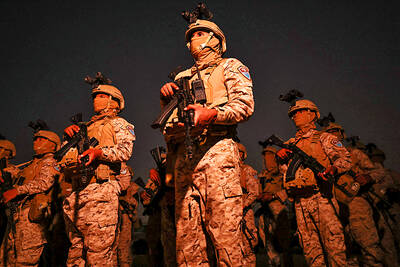
PRECARIOUS RELATIONS: Commentators in Saudi Arabia accuse the UAE of growing too bold, backing forces at odds with Saudi interests in various conflicts A Saudi Arabian media campaign targeting the United Arab Emirates (UAE) has deepened the Gulf’s worst row in years, stoking fears of a damaging fall-out in the financial heart of the Middle East. Fiery accusations of rights abuses and betrayal have circulated for weeks in state-run and social media after a brief conflict in Yemen, where Saudi airstrikes quelled an offensive by UAE-backed separatists. The United Arab Emirates is “investing in chaos and supporting secessionists” from Libya to Yemen and the Horn of Africa, Saudi Arabia’s al-Ekhbariya TV charged in a report this week. Such invective has been unheard of
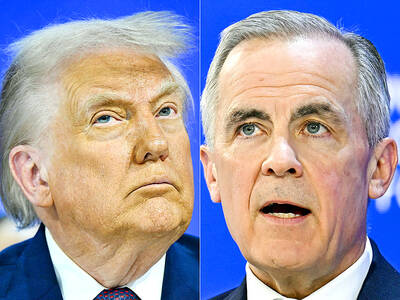
US President Donald Trump on Saturday warned Canada that if it concludes a trade deal with China, he would impose a 100 percent tariff on all goods coming over the border. Relations between the US and its northern neighbor have been rocky since Trump returned to the White House a year ago, with spats over trade and Canadian Prime Minister Mark Carney decrying a “rupture” in the US-led global order. During a visit to Beijing earlier this month, Carney hailed a “new strategic partnership” with China that resulted in a “preliminary, but landmark trade agreement” to reduce tariffs — but
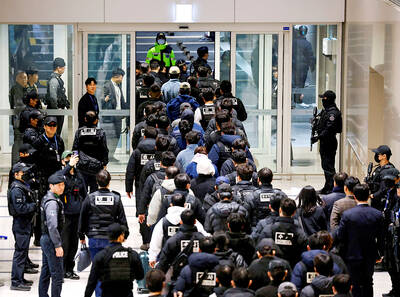
SCAM CLAMPDOWN: About 130 South Korean scam suspects have been sent home since October last year, and 60 more are still waiting for repatriation Dozens of South Koreans allegedly involved in online scams in Cambodia were yesterday returned to South Korea to face investigations in what was the largest group repatriation of Korean criminal suspects from abroad. The 73 South Korean suspects allegedly scammed fellow Koreans out of 48.6 billion won (US$33 million), South Korea said. Upon arrival in South Korea’s Incheon International Airport aboard a chartered plane, the suspects — 65 men and eight women — were sent to police stations. Local TV footage showed the suspects, in handcuffs and wearing masks, being escorted by police officers and boarding buses. They were among about 260 South

Chinese President Xi Jinping’s (習近平) purge of his most senior general is driven by his effort to both secure “total control” of his military and root out corruption, US Ambassador to China David Perdue said told Bloomberg Television yesterday. The probe into Zhang Youxia (張又俠), Xi’s second-in-command, announced over the weekend, is a “major development,” Perdue said, citing the family connections the vice chair of China’s apex military commission has with Xi. Chinese authorities said Zhang was being investigated for suspected serious discipline and law violations, without disclosing further details. “I take him at his word that there’s a corruption effort under


 RSS
RSS