


South Korean and US troops yesterday practiced building floating bridges to ferry tanks and other armored vehicles across rivers, part of a larger joint military exercise that has angered North Korea.
South Korean attack helicopters deployed flares and armored vehicles blew white smoke screens into the air as main battle tanks, armored personnel carriers and other military vehicles crossed pontoon bridges over the Namhan River near Yeoju, south of Seoul.
The drill involved armored “attacking” forces of the South Korean army’s 11th Mobile Division, which is participating in the 12-day Hoguk 22 field exercises, crossing bridges established by South Korean and US engineering units.
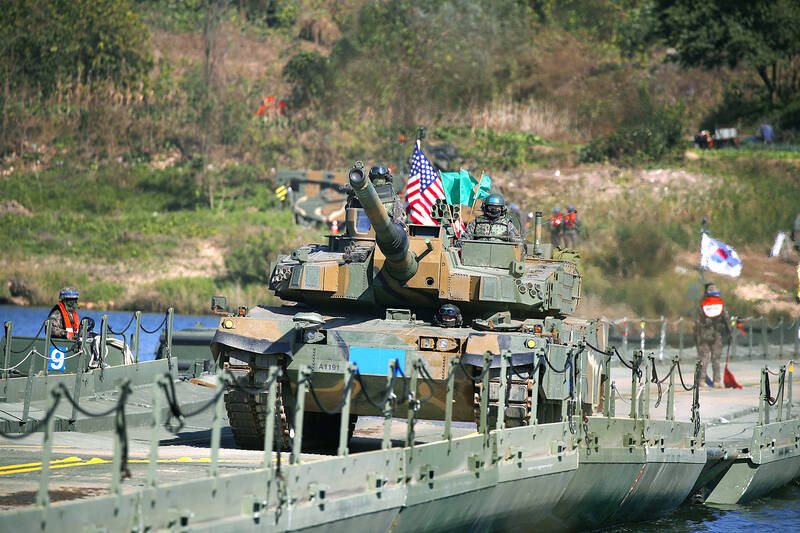
Photo: EPA-EFE
North Korea in response fired an artillery barrage into waters off its coast for the second day in a row, targeting a maritime “buffer zone” set up in 2018 to reduce tensions with the South.
Roughly 100 artillery shells were fired from South Hwanghae Province into the West Sea at about 12:30pm, South Korea’s Joint Chiefs of Staff said, calling the barrage a “clear violation” of the 2018 agreement.
It said none of the shells landed in South Korean waters south of the buffer zone.
Pyongyang said the latest barrage was intended to counter a “military provocation” by the South Korean army along the border earlier in the day.
South Korea and the US say the drills are defensive and necessary for deterring the North.
About 1,000 South Korean and US troops participated yesterday, with about 50 tanks and other armored vehicles, KF-16 jets, Apache and Cobra attack helicopters, and more than 140 pieces of engineering equipment such as floating bridge units, the South Korean Ministry of Defense said.
Nearby, residents water skied on the river and rode by on riverside bicycle paths.
The drills simulated a so-called wet gap crossing, military jargon for any obstacle filled with water, such as a river, said Captain Sean Kasprisin, a company commander in the US Army’s 11th Engineer Battalion, calling it “tough and realistic training.”
In a war, such operations might be required if bridges were knocked out by bombing, or if an army wanted to surprise its opponents by crossing away from established bridges or roads.
“Developing river-crossing capabilities is a key factor that can make or break wartime operations given the Korean Peninsula’s geography with many rivers,” said Lieutenant Colonel Won Seong-hoon of the South Korean 7th Engineer Brigade.
South Korea uses an older version of US-made bridging equipment, and one span was assembled using elements from each side, allowing troops to practice combining the different systems.
“A lot of rivers can vary in how far across they are, so we don’t know where we need to deploy,” Kasprisin said. “So if that length is too far, then we need to be able to work together.”
Despite the tensions with North Korea, US soldiers said they rarely had time to ponder geopolitics during the drills.
“The only thing on our mind is the training and making it realistic and effective,” Kasprisin said.
Additional reporting by AFP

Young Chinese, many who fear age discrimination in their workplace after turning 35, are increasingly starting “one-person companies” that have artificial intelligence (AI) do most of the work. Smaller start-ups are already in vogue in Silicon Valley and elsewhere, with rapidly advancing AI tools seen as a welcome teammate even as they threaten layoffs at existing firms. More young people in China are subscribing to the model, as cities pledge millions of dollars in funding and rent subsidies for such ventures, in alignment with Beijing’s political goal of “technological self-reliance.” “The one-person company is a product of the AI era,” said Karen Dai
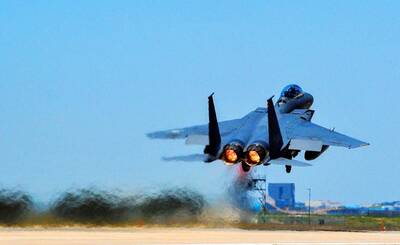
South Korea’s air force yesterday apologized for a 2021 midair collision involving two fighter jets, a day after auditors said the pilots were taking selfies and filming during the flight and held them responsible for the accident. “We sincerely apologize to the public for the concern caused by the accident that occurred in 2021,” an air force spokesman told a news conference, adding that one of the pilots involved had been suspended from flying duties, received severe disciplinary action and has since left the military. The apology followed a report released on Wednesday by the South Korean Board of Audit and Inspection,

About 240 Indians claiming descent from a Biblical tribe landed at Tel Aviv airport on Thursday as part of a government operation to relocate them to Israel. The newcomers passed under a balloon arch in blue and white, the colors of the Israeli flag, as dozens of well-wishers welcomed them with a traditional Jewish song. They were the first “bnei Menashe” (“sons of Manasseh”) to arrive in Israel since the government in November last year announced funding for the immigration of about 6,000 members of the community from the states of Manipur and Mizoram in northeast India. The community claims to descend from

‘TROUBLING’: The firing of Phelan, who was an adviser to a nonprofit that supported the defense of Taiwan, was another example of ‘dysfunction’ under Trump, a US senator said US Secretary of the Navy John Phelan has been fired, a US official and a person familiar with the matter said on Wednesday, in another wartime shakeup at the Pentagon coming just weeks after US Secretary of Defense Pete Hegseth ousted the Army’s top general. The Pentagon announced his departure in a brief statement, saying he was leaving the administration “effective immediately,” but it did not provide a reason or say whether it was his decision to go. The sources, who spoke on condition of anonymity, said Phelan was dismissed in part because he was moving too slowly to implement reforms to


 RSS
RSS