


Babies born during the first lockdown met fewer developmental milestones aged one compared with those born before the COVID-19 pandemic — although they might have been faster to crawl, data suggest.
About 600,000 babies were born in the UK, and a further 60,000 in Ireland, during 2020 — when COVID-19 restrictions and mask-wearing put a stop to many social activities, including toddler rhyme-times, antenatal group outings and cuddles with grandparents. Since then, parents and psychologists have pondered the impact of such enforced isolation on babies’ social development.
“The Irish lockdown, in particular, was a very stringent lockdown,” said Susan Byrne, a pediatric neurologist at the Royal College of Surgeons in Ireland.
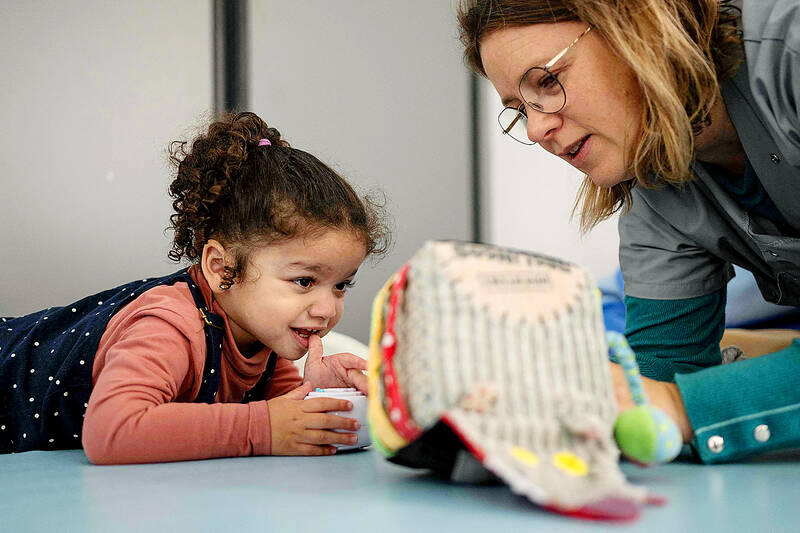
Photo: AFP
“During the first six months, the families [we studied] were in contact with only four other people outside the family unit, on average, and by the time they reached 12 months, one in four of the babies hadn’t met another child their own age,” she said.
To investigate how this affected their development, Byrne and her colleagues asked the parents of 309 “pandemic” babies to assess their ability to crawl; pick up tiny objects with their thumb and index finger; express at least one definite and meaningful word; and seven other developmental milestones, once they reached 12 months of age. The babies were all born between March and May 2020.
The study, published in Archives of Disease in Childhood, suggested that the pandemic lockdown had a small, but measurable effect on babies’ language and communication skills: Compared with pre-pandemic babies, they were less likely to have one definite and meaningful word (89 percent versus 77 percent), to point at people or objects (93 percent versus 84 percent), or to be able to wave “bye-bye” (94.5 percent versus 88 percent).
However, more of them were able to crawl (91 percent versus 97.5 percent) — possibly because they spent more time on the ground, rather than strapped into vehicles and pushchairs.
“It’s interesting, because a lot of these babies were at home and not seeing many people leave, meaning there wouldn’t have been anybody to say ‘bye-bye’ to. Babies also tend to point when they see new things that they want, but if they weren’t going outside, they would have already known about everything in their environments,” Byrne said.
She said that the differences were small, and there was plenty that parents could do to help toddlers catch up — such as regularly reading and chatting to them.
“Babies are resilient and inquisitive by nature, and it is very likely that with societal re-emergence and increase in social circles that their social communication skills will improve,” Byrne said.

Kehinde Sanni spends his days smoothing out dents and repainting scratched bumpers in a modest autobody shop in Lagos. He has never left Nigeria, yet he speaks glowingly of Burkina Faso military leader Ibrahim Traore. “Nigeria needs someone like Ibrahim Traore of Burkina Faso. He is doing well for his country,” Sanni said. His admiration is shaped by a steady stream of viral videos, memes and social media posts — many misleading or outright false — portraying Traore as a fearless reformer who defied Western powers and reclaimed his country’s dignity. The Burkinabe strongman swept into power following a coup in September 2022

TRUMP EFFECT: The win capped one of the most dramatic turnarounds in Canadian political history after the Conservatives had led the Liberals by more than 20 points Canadian Prime Minister Mark Carney yesterday pledged to win US President Donald Trump’s trade war after winning Canada’s election and leading his Liberal Party to another term in power. Following a campaign dominated by Trump’s tariffs and annexation threats, Carney promised to chart “a new path forward” in a world “fundamentally changed” by a US that is newly hostile to free trade. “We are over the shock of the American betrayal, but we should never forget the lessons,” said Carney, who led the central banks of Canada and the UK before entering politics earlier this year. “We will win this trade war and
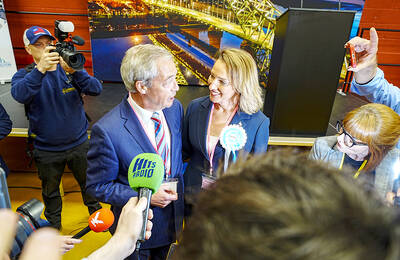
‘FRAGMENTING’: British politics have for a long time been dominated by the Labor Party and the Tories, but polls suggest that Reform now poses a significant challenge Hard-right upstarts Reform UK snatched a parliamentary seat from British Prime Minister Keir Starmer’s Labor Party yesterday in local elections that dealt a blow to the UK’s two establishment parties. Reform, led by anti-immigrant firebrand Nigel Farage, won the by-election in Runcorn and Helsby in northwest England by just six votes, as it picked up gains in other localities, including one mayoralty. The group’s strong showing continues momentum it built up at last year’s general election and appears to confirm a trend that the UK is entering an era of multi-party politics. “For the movement, for the party it’s a very, very big

‘BODIES EVERYWHERE’: The incident occurred at a Filipino festival celebrating an anti-colonial leader, with the driver described as a ‘lone suspect’ known to police Canadian police arrested a man on Saturday after a car plowed into a street party in the western Canadian city of Vancouver, killing a number of people. Authorities said the incident happened shortly after 8pm in Vancouver’s Sunset on Fraser neighborhood as members of the Filipino community gathered to celebrate Lapu Lapu Day. The festival, which commemorates a Filipino anti-colonial leader from the 16th century, falls this year on the weekend before Canada’s election. A 30-year-old local man was arrested at the scene, Vancouver police wrote on X. The driver was a “lone suspect” known to police, a police spokesperson told journalists at the


 RSS
RSS