


Prominent Chinese commentator Hu Xijin (胡錫進) on Sunday said that as China ponders its COVID-19 policies, epidemic experts need to speak out and China ought to conduct comprehensive research and make any studies transparent to the public.
Hu’s unusual call on Chinese social media for candor and transparency earned him 34,000 likes on the popular Sina Weibo microblogging platform, as well as frank responses from commentators in a normally tightly policed Internet quick to censor voices deemed a risk to social stability.
China’s top leaders warned in May amid the COVID-19 lockdown of Shanghai and widespread restrictions in the Chinese capital, Beijing, that they would fight any comment or action that distorted, doubted or repudiated the country’s COVID-19 policies.
Photo: Reuters
“About the future, China needs very rational research and calculations,” said Hu, a former editor-in-chief of nationalist state tabloid the Global Times.
“Experts must speak out, and the country should organize comprehensive studies and make them transparent to the public: What are the pros and cons for our common people, and what are the overall pros and cons for the country?” he wrote.
China has significantly tightened its epidemic prevention policies this year to contain the spread of the highly transmissible Omicron variant of SARS-CoV-2, even as its death toll since the COVID-19 pandemic began remains low — about 5,226 as of Saturday — and as many other countries let go of tough restrictions and learn to live with the virus.
“Oppose excessive epidemic prevention,” one user wrote in response to Hu’s post.
In the name of putting the lives of people first, entire cities have been subjected to varying degrees of lockdown, while the infected or suspected cases are confined in facilities or at home, and local populations are required to take a polymerase chain reaction test every two to three days or be barred from public amenities and spaces.
“I don’t mind being infected, but I fear you can’t help but stop me from moving freely,” another person wrote.
Even Chinese-controlled Hong Kong is moving to scrap its controversial COVID-19 hotel quarantine policy for all arrivals, more than two-and-a-half years after it was first implemented, and just weeks ahead of a major Chinese Communist Party congress in Beijing next month when President Xi Jinping (習近平) is expected to secure a precedent-breaking third term as China’s leader.
Macau is also planning to reopen its borders to mainland tour groups in November, the Chinese special administrative region surprised with an announcement on Saturday.
“The people must trust the state, but the state must also trust the understanding of the people,” Hu said.


Through the noise of rushing papers and whirring belts at a print factory in Kyoto, two creators watch their photo essay come to life in broadsheet form — part of an effort to win new audiences in the age of artificial intelligence (AI). Despite the decline of the publishing industry, self-publication and handmade “zine” magazines are growing in popularity in Japan, reflecting the nation’s enduring love of paper in the digital era. While speaking to Agence France-Presse at the plant, his hands black with ink, one of the creators, Kazuma Obara, said: “I think [paper] is a medium that engages all five
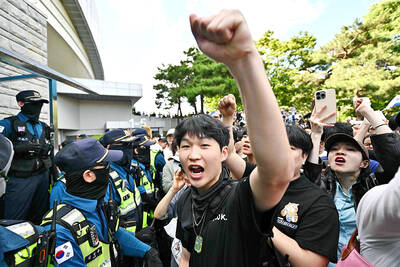
‘ABSURD MISTAKE’: The election commission said that there had been a failure to anticipate turnout after 14 polling stations ran short of ballot papers South Korean riot police yesterday cleared protesters from a Seoul polling station after a 35-hour blockade sparked by a shortage of ballot papers during local elections earlier this week. Wednesday’s election was the first nationwide vote since South Korean President Lee Jae-myung took office following the ouster of Yoon Suk-yeol over his short-lived martial law declaration. Lee’s ruling Democratic Party swept most races, but failed to flip the crucial Seoul mayoral seat. The South Korean National Election Commission apologized, blaming a failure to anticipate turnout after 14 polling stations in Seoul ran short of ballot papers. Some polling stations stayed open until 10pm to

France experienced its hottest spring on record, the French weather service said on Tuesday, after an exceptional early heat wave that also broke highs for the season in England and Wales. Meteo-France said the average nationwide temperature over March to May was 13.8°C — about 1.7°C above the norm, and surpassing records set in 2011 and 2020. “The warmest spring since records began in 1900,” it said in a bulletin. All three months were warmer than average, but the onset of an “unprecedented heatwave” late last month pushed the mercury to highs typically seen at the height of the summer. “Our country had never

A Sherpa guide was found crawling to base camp on Mount Everest a week after he went missing and was reunited with his family, who had given up hope he would return. Dawa Sherpa was last seen on Friday last week descending the mountain, but he did not reach base camp even though his client did. The pair were among the last climbers on the mountain as the climbing season came to an end and the route was dismantled. Dawa was located by a cleaning crew on Thursday morning as he was crawling down the snowy slopes around the Khumbu Icefall, just above


 RSS
RSS