


At first light, children from one of Kenya’s smallest and most isolated tribes put on life jackets and board a fishing boat for the journey across the lake to school.
Until recently, they could walk the distance. A road connected the El Molo with the world beyond their tiny village, a lifeline for a secluded community of fishers and craftspeople subsisting on the shores of Lake Turkana.
Three years ago, the lake started rising dramatically, lapping at the El Molo’s dome-shaped huts draped in dry fish, then pushing inland, forcing villagers to higher ground.
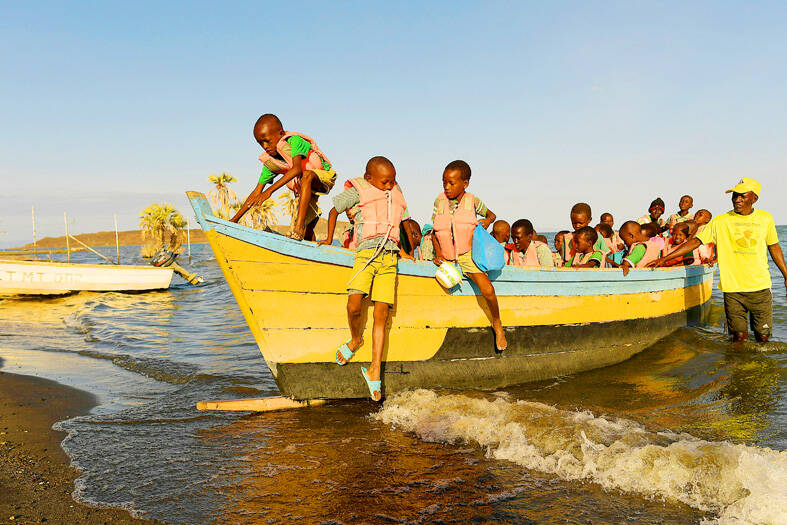
Photo: AFP
As the tide reached levels not seen in living memory, the El Molo watched their only freshwater pipeline slip beneath the surface, as well as the burial mounds of their ancestors.
Eventually, the road to the mainland disappeared completely, marooning the El Molo on an island in a lake so large and imposing it is sometimes called the “Jade Sea.”
“There never used to be water here,” El Molo fisherman Julius Akolong said, as he crossed the wide channel that today separates his community from the rest of far northern Kenya. “You could drive a jeep across.”
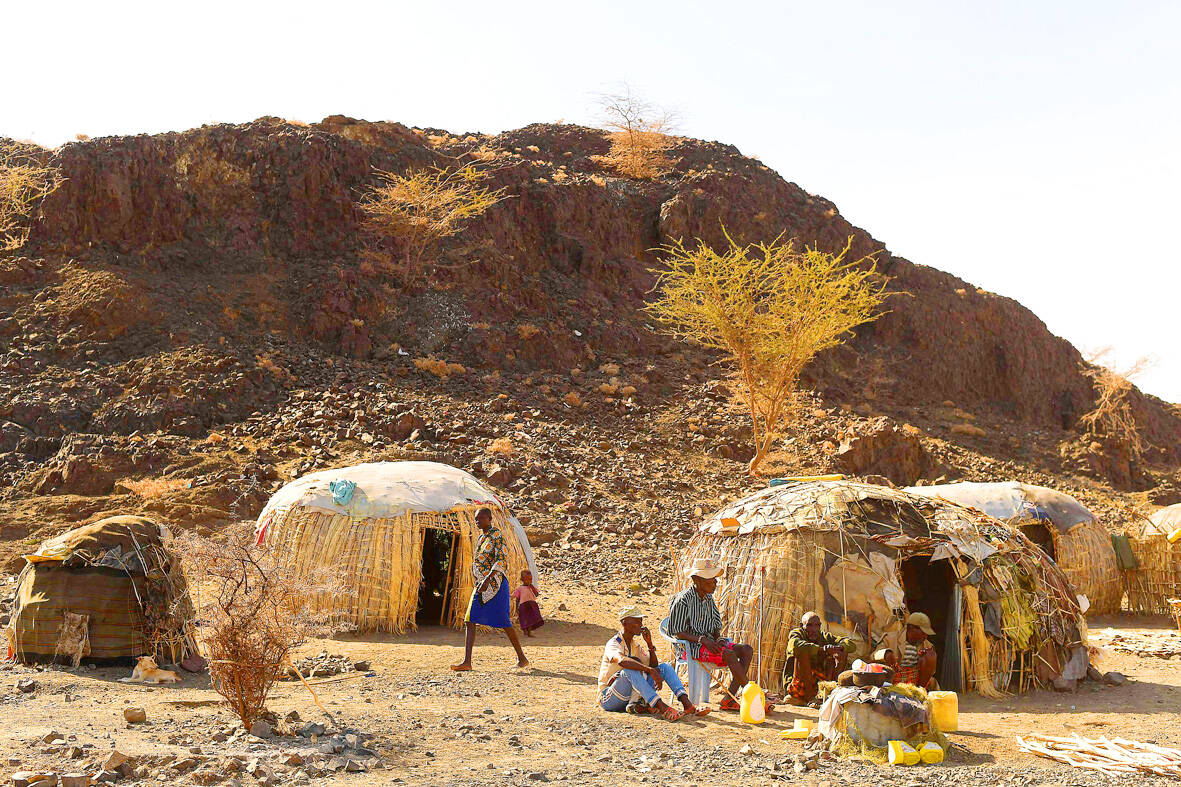
Photo: AFP
Turkana, already the world’s largest desert lake, stretching 250km tip to tip, grew 10 percent in the decade to 2020, a government study published last year showed.
That expansion submerged another nearly 800km2 of land including around El Molo Bay, where people live on Turkana’s eastern shores.
Extreme rainfall over catchment areas — a climatic event linked to global warming — greater soil runoff from deforestation and farming, and tectonic activity were all cited as contributing causes.
The phenomenon has profoundly affected the El Molo, whose distinct Cushitic culture was already under serious threat.
Barely numbering 1,100 in the last census, the El Molo are dwarfed by Kenya’s larger and more prosperous ethnic groups that dominate a country of about 50 million people.
Known as “the people who eat fish” by the livestock-rearing tribes of northern Kenya, the El Molo are believed to have migrated from Ethiopia to Turkana around 1,000 BC.
Few today speak a word of their mother tongue, and ancient customs have evolved or vanished entirely through generations of intermarriage with neighboring ethnic groups.
The lake’s unexpected rise fragmented the remaining El Molo still following the old ways of life.
Some displaced in the disaster made the wrenching decision to relocate to the mainland, erecting a squatter camp on the opposite shore.
The cluster of shanties on a barren and windswept clearing is nearer to the school and other facilities, but a world away from their tight-knit community and its traditions.
“It was very difficult... We had to go and discuss this with the elders so they could permit or bless us to go with no curses,” said Akolong, a 39-year-old father of two.
For those who stayed, life on the island has become a struggle.
The El Molo are skilled fishers, but as Turkana rose higher their people went hungry.
The fishing nets and baskets used for millennia, hand-woven with reeds and doum palm fiber, proved less effective in the deeper water, reducing catch. No longer able to access freshwater, the El Molo were forced to drink from Turkana, the most saline lake in Africa.
Children in the village have chalky teeth and bleached hair, a side effect of the lake’s high fluoride content.
“We often get diarrhea ... we have no other clean water. This is all we have. It is salty, and corrodes our teeth and hair,” said Anjela Lenapir, a 31-year-old mother of three who decided to stay.
School attendance has fallen sharply because parents cannot afford the boat fare, said David Lesas, deputy head teacher at El Molo Bay Primary School.
“Most of them remain at home,” Lesas said.
The local government and World Vision, an aid group, are assisting but resources are scarce and needs many in the region, which is experiencing a once-in-a-generation drought.
The school has been affected, too: The perimeter fence and toilet block are underwater, and crocodiles have taken over part of the playground.
The real damage to the El Molo is indelible.
Separated from his people, Akolong has missed initiation rites, naming ceremonies, and funerals — rituals that strengthen tribal identity and community.
“We are now divided,” he said.
Stone cairns marking the resting place of El Molo’s dead have been swept away, erasing memories of the past, while the lake threatens venerated shrines to tribal deities.
“It is a place that is deeply respected in our culture. With the water rising, we will lose that tradition too,” Lenapir said.


Through the noise of rushing papers and whirring belts at a print factory in Kyoto, two creators watch their photo essay come to life in broadsheet form — part of an effort to win new audiences in the age of artificial intelligence (AI). Despite the decline of the publishing industry, self-publication and handmade “zine” magazines are growing in popularity in Japan, reflecting the nation’s enduring love of paper in the digital era. While speaking to Agence France-Presse at the plant, his hands black with ink, one of the creators, Kazuma Obara, said: “I think [paper] is a medium that engages all five

‘ABSURD MISTAKE’: The election commission said that there had been a failure to anticipate turnout after 14 polling stations ran short of ballot papers South Korean riot police yesterday cleared protesters from a Seoul polling station after a 35-hour blockade sparked by a shortage of ballot papers during local elections earlier this week. Wednesday’s election was the first nationwide vote since South Korean President Lee Jae-myung took office following the ouster of Yoon Suk-yeol over his short-lived martial law declaration. Lee’s ruling Democratic Party swept most races, but failed to flip the crucial Seoul mayoral seat. The South Korean National Election Commission apologized, blaming a failure to anticipate turnout after 14 polling stations in Seoul ran short of ballot papers. Some polling stations stayed open until 10pm to

France experienced its hottest spring on record, the French weather service said on Tuesday, after an exceptional early heat wave that also broke highs for the season in England and Wales. Meteo-France said the average nationwide temperature over March to May was 13.8°C — about 1.7°C above the norm, and surpassing records set in 2011 and 2020. “The warmest spring since records began in 1900,” it said in a bulletin. All three months were warmer than average, but the onset of an “unprecedented heatwave” late last month pushed the mercury to highs typically seen at the height of the summer. “Our country had never

A Sherpa guide was found crawling to base camp on Mount Everest a week after he went missing and was reunited with his family, who had given up hope he would return. Dawa Sherpa was last seen on Friday last week descending the mountain, but he did not reach base camp even though his client did. The pair were among the last climbers on the mountain as the climbing season came to an end and the route was dismantled. Dawa was located by a cleaning crew on Thursday morning as he was crawling down the snowy slopes around the Khumbu Icefall, just above


 RSS
RSS