


Screams from soldiers being tortured, overflowing cells, inhuman conditions, a regime of intimidation and murder. Inedible gruel, no communication with the outside world and days marked off with a home-made calendar written on a box of tea.
This is what conditions are like inside Olenivka, a notorious detention center where dozens of Ukrainian soldiers burned to death late last month, said a former prisoner of the camp outside Donetsk in the Russian-occupied east of Ukraine.
Anna Vorosheva — a 45-year-old Ukrainian entrepreneur — gave a harrowing account to the Observer of her time inside the jail.
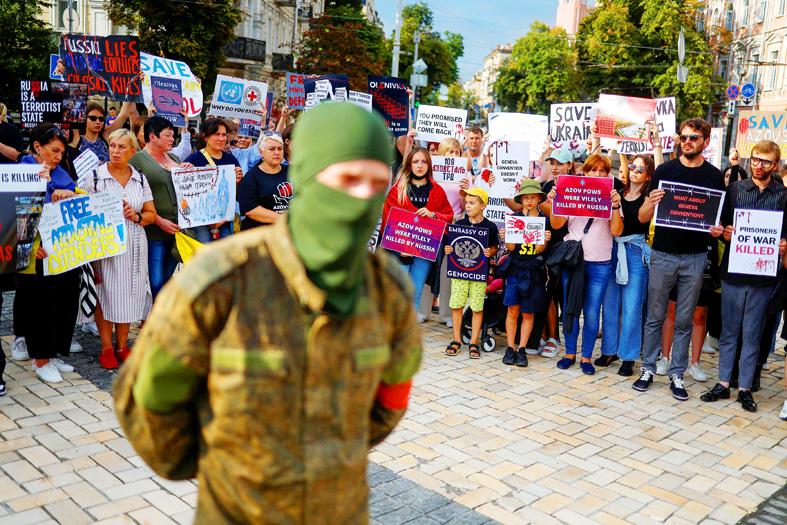
Photo: Reuters
She spent 100 days in Olenivka after being detained in the middle of March at a checkpoint run by the pro-Russian Donetsk People’s Republic (DNR).
She had been trying to deliver humanitarian supplies to Mariupol, her home city, which the Russian army had besieged.
The separatists arrested her and drove her in a packed police van to the prison, where she was held until early last month on charges of “terrorism.”
Now recovering in France, Vorosheva said she had no doubt Russia “cynically and deliberately” murdered Ukrainian prisoners of war.
“We are talking about absolute evil,” she said.
The fighters were blown up on July 29 in a mysterious and devastating explosion.
Moscow claims Ukraine killed them with a US-made precision-guided Himars rocket. Satellite images and independent analysis, however, suggest they were obliterated by a powerful bomb detonated from inside the building.
Russia says 53 prisoners were killed and 75 injured. Ukraine has been unable to confirm these figures and has called for an investigation.
The victims were members of the Azov Battalion, who had defended Mariupol’s Azovstal steel plant, holding out underground until their surrender in May.
A day before the blast, they were transferred to a separate area in the camp’s industrial zone, some distance from the grimy two-story concrete block where Vorosheva shared a cell with other female prisoners.
Video shown on Russian state TV revealed charred bodies and twisted metal bunk beds.
“Russia didn’t want them to stay alive. I’m sure some of those ‘killed’ in the explosion were already corpses. It was a convenient way of accounting for the fact they had been tortured to death,” she said.
Male prisoners were regularly removed from their cells, beaten and then locked up again.
“We heard their cries,” she said. “They played loud music to cover the screams. Torture happened all the time.”
“Investigators would joke about it and ask inmates: ‘What happened to your face?’ The soldier would reply: ‘I fell over,’ and they would laugh,” she said. “It was a demonstration of power. The prisoners understood that anything could happen to them, that they might easily be killed. A small number of the Azov guys were captured before the mass surrender in May.”
Vorosheva said there was constant traffic near Olenivka, known as correctional colony No. 120.
A former Soviet agricultural school, it was in the 1980s converted into a prison and later abandoned. The DNR began using it earlier this year to house enemy civilians.
Captives arrived and departed every day at the camp, 20km south-west of Donetsk, Vorosheva said.
About 2,500 people were held there, with the figure sometimes rising to 3,500 to 4,000, she said, adding that there was no running water or electricity.
The atmosphere changed when about 2,000 Azov fighters were bussed in on the morning of May 17 May, she said.
Russian flags were raised and the DNR colors taken down, and guards were initially wary of the new prisoners.
Later they talked openly about how they were going to brutalize and humiliate them, she said.
“We were frequently called Nazis and terrorists. One of the women in my cell was an Azovstal medic. She was pregnant. I asked if I could give her my food ration. I was told: ‘No, she’s a killer.’ The only question they ever asked me was: ‘Do you know any Azov soldiers?’”
Conditions for the female inmates were grim. She said they were not tortured, but received barely any food — 50g of bread for dinner and sometimes porridge.
“It was fit for pigs,” she said, adding that she suspects that the prison governor siphoned off money allocated for meals.
The toilets overflowed and the women were given no sanitary products. The cells were so overcrowded they slept in shifts.
“It was tough. People were crying, worried about their kids and families,” she said.
Vorosheva said that the camp’s staff were brainwashed by Russian propaganda and considered Ukrainians to be Nazis, adding that some were local villagers.
“They blamed us for the fact that their lives were terrible. It was like an alcoholic who says he drinks vodka because his wife is no good,” she said. “The philosophy is: ‘Everything is horrible for us, so everything should be horrible for you.’ It’s all very communist.”
Other detainees confirmed Vorosheva’s version of events and said the Azov soldiers were treated worse than civilians.
Dmitry Bodrov, a 32-year-old volunteer worker, told the Wall Street Journal that the guards took anyone they suspected of misbehavior to a special disciplinary section of the camp for beatings.
They emerged limping and moaning, he said.
Some captives were forced to crawl back to their cells.
Another prisoner, Stanislav Hlushkov, said an inmate who was regularly beaten was found dead in solitary confinement.
Orderlies put a sheet over his head, loaded him into a mortuary van and told fellow inmates he had “committed suicide.”
Vorosheva was freed on 4 July.
It was a “miracle,” she said, adding that “the guards read out the names of those who were going to be freed. Everyone listened in silence. My heart leaped when I heard my name. I packed my things, but didn’t celebrate. There were cases where people were on the list, got out, then came back.”
“The people who run the camp represent the worst aspects of the Soviet Union,” she said. “They could only behave well if they thought nobody was looking.”

‘CROSSING THE LINE’: China’s embassy in Seoul criticized US Forces Korea Commander General Xavier Brunson, asking if his ‘hostile’ remarks were authorized by Washington South Korea and the US are in talks over recent public remarks by the commander of US Forces Korea, Seoul’s presidential office said yesterday, after the comments drew sharp criticism from China. In a recent podcast interview, US Forces Korea Commander General Xavier Brunson described South Korea as “the dagger in the heart of Asia” from China’s east coast, prompting the Chinese embassy in Seoul to say that he had “truly crossed the line.” The interview came amid growing speculation that Washington might seek to expand the role of US Forces Korea in countering the growing regional influence of China, a key

Through the noise of rushing papers and whirring belts at a print factory in Kyoto, two creators watch their photo essay come to life in broadsheet form — part of an effort to win new audiences in the age of artificial intelligence (AI). Despite the decline of the publishing industry, self-publication and handmade “zine” magazines are growing in popularity in Japan, reflecting the nation’s enduring love of paper in the digital era. While speaking to Agence France-Presse at the plant, his hands black with ink, one of the creators, Kazuma Obara, said: “I think [paper] is a medium that engages all five

Australian researchers have trained lab-grown brain cells on a silicon computer chip to play the 1990s shooter game Doom and said they are just scratching the surface of what the neurons could be capable of doing. It is the science-fiction work of biotech boffins at Cortical Labs, who researched and developed the technology that harnesses the workings of the brain’s networking system. Each so-called “biological computer” contains about 200,000 living human brain cells, grown from stem cells that were harvested from blood donations. Having mastered the simple computer game Pong, where a paddle is moved up and down to send a ball

France experienced its hottest spring on record, the French weather service said on Tuesday, after an exceptional early heat wave that also broke highs for the season in England and Wales. Meteo-France said the average nationwide temperature over March to May was 13.8°C — about 1.7°C above the norm, and surpassing records set in 2011 and 2020. “The warmest spring since records began in 1900,” it said in a bulletin. All three months were warmer than average, but the onset of an “unprecedented heatwave” late last month pushed the mercury to highs typically seen at the height of the summer. “Our country had never


 RSS
RSS