


A Japanese video journalist has been detained by security forces in Myanmar while covering a protest against military rule in the country’s largest city, pro-democracy advocates said on Sunday.
Toru Kubota, a Tokyo-based documentary filmmaker, was arrested on Saturday by plainclothes police after a flash protest in Yangon, said Typ Fone, a leader of the group Yangon Democratic Youth Strike, which organized the rally. Like many advocates, he uses a pseudonym for protection against the military authorities.
The Burmese military seized power in February last year by ousting the elected government of Aung San Suu Kyi, and has since cracked down on dissent.
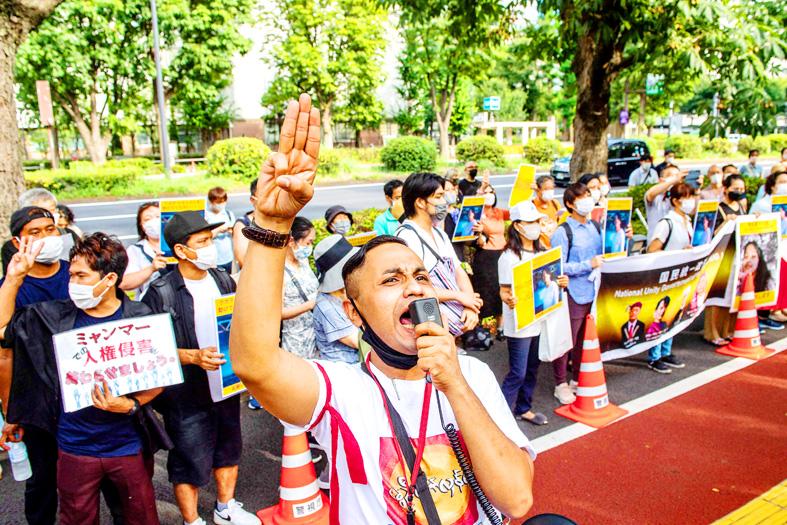
Photo: AFP
A detailed tally compiled by the Assistance Association for Political Prisoners, at least 2,138 civilians have been killed by the security forces and 14,917 arrested since the military takeover.
Last week, the military government drew sharp international criticism after announcing that it had hanged four advocates convicted of terrorism in secret trials.
Typ Fone said that two protesters in Saturday’s march were also arrested and detained in a township police station. The arrests were also reported by several other anti-government groups.
Japanese Deputy Chief Cabinet Secretary Seiji Kihara yesterday said “a Japanese male citizen in his 20s” was arrested on Saturday while filming a demonstration in Yangon and that he has since been detained by local police.
Kihara said that Japanese embassy officials have been requesting his early release, while “doing utmost” for his safety and information gathering.
Pro-military accounts on the Telegram messaging app said a Japanese man was arrested not for taking pictures, but for participating in the protest by holding a banner.
Typ Fone said that photos of Kubota with a banner uploaded to the Telegram channels were taken after he had been arrested, indicating they were done under duress.
During the march, about a dozen protesters chanted slogans opposing the military takeover, and shortly after, scattered into the crowds in the surrounding streets.
“He was taking a picture with his camera from a short distance from our strike yesterday,” Typ Fone said of Kubota. “When we finished the strike and dispersed, he was arrested by the security forces in plainclothes and put into a Probox car.”
The vehicle is typically used by taxis in Yangon, and Typ Fone said the car in question also had the markings of a taxi.
According to a portfolio of Kubota’s work online, his primary focus was on ethnic conflicts, immigrants and refugee issues, and he has tried to highlight the conditions of “marginalized, deprived communities.”
It says he has worked with media companies such as Yahoo News Japan, VICE Japan and al-Jazeera.
Virtually all independent journalism in Myanmar is carried out underground or from exile. The military government has arrested about 140 journalists, about 55 of whom remain detained awaiting charges or trial.
Kubota is the fifth foreign journalist to be detained, after US citizens Nathan Maung and Danny Fenster, who worked for local publications, and freelancers Robert Bociaga of Poland and Yuki Kitazumi of Japan, all of whom were eventually expelled.

When a hiker fell from a 55m waterfall in wild New Zealand bush, rescuers were forced to evacuate the badly hurt woman without her dog, which could not be found. After strangers raised thousands of dollars for a search, border collie Molly was flown to safety by a helicopter pilot who was determined to reunite the pet and the owner. A week earlier, an emergency rescue helicopter found the woman with bruises and lacerations after a fall at a rocky spot at the waterfall on the South Island’s West Coast. She was airlifted on March 24, but they were forced to

CONFIDENCE BOOSTER: ’After parkour ... you dare to do a lot of things that you think only young people can do,’ a 67-year-old parkour enthusiast said In a corner of suburban Singapore, Betty Boon vaults a guardrail, crawls underneath a slide, executes forward shoulder rolls and scales a steep slope, finishing the course to applause. “Good job,” the 69-year-old’s coach cheers. This is “geriatric parkour,” where about 20 retirees learned to tackle a series of relatively demanding exercises, building their agility and enjoying a sense of camaraderie. Boon, an upbeat grandmother, said learning parkour has aided her confidence and independence as she ages. “When you’re weak, you will be dependent on someone,” she said after sweating it out with her parkour classmates in suburban Toa Payoh,
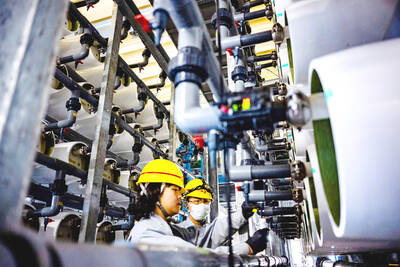
HIGH HOPES: The power source is expected to have a future, as it is not dependent on the weather or light, and could be useful for places with large desalination facilities A Japanese water plant is harnessing the natural process of osmosis to generate renewable energy that could one day become a common power source. The possibility of generating power from osmosis — when water molecules pass from a less salty solution to a more salty one — has long been known. However, actually generating energy from that has proved more complicated, in part due the difficulty of designing the membrane through which the molecules pass. Engineers in Fukuoka, Japan, and their private partners think they might have cracked it, and have opened what is only the world’s second osmotic power plant. It generates
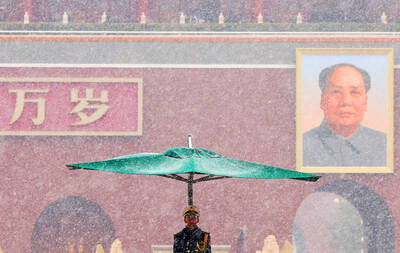
Chinese dissident artist Gao Zhen (高兟), famous for making provocative satirical sculptures of former Chinese leader Mao Zedong (毛澤東), was tried on Monday over accusations of “defaming national heroes and martyrs,” his wife and a rights group said. Gao, 69, who was detained in 2024 during a visit from the US, faces a maximum three-year prison sentence, said his wife, Zhao Yaliang (趙雅良), and Shane Yi, a researcher at the Chinese Human Rights Defenders group which operates outside the nation. The closed-door, one-day trial took place at Sanhe City People’s Court in Hebei Province neighboring the capital, Beijing, and ended without a


 RSS
RSS