


US-China rivalry and an inter-island rift yesterday overshadowed the start of a landmark Pacific summit in Fiji, hampering efforts to focus world attention on the islands’ dire climate crisis.
This year’s Pacific Islands Forum is the region’s most important meeting in years, coming after a hiatus due to COVID-19 and as low-lying tropical isles run out of time for climate action.
Forum chairman Fiji President Voreqe Bainimarama opened yesterday’s first meeting by saying that the “runaway climate change crisis” threatened the security and sovereignty of many Pacific nations.

Photo: AFP
However, instead of a singular focus on the threat of rising sea levels and ever-more-powerful storms, a shock decision by Beijing-allied leaders in Kiribati to quit the forum altogether, revealed on the eve of the summit, loomed over proceedings.
Geopolitical jostling between the US and China has been building since Solomon Islands controversially signed a security pact with Beijing in April.
US Vice President Kamala Harris yesterday said that she would make an unprecedented video appearance at the summit, which is usually restricted to Pacific nations, Australia and New Zealand.
Leaders gathered at Suva’s luxurious Grand Pacific Hotel are to discuss a strategy to guide the Pacific through to 2050, keenly focused on the existential threat posed by climate change.
They are also to debate announcing a climate emergency in the Pacific and whether to endorse a push, spearheaded by Vanuatu, to ask the International Court of Justice to weigh in on nations’ climate obligations.
Vanuatuan Prime Minister Bob Loughman yesterday said that the people of the region “are calling on us, Pacific leaders, to take action to fight this emergency.”
However, Kiribati’s exit from the forum has sparked concerns about a fracturing of the Pacific’s closely held unity, which gives the region of small island states heft in global climate negotiations.
Tuvaluan Minister of Foreign Affairs Simon Kofe said he was optimistic the nation could be enticed to rejoin.
Last year, Kofe made headlines when he addressed the Conference of the Parties summit standing knee-deep in water to draw attention to the threat climate change poses to his low-lying nation, which could disappear below rising seas in the next 50 years.
Faced with such a threat, his priority at the summit is climate change — Tuvalu would be pushing for a focus on statehood and climate financing.
Concerns about regional security — brought to the fore by the Solomons-China pact — “draw a bit of attention away from climate change,” Kofe said.
The summit would be a test of newly elected Australian Prime Minister Anthony Albanese, who has pledged to do more on climate and to heal his country’s fractured relationship with the Pacific.
At the last Pacific Islands Forum leaders’ meeting, held in 2019, negotiations descended into shouting and tears as Australia’s former government attempted to muzzle leaders who wanted to issue a global call for climate action.
Yet Albanese also wants to use the summit to raise his concerns about security developments in the region in the wake of the Solomons-China deal.
Albanese yesterday sought to knit the issues of climate and security together.
“Our neighbors in the Pacific understand that climate change is a national security issue,” he told a news conference in Sydney.


Through the noise of rushing papers and whirring belts at a print factory in Kyoto, two creators watch their photo essay come to life in broadsheet form — part of an effort to win new audiences in the age of artificial intelligence (AI). Despite the decline of the publishing industry, self-publication and handmade “zine” magazines are growing in popularity in Japan, reflecting the nation’s enduring love of paper in the digital era. While speaking to Agence France-Presse at the plant, his hands black with ink, one of the creators, Kazuma Obara, said: “I think [paper] is a medium that engages all five
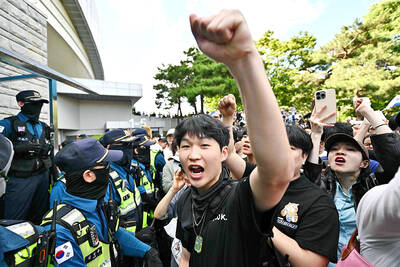
‘ABSURD MISTAKE’: The election commission said that there had been a failure to anticipate turnout after 14 polling stations ran short of ballot papers South Korean riot police yesterday cleared protesters from a Seoul polling station after a 35-hour blockade sparked by a shortage of ballot papers during local elections earlier this week. Wednesday’s election was the first nationwide vote since South Korean President Lee Jae-myung took office following the ouster of Yoon Suk-yeol over his short-lived martial law declaration. Lee’s ruling Democratic Party swept most races, but failed to flip the crucial Seoul mayoral seat. The South Korean National Election Commission apologized, blaming a failure to anticipate turnout after 14 polling stations in Seoul ran short of ballot papers. Some polling stations stayed open until 10pm to

France experienced its hottest spring on record, the French weather service said on Tuesday, after an exceptional early heat wave that also broke highs for the season in England and Wales. Meteo-France said the average nationwide temperature over March to May was 13.8°C — about 1.7°C above the norm, and surpassing records set in 2011 and 2020. “The warmest spring since records began in 1900,” it said in a bulletin. All three months were warmer than average, but the onset of an “unprecedented heatwave” late last month pushed the mercury to highs typically seen at the height of the summer. “Our country had never

A Sherpa guide was found crawling to base camp on Mount Everest a week after he went missing and was reunited with his family, who had given up hope he would return. Dawa Sherpa was last seen on Friday last week descending the mountain, but he did not reach base camp even though his client did. The pair were among the last climbers on the mountain as the climbing season came to an end and the route was dismantled. Dawa was located by a cleaning crew on Thursday morning as he was crawling down the snowy slopes around the Khumbu Icefall, just above


 RSS
RSS