


Chinese-Canadian billionaire Xiao Jianhua (肖建華), who went missing in Hong Kong five years ago, was due to go on trial in China yesterday, the Canadian embassy in Beijing said.
China-born Xiao, known to have links to the Chinese Communist Party (CCP) elite, has not been seen in public since 2017 after he was investigated amid a state-led conglomerate crackdown. The specifics of the probe have not been disclosed by officials.
Xiao was whisked away in a wheelchair from a luxury Hong Kong hotel in the early hours with his head covered, a source close to the tycoon said at the time.
“Global Affairs Canada, our home office, is aware that a trial in the case of Canadian citizen Mr Xiao Jianhua will take place today,” a Canadian embassy official said by telephone in a readout of a statement from Ottawa.
“Canadian consular officials are monitoring this case closely, providing consular services to his family and continue to press for consular access,” the official said.
Asked about the trial at a media briefing, Chinese Ministry of Foreign Affairs spokesman Zhao Lijian (趙立堅) yesterday said that he was not aware of the situation.
Xiao was ranked 32nd on the 2016 Hurun China rich list, China’s equivalent of the Forbes list, with an estimated net worth of US$5.97 billion at the time.
At the center of Xiao’s empire is the financial group Tomorrow Holdings Co. In July 2020, nine of the group’s related institutions were seized by Chinese regulators as part of a crackdown on risks posed by financial conglomerates.
Last year, regulators extended the one-year take-over period of the nine financial enterprises by another year to “further promote risk disposal work and defuse financial risks.” The extended custody is set to end on July 16.
The seizures were preceded by a takeover of Baoshang Bank in 2019, a lender once controlled by Tomorrow, by regulators, citing severe credit risks.
The lender, which had operated nationwide, was revamped into a much smaller lender back in its home region of Inner Mongolia in northern China.
In recent years, a number of executives at big Chinese companies have been subject to investigation or prosecution amid a broader crackdown on corruption spearheaded by Chinese President Xi Jinping (習近平) that has also ensnared politicians and bankers.
Among those who fell from grace was Jiang Jiemin (蔣潔敏), former head of China National Petroleum Corp, who in 2015 was sentenced to 16 years for bribery and abuse of power.
In 2017, Ai Baojun (艾寶俊), a former chairman of Baoshan Iron and Steel who was vice mayor of Shanghai from 2012 to 2015, was sentenced to 17 years in jail for bribery and graft.


Through the noise of rushing papers and whirring belts at a print factory in Kyoto, two creators watch their photo essay come to life in broadsheet form — part of an effort to win new audiences in the age of artificial intelligence (AI). Despite the decline of the publishing industry, self-publication and handmade “zine” magazines are growing in popularity in Japan, reflecting the nation’s enduring love of paper in the digital era. While speaking to Agence France-Presse at the plant, his hands black with ink, one of the creators, Kazuma Obara, said: “I think [paper] is a medium that engages all five
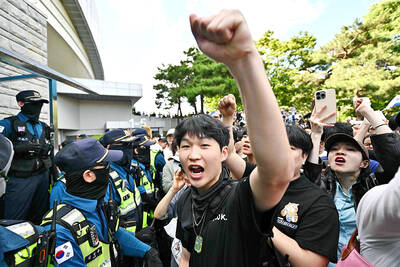
‘ABSURD MISTAKE’: The election commission said that there had been a failure to anticipate turnout after 14 polling stations ran short of ballot papers South Korean riot police yesterday cleared protesters from a Seoul polling station after a 35-hour blockade sparked by a shortage of ballot papers during local elections earlier this week. Wednesday’s election was the first nationwide vote since South Korean President Lee Jae-myung took office following the ouster of Yoon Suk-yeol over his short-lived martial law declaration. Lee’s ruling Democratic Party swept most races, but failed to flip the crucial Seoul mayoral seat. The South Korean National Election Commission apologized, blaming a failure to anticipate turnout after 14 polling stations in Seoul ran short of ballot papers. Some polling stations stayed open until 10pm to

France experienced its hottest spring on record, the French weather service said on Tuesday, after an exceptional early heat wave that also broke highs for the season in England and Wales. Meteo-France said the average nationwide temperature over March to May was 13.8°C — about 1.7°C above the norm, and surpassing records set in 2011 and 2020. “The warmest spring since records began in 1900,” it said in a bulletin. All three months were warmer than average, but the onset of an “unprecedented heatwave” late last month pushed the mercury to highs typically seen at the height of the summer. “Our country had never

A Sherpa guide was found crawling to base camp on Mount Everest a week after he went missing and was reunited with his family, who had given up hope he would return. Dawa Sherpa was last seen on Friday last week descending the mountain, but he did not reach base camp even though his client did. The pair were among the last climbers on the mountain as the climbing season came to an end and the route was dismantled. Dawa was located by a cleaning crew on Thursday morning as he was crawling down the snowy slopes around the Khumbu Icefall, just above


 RSS
RSS