


The Japanese island chain of Okinawa yesterday marked the 50th anniversary of the end of US occupation and its return to Japan with calls for more economic growth and fewer US bases, despite growing worries over its proximity to an increasingly assertive China.
Okinawa, a string of tropical islands off far southwest Japan much closer to Taiwan than Tokyo, suffered massive devastation in World War II. Two months of bloody battles between US and Japanese forces left as many as one-third of its people dead. Nearly 30 years of US rule followed.
On May 15, 1972, the islands were finally returned to Japan in what was seen as a hopeful step forward from the war’s painful legacy.
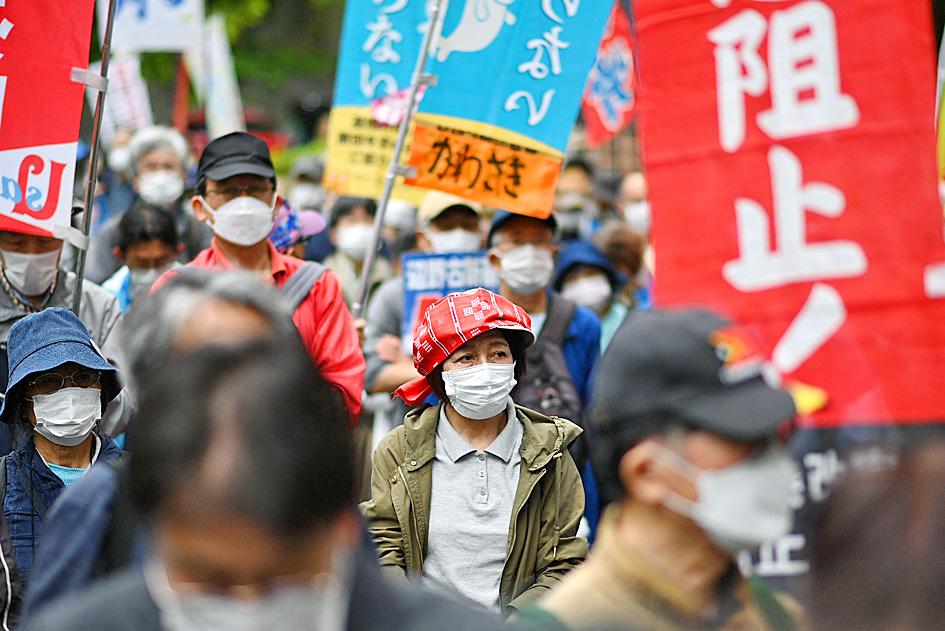
Photo: AFP
However, they still host the majority of US military bases in Japan, a devil’s bargain that has provided jobs, but also fed worries about crime and military accidents.
Now, as China grows increasingly assertive in the Pacific region and tensions rise around Taiwan, Okinawans are concerned that they could once more end up on the front lines — especially after Russia’s invasion of Ukraine.
“These are small islands,” said a protester on the island of Miyako, host to Japan’s newest army base. “Building up a military base will not protect them but rather make them a target of attack.”
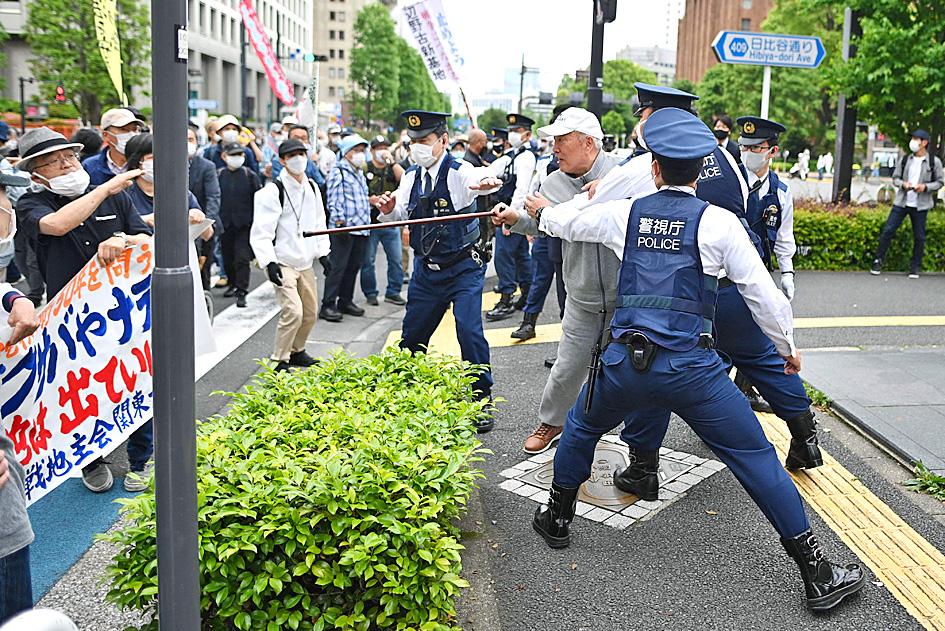
Photo: AFP
She declined to give her name.
Okinawans have long resented having to bear the outsize burden of hosting US bases, an issue that has occasionally sparked huge protests.
Of 812 Okinawans polled by public broadcaster NHK in March, 56 percent said they strongly opposed US bases; only one-quarter of 1,115 people outside the prefecture said the same.
Japanese Prime Minister Fumio Kishida acknowledged this, as well as the economic inequalities that still make Okinawa one of Japan’s poorest areas, in remarks at a government ceremony in Okinawa.
“Even now, 50 years on, Okinawa still bears a heavy burden,” he said. “We take this seriously and will do our utmost to reduce it.”
Okinawan Governor Denny Tamaki said that despite his prefecture’s small area, it still hosts 70 percent of US bases in Japan.
“We still haven’t been able to make Okinawa an island of peace,” he said.
US President Joe Biden — who is to visit Japan this week — in a written message, lauded bilateral ties and shared values.
“I am profoundly grateful for Japan’s resolute support for democracy, freedom, and the rule of law and for Okinawa’s contribution to advancing these ideals,” he wrote.
Tensions in Okinawa are likely to rise further given that lawmakers in Kishida’s ruling Liberal Democratic Party have said they want a commitment to more defense spending, including missiles that can hit targets on foreign soil — missiles that could be deployed on Okinawa.
Outside the ceremony, the mood was subdued.
“What has changed? Nothing much, really,” one man, visiting a memorial for citizens who died in the war, told NHK. “We can’t celebrate or be happy. It’s just another historical marker.”
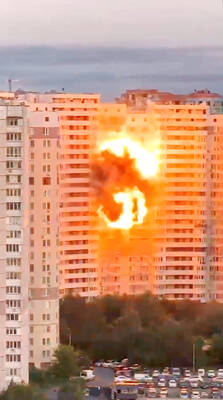
BOMBARDMENT: Moscow sent more than 440 drones and 32 missiles, Volodymyr Zelenskiy said, in ‘one of the most terrifying strikes’ on the capital in recent months A nighttime Russian missile and drone bombardment of Ukraine killed at least 15 people and injured 116 while they slept in their homes, local officials said yesterday, with the main barrage centering on the capital, Kyiv. Kyiv City Military Administration head Tymur Tkachenko said 14 people were killed and 99 were injured as explosions echoed across the city for hours during the night. The bombardment demolished a nine-story residential building, destroying dozens of apartments. Emergency workers were at the scene to rescue people from under the rubble. Russia flung more than 440 drones and 32 missiles at Ukraine, Ukrainian President Volodymyr Zelenskiy

‘SHORTSIGHTED’: Using aid as leverage is punitive, would not be regarded well among Pacific Island nations and would further open the door for China, an academic said New Zealand has suspended millions of dollars in budget funding to the Cook Islands, it said yesterday, as the relationship between the two constitutionally linked countries continues to deteriorate amid the island group’s deepening ties with China. A spokesperson for New Zealand Minister of Foreign Affairs Winston Peters said in a statement that New Zealand early this month decided to suspend payment of NZ$18.2 million (US$11 million) in core sector support funding for this year and next year as it “relies on a high trust bilateral relationship.” New Zealand and Australia have become increasingly cautious about China’s growing presence in the Pacific
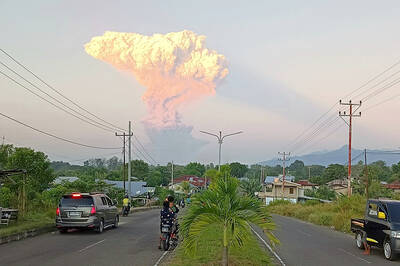
Indonesia’s Mount Lewotobi Laki-Laki yesterday erupted again with giant ash and smoke plumes after forcing evacuations of villages and flight cancelations, including to and from the resort island of Bali. Several eruptions sent ash up to 5km into the sky on Tuesday evening to yesterday afternoon. An eruption on Tuesday afternoon sent thick, gray clouds 10km into the sky that expanded into a mushroom-shaped ash cloud visible as much as 150km kilometers away. The eruption alert was raised on Tuesday to the highest level and the danger zone where people are recommended to leave was expanded to 8km from the crater. Officers also
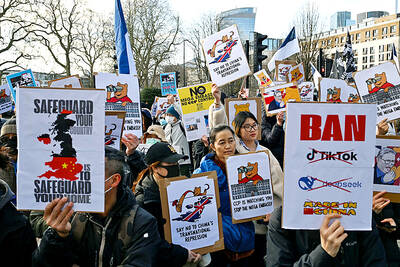
ESPIONAGE: The British government’s decision on the proposed embassy hinges on the security of underground data cables, a former diplomat has said A US intervention over China’s proposed new embassy in London has thrown a potential resolution “up in the air,” campaigners have said, amid concerns over the site’s proximity to a sensitive hub of critical communication cables. The furor over a new “super-embassy” on the edge of London’s financial district was reignited last week when the White House said it was “deeply concerned” over potential Chinese access to “the sensitive communications of one of our closest allies.” The Dutch parliament has also raised concerns about Beijing’s ideal location of Royal Mint Court, on the edge of the City of London, which has so


 RSS
RSS