


Indonesia’s decision to name a pop star as its G20 spokesperson is the latest move in what critics say are vanity appointments the government has made as part of a bid to connect with its young population.
Ayunda Faza Maudya — a 27-year-old singer and actress better known as Maudy Ayunda — was named as spokesperson for the country’s G20 presidency.
She takes on the role as Indonesia faces the delicate balance of hosting several leaders of the world’s 20 largest economies against the backdrop of Russia’s invasion of Ukraine. Russian delegates are invited to a G20 meeting in Washington this week, despite other nations threatening boycotts.
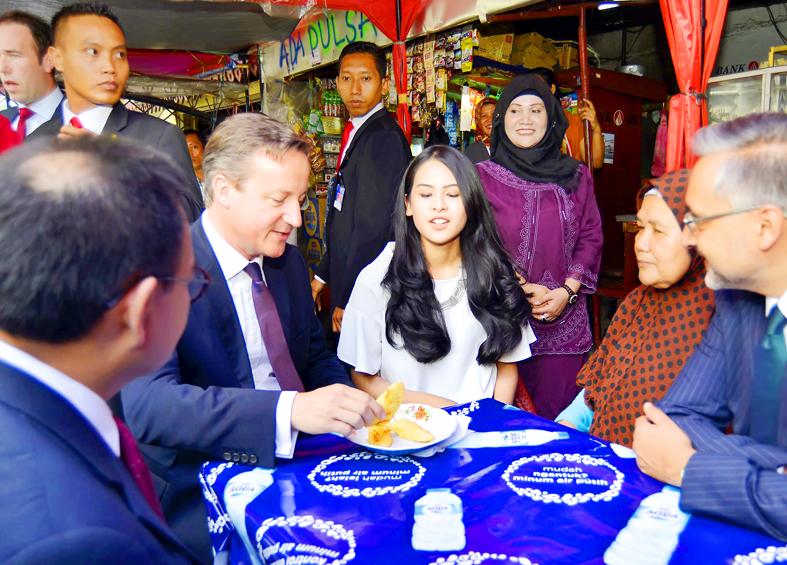
Photo: AFP
The appointment is the latest in what critics say is a string of celebrities, start-up founders and children of tycoons named to political roles as Indonesian President Joko Widodo’s administration attempts to woo a young population that is battling high unemployment.
More than half of the country’s 273 million people are younger than 35 years old and the unemployment rate for those aged 16 to 30 was hovering at 14 percent last year.
“These symbolic appointments are part of efforts to temper criticism from the youth on critical issues, like jobs and public services,” said Wasisto Raharjo Jati, a political researcher at Indonesian Institute of Sciences. “The government’s outreach leans toward the privileged urban youths — the kind of millennials who fit the idea they want to promote — while leaving out the majority who are middle to lower-income and live in rural areas.”
Young Indonesians are more likely to be jobless at double the national rate of 6.5 percent. Despite state-run employment training programs and scholarships for higher education, about one in five of them are neither working nor studying, figures that bode poorly for Indonesia’s aim to become a higher-income economy by 2045.
Ayunda, who lacks any diplomatic or economic experience, took on the role on March 31. At her first briefing, she appeared to ignore questions about Russian President Vladimir Putin’s attendance. Organizers told journalists to ask about her personality instead.
As part of a team of spokespeople, her role is to report the G20 meeting results that are relevant to Indonesia, while sensitive issues would be handled by other representatives, Ayunda said.
She was picked as someone who can reach the broader public, especially the millennial and Gen Z generation, Indonesian Ministry of Communication and Information Technology spokesman Dedy Permadi said.
Ayunda’s appointment makes sense due to her overseas education and the government’s push to create role models for young people, said Irfan Wahyudi, a deputy dean at social and political science faculty of Airlangga University.
However, for G20, the country needs a representative who can speak on global issues on its behalf, he said.
“In this case, the use of young people will be seen as a gimmick, not as a strategic function,” he said.
There is also some doubt about whether the appointments do garner support from Indonesia’s millennials.
Young Indonesians are mainly concerned about economic issues, including access to education, jobs and a supportive environment to start businesses, said Hasanuddin Ali, chief executive officer at research firm Alvara Strategic.
Last week, thousands of university students took to the streets to protest issues including the rising cost of food and fuel.
“These appointments to the president’s circle are more cosmetic, giving no significant power to them to influence policymaking,” he said.

Through the noise of rushing papers and whirring belts at a print factory in Kyoto, two creators watch their photo essay come to life in broadsheet form — part of an effort to win new audiences in the age of artificial intelligence (AI). Despite the decline of the publishing industry, self-publication and handmade “zine” magazines are growing in popularity in Japan, reflecting the nation’s enduring love of paper in the digital era. While speaking to Agence France-Presse at the plant, his hands black with ink, one of the creators, Kazuma Obara, said: “I think [paper] is a medium that engages all five
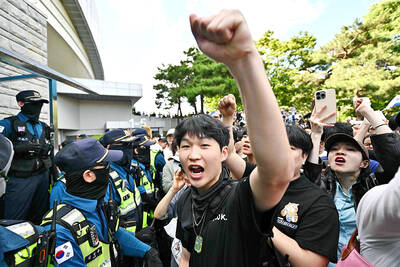
‘ABSURD MISTAKE’: The election commission said that there had been a failure to anticipate turnout after 14 polling stations ran short of ballot papers South Korean riot police yesterday cleared protesters from a Seoul polling station after a 35-hour blockade sparked by a shortage of ballot papers during local elections earlier this week. Wednesday’s election was the first nationwide vote since South Korean President Lee Jae-myung took office following the ouster of Yoon Suk-yeol over his short-lived martial law declaration. Lee’s ruling Democratic Party swept most races, but failed to flip the crucial Seoul mayoral seat. The South Korean National Election Commission apologized, blaming a failure to anticipate turnout after 14 polling stations in Seoul ran short of ballot papers. Some polling stations stayed open until 10pm to

Australian researchers have trained lab-grown brain cells on a silicon computer chip to play the 1990s shooter game Doom and said they are just scratching the surface of what the neurons could be capable of doing. It is the science-fiction work of biotech boffins at Cortical Labs, who researched and developed the technology that harnesses the workings of the brain’s networking system. Each so-called “biological computer” contains about 200,000 living human brain cells, grown from stem cells that were harvested from blood donations. Having mastered the simple computer game Pong, where a paddle is moved up and down to send a ball

France experienced its hottest spring on record, the French weather service said on Tuesday, after an exceptional early heat wave that also broke highs for the season in England and Wales. Meteo-France said the average nationwide temperature over March to May was 13.8°C — about 1.7°C above the norm, and surpassing records set in 2011 and 2020. “The warmest spring since records began in 1900,” it said in a bulletin. All three months were warmer than average, but the onset of an “unprecedented heatwave” late last month pushed the mercury to highs typically seen at the height of the summer. “Our country had never


 RSS
RSS