


Jennie Tiderman-Osterberg lets loose a high-pitched call into the Swedish forest, her voice rising and falling in a haunting, eerie melody.
The echo reverberates through the woods and moments later, three cream-and-black cows emerge from the trees. The bells around their necks jingle as they make their way toward her to return to their shed.
This is kulning — a form of Scandinavian cattle-calling dating back to the Middle Ages. Once these calls rang out from summer farms across central Sweden as farmers brought their animals back from the woods after a day of grazing.
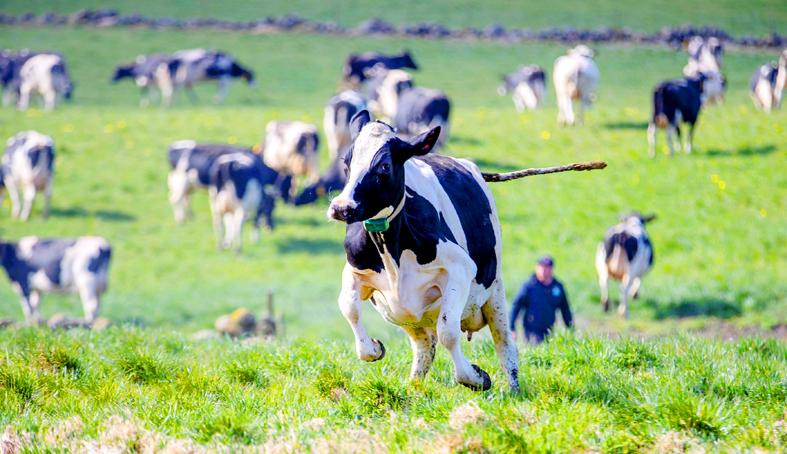
Photo: Reuters
Many of the farms vanished as Sweden industrialized in the mid-19th century, but kulning has grown in popularity in the past few decades.
Prestigious music schools now offer courses, and the hypnotic and entrancing art was even featured in the 2019 Disney movie Frozen II.
Sweden recently decided to nominate the summer farms known as fabods, where kulning developed, to UNESCO’s intangible cultural heritage list to better preserve their unique culture.
Tiderman-Osterberg’s lifelong passion for music started with a childhood obsession with opera, before going through a punk drummer stage. She is studying toward a doctorate in musicology.
Hearing kulning changed her life, as she fell in love with the art form and its cultural origins, she said.
“The first time I used kulning, it felt almost as if my feet were growing roots,” she said. “I decided that it was my life’s mission to spread knowledge” about kulning and other fabod traditions, said the tattooed musician dressed in a pinafore, cotton dress and head-covering harking back to the 19th century.
Traditionally, fabod women would take cows and goats to graze in the woods to ensure they did not eat the crops grown on arable land.
When reporters caught up with Tiderman-Osterberg in July last year, she was visiting the Arvselen fabod in the central Dalarna region, where she practiced calling the farm’s cows back from the forests.
Owner Tapp Lars Arnesson returned to his family farm after a career as an actor, attracted by a simple life in the countryside.
“For me there’s nothing better,” he said, standing outside one of the farm buildings, a trilby pulled down over his eyes. “This is the real life.”
He has maintained the group of little red traditional buildings without electricity and still lives off the land, growing vegetables and milking his three cows. His fabod is one of only about 200 left in Sweden, down from tens of thousands in the mid-19th century, and only a handful keep kulning alive.
Tiderman-Osterberg is planning to tour Sweden this summer with fabod farmers to give lectures and kulning demonstrations to raise awareness.
Its rising popularity means the high-pitched, wordless call is now also practiced as an art, with concerts given around the country.
At Stockholm’s Royal College of Music, a small group of students are spread out into the corners of a dimly lit auditorium, responding to their tutor’s call with melodious ones of their own.
They learn to project their voices as farmers in the forest would have done to reach animals kilometers away.
“People want to learn kulning because there is something intriguing about using your voice in this powerful way,” said Susanne Rosenberg, a folk singer and professor who started the course.
Rosenberg’s students come from a variety of backgrounds.
“They could be an opera singer ... [or] someone who just wants to call the kids home for dinner,” she said.
Enthusiasts also offer courses outdoors, with or without cows. On a farm near Gnesta, south of Stockholm, tutor Karin Lindstrom troops across verdant hillsides followed by a dozen students. Standing in a field as mosquitoes and gnats buzz around, her dozen students start with short sounds, building up until they are ready to attempt their own cattle calls.
Few are likely to ever use their new skills to round up cattle, but Lindstrom said the centuries-old tradition had other benefits.
“The personality is very closely [linked] to the voice, and many people have not been able to express themselves,” she said. “It’s very releasing.”
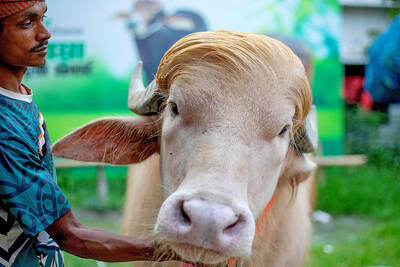
Crowds in Bangladesh are flocking to snap photographs with an unlikely social media star — an albino buffalo with flowing blond hair nicknamed “Donald Trump” that is due to be sacrificed within days. Owner Zia Uddin Mridha, 38, said his brother named the 700kg bull over its flowing helmet of hair resembling the signature look of the US president. “My younger brother picked this name because of the buffalo’s extraordinary hair,” he said at his farm in Narayanganj, just outside the capital, Dhaka. Mridha said that a constant stream of curious visitors — social media fans, onlookers and children — have come throughout

It began as a satirical online project. Now millions of young people in India are flocking to it as an outlet for their frustration. A parody political party called the Cockroach Janta Party, with the insect as its symbol, has exploded across India’s social media by turning absurdist humor into protest. Memes and short videos mocking corruption, joblessness and political dysfunction have flooded social media sites, where millions of users are embracing the cockroach — known for its ability to survive harsh conditions — as a tongue-in-cheek symbol of endurance. The online movement’s rise has been unusually rapid. The Cockroach Janta Party (CJP)

HOTTER: While Indians are accustomed to summer heat, climate change has caused northwestern India to warm faster than other parts of the country, an academic said Roads and markets have emptied during afternoons and some farmers have switched to nighttime work to avoid scorching temperatures as a heat wave grips large parts of India. The India Meteorological Department forecast maximum temperatures for yesterday of about 45°C in the capital, New Delhi, where authorities have opened temporary “cooling zones” to help people cope. The weather department warned that conditions would likely persist across several northern regions in the coming days, with temperatures staying well above seasonal averages. Authorities urged people to stay indoors during the hottest hours and take precautions against heat-related illnesses. India declares a heat wave whenever maximum temperatures

BIGGER ROLE: Beijing has said it maintains an impartial stance on the war in Ukraine, but by training Russian troops, China is far more involved than previously known China’s armed forces secretly trained about 200 Russian military personnel in China late last year, and some have since returned to fight in Ukraine, according to three European intelligence agencies and documents seen by Reuters. While China and Russia have held a number of joint military exercises since Moscow’s full-scale invasion of Ukraine in 2022, Beijing has repeatedly said that it is neutral in the conflict and presents itself as a peace mediator. The covert training sessions, which predominantly focused on the use of drones, were outlined in a dual-language Russian-Chinese agreement signed by senior Russian and Chinese officers in Beijing on


 RSS
RSS